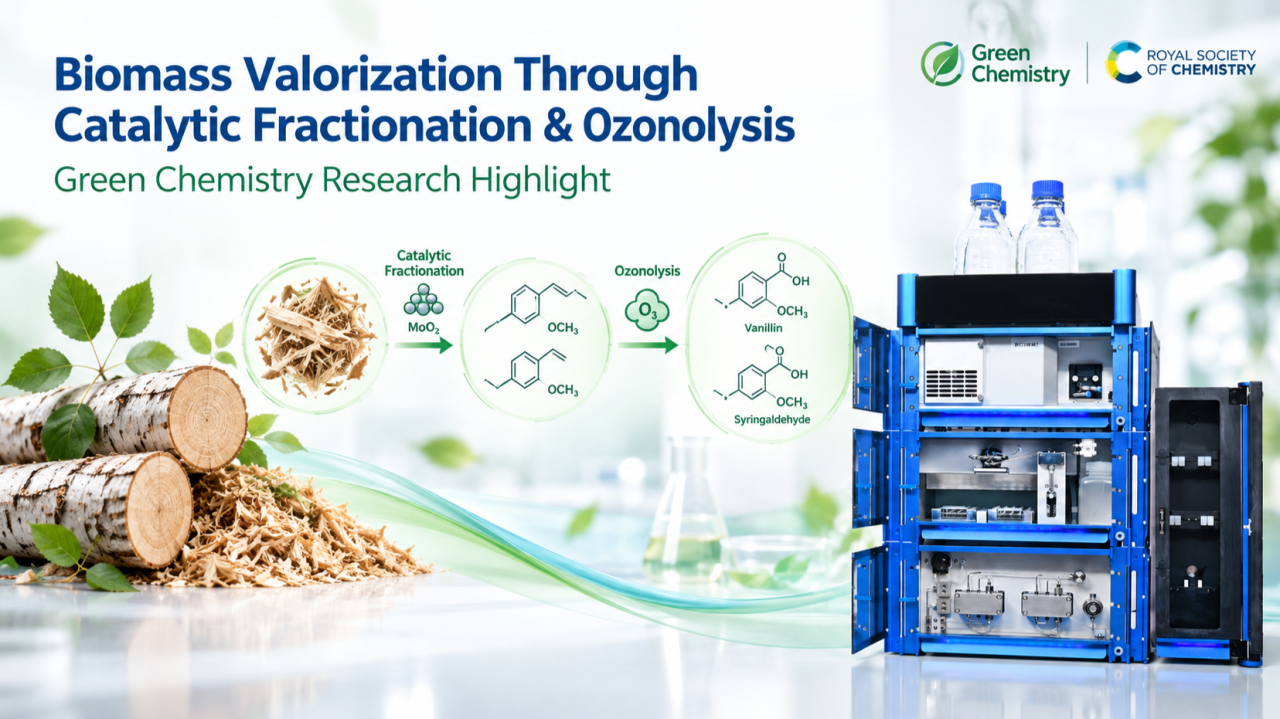
A research team from the Guangzhou Institute of Energy Conversion, Chinese Academy of Sciences, published an important study in Green Chemistry (IF 9.3), proposing a new pathway from biomass to aromatic aldehydes that combines lignin valorization with the preservation of cellulose and hemicellulose, offering a new approach to sustainable biomass valorization.
The new pathway from biomass to aromatic aldehydes with support from Elite Eclassical 3200
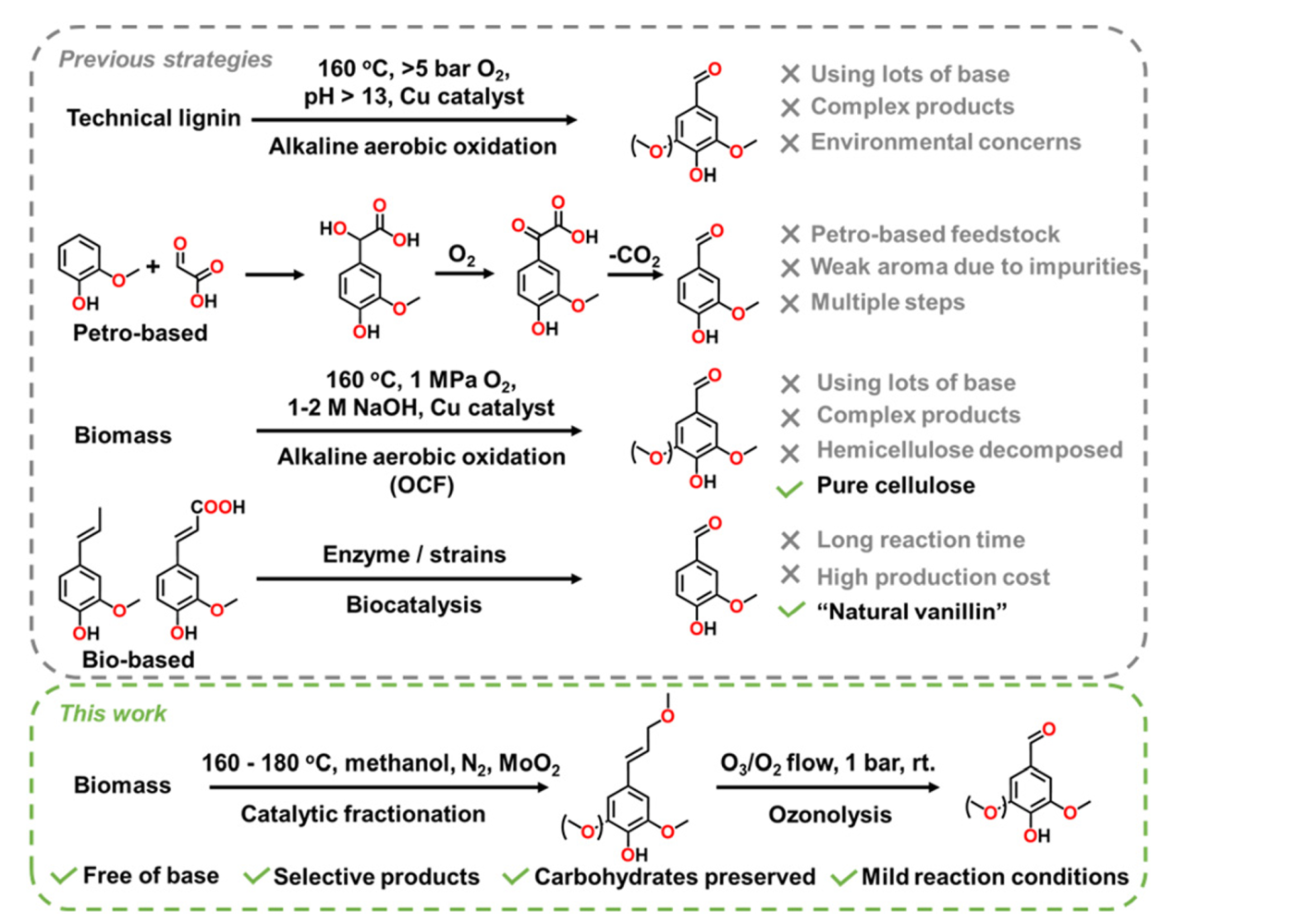
The team proposed for the first time a “catalytic fractionation–ozonolysis” cascade strategy to produce vanillin and syringaldehyde with high selectivity from biomass feedstocks such as poplar and birch under base-free conditions. In this strategy, a commercial MoO₂ catalyst selectively depolymerizes native lignin into 4-methoxypropenyl guaiacol and syringol (total yield >30 wt%), which are then converted to the target aromatic aldehydes via ozonolysis, achieving an overall yield of 20 wt% while preserving most of the cellulose and hemicellulose fractions.
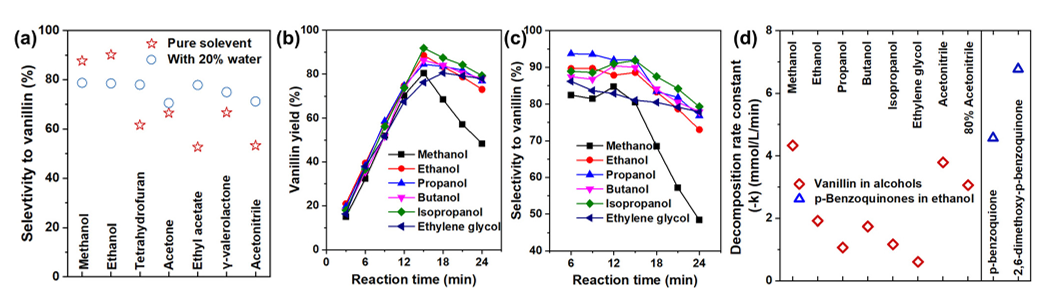
Fig. 2 Ozonolysis of 4-propenyl-G. (a) Influence of solvents on vanillin selectivity; (b) the yield and (c) selectivity of vanillin over time in different alcohol solvents; and (d) decomposition rates of vanillin and p-benzoquinone in different alcoh
During the study, the authors used an Elite EClassical 3200 HPLC system equipped with a PDA detector to quantitatively analyze vanillin and syringaldehyde in the ozonolysis products. The HPLC analysis was performed on an XDB‑C18 column with gradient elution using acetonitrile and 0.1% aqueous trifluoroacetic acid as the mobile phase, with detection at 280 nm. This analytical method allowed the research team to precisely determine the yield and selectivity of vanillin from 4‑propenyl guaiacol under different solvent systems (Figure 2a–d), as well as the dynamic changes of the target products over reaction time, providing crucial quantitative data for optimizing the ozonolysis conditions. The stability and separation performance of the HPLC method enabled the team to accurately evaluate the influence of solvent effects (methanol, ethanol, acetonitrile, etc.) on product selectivity, and to monitor the oxidative decomposition behavior of vanillin during ozonolysis, thereby revealing the intrinsic mechanism by which solvents regulate product stability in this reaction system.
The stable and reliable separation and quantification capabilities of the Elite EClassical 3200 HPLC system provided reliable analytical data for accurately evaluating solvent effects, reaction selectivity, and the oxidative stability of vanillin, supporting the validation of this green process and the optimization of key reaction parameters
Further Reading-
“In practical applications of HPLC, the separation method is a core factor determining analytical success or failure. When faced with complex samples—especially mixtures containing components with widely differing polarities and broad retention ranges—isocratic elution often falls short. In such cases, gradient elution becomes an indispensable and powerful tool. This article systematically introduces HPLC gradient separation technology, covering principles, operational strategies, and common issues, to help you better master this key technique.“ - Learn more about how to quantitatively monitor reaction products , and utilize data from various solvents and reaction times to understand, compare, and optimize ozonolysis.
Title: Green aromatic aldehyde production from biomass via catalytic fractionation and ozonolysis | Journal: Green Chemistry, 2024, 26, 11866-11872