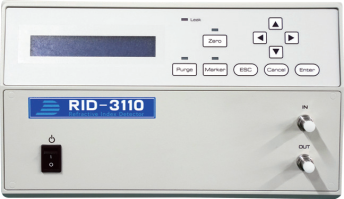
Double temperature control system – Ensures rapid start‑up and excellent baseline stability by precisely controlling the optical system temperature.
Built-in solvent leak sensor – Automatically detects eluent leakage and generates a contact signal to stop the pump, enhancing safety.
Full automatic auto-zero – Both optical and electrical auto‑zero functions provide convenient and reliable baseline adjustment.
Integrated communication – LAN port and well‑organized output terminals (integrator, recorder, external contact signals) enable seamless integration with HPLC systems for high‑level automation.
Compact and rugged design – Small footprint (260×150×400 mm) and robust construction make it suitable for routine laboratory use.
| Parameter | Specification |
| Light source | Tungsten lamp |
| Measurement range | 0.25 – 512 µRIU |
| Temperature Increment | 1 °C |
| Linearity | 600 µRIU |
| Auto zero | Full automatic (optical & electrical) |
| Baseline drift | Range: 0 – 10000 nRIU; Resolution: 50 nRIU |
| Temperature control | OFF, 30 – 50 °C (1 °C increments); 77 °C temp. fuse |
| Communication | LAN |
| Cell volume | 8 µL |
| Maximum flow rate | 10 mL/min (mobile phase: pure water) |
| Pressure rating | 50 kPa (0.5 kgf/cm²) |
| Dimensions (W×H×D) | 260 mm × 150 mm × 400 mm |
| Weight | Approx. 12 kg |
| Power requirements | AC 100 – 240 V ±10%, 50/60 Hz |
| Power consumption | 150 VA (max) |
The RID-3110 Refractive Index Detector provides stable, sensitive, and reliable detection for HPLC systems by measuring the difference in refractive index between the sample and reference streams. Its double temperature control system minimizes baseline drift caused by ambient temperature changes, ensuring fast start-up and excellent long-term stability. The detector offers a wide measurement range (0.25–512 µRIU) with selectable response times to suit various analytical needs. Full automatic auto-zero (both optical and electrical) simplifies operation and ensures accurate baseline reset. The built-in solvent leak sensor and comprehensive error output signals (ROM, RAM, Parameter, Home Position, Overheat, Optical Balance, Intensity) enhance system safety and diagnostics. With LAN communication and multiple output options (integrator, recorder, and contact signals), the RID-3110 integrates seamlessly into automated HPLC systems, making it well-suited for routine analysis of non-UV-absorbing compounds such as sugars, polymers, and lipids in pharmaceutical, food, chemical, and polymer industries.