When performing HPLC analysis, many people tend to overlook a key accessory – the column oven – yet it is actually an “invisible helper” for obtaining reliable experimental results. No matter how meticulous the experimental steps are, without it, the stability and reproducibility of the analytical results may suffer. Its core function is straightforward: to keep the column temperature extremely stable, shielding it from ambient temperature fluctuations. As a result, separation efficiency improves, chromatographic peaks become more symmetrical, and even system pressure can be reduced, making the experiment run more smoothly.
If Column Temperature Is Not Controlled Well, HPLC Results May Go “Off Track”
The separation principle of HPLC is essentially about the sample finding an “equilibrium” between the stationary phase and the mobile phase – sometimes dissolving in the mobile phase and “moving”, sometimes adsorbing onto the stationary phase and “stopping”. Temperature precisely affects this equilibrium. Although column temperature does not directly have a huge impact on resolution, it works together with other factors to ultimately determine separation quality. Among these key factors, special attention should be paid to:
The column: Column length, stationary phase type, particle size, and packing quality all affect separation. For example, a longer column and finer particles can improve resolution, but they also significantly increase column backpressure – a balance must be struck between resolution and pressure.
Column temperature: Temperature changes the solubility and adsorption capacity of the sample. Raising the temperature slightly often accelerates mass transfer, improves column efficiency, sharpens peaks, and reduces tailing.
Mobile phase: A lower flow rate gives the sample more time to interact with the column, generally improving resolution; the composition of the mobile phase must also be adjusted according to sample characteristics.
Injection practice: To avoid sample diffusion and maintain stable separation, do not use excessively large injection volumes or overly slow injection speeds.
If you want to improve resolution, the commonly used approaches are clear: appropriately increase column length, slow down the mobile phase flow rate, reduce injection volume, optimise the column temperature, and minimise system dead volume. Paying attention to these details yields more accurate results.
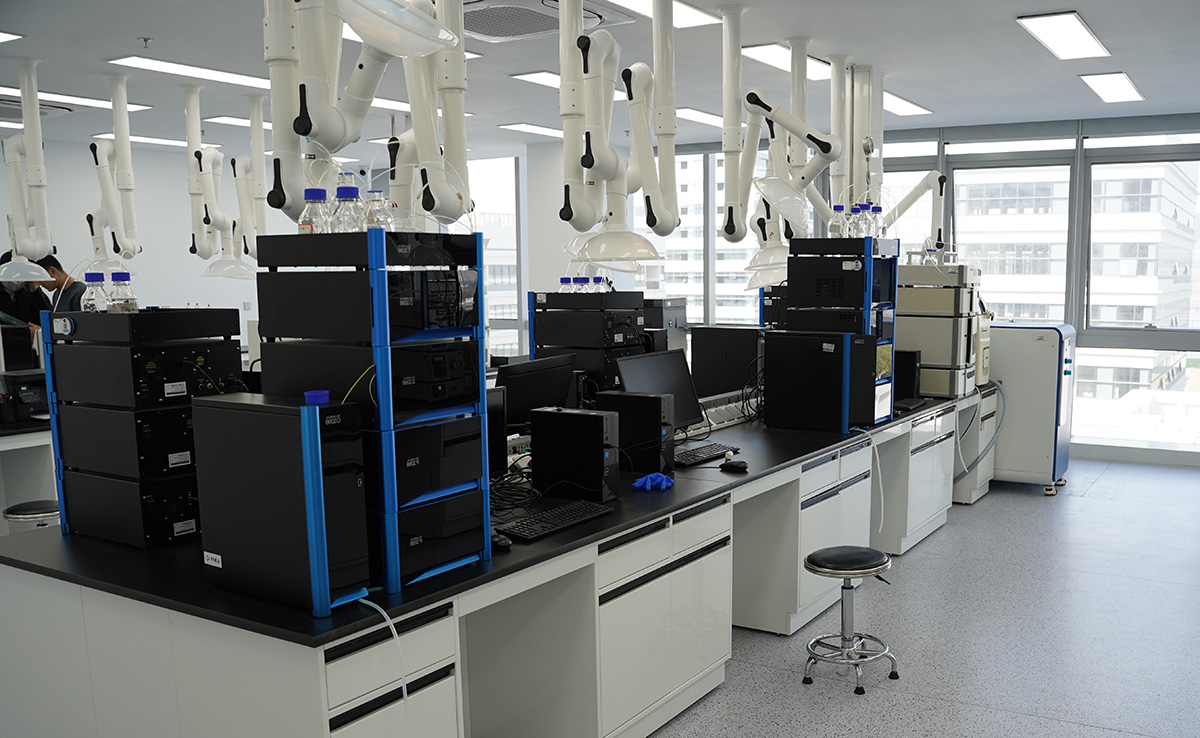
Why is a column oven indispensable for HPLC analysis?
The core of a column oven is “constant temperature”. Common types include forced‑air circulation, water‑bath, and module heating. Although the structure is not complicated, the benefits it brings are critical.
Making experimental results “reproducible” and column efficiency more stable
Ambient laboratory temperature inevitably fluctuates, and such variations disrupt the chemical equilibrium of chromatographic separation, causing retention times to drift unpredictably and making results impossible to reproduce. A column oven maintains a constant temperature, especially for separation modes that are sensitive to temperature, such as ion‑exchange chromatography – without it, the reliability of experimental data would be severely compromised. Moreover, appropriate heating can optimise peak shape, further improve separation efficiency, and reduce the need for repeated method adjustments.
Reducing system pressure and extending equipment life
As temperature increases, the viscosity of the mobile phase decreases, naturally lowering column backpressure. This is very friendly to the entire chromatography system – for example, when using narrow‑bore columns, small‑particle packings, or polymer packings, low‑pressure operation reduces equipment wear. More importantly, lower pressure allows the use of higher‑performance columns, improving both resolution and detection sensitivity – two benefits in one.
Helping the detector stay stable, making data more reliable
Many HPLC detectors, such as refractive index detectors and electrochemical detectors, are particularly sensitive to temperature. Even small temperature changes can cause baseline drift, increased noise, and fluctuating detection signals. A column oven keeps the temperature of the mobile phase entering the detector stable, eliminating these interferences at their source, making the detection data more accurate, and reducing the need for frequent baseline recalibration.
However, it is important to note that higher column temperature is not always better. Too high a temperature may damage the column and may also alter separation selectivity, preventing you from obtaining ideal results. The specific temperature setting must be determined according to your analytical method – do not blindly increase the temperature.
The value of the column oven in improving the efficiency of HPLC experiments and ensuring reliable results has long been recognised by more and more laboratories. If you want your HPLC experiments to run stably and produce accurate data, a column oven is truly indispensable.