The determination of vitamin C (ascorbic acid, AA) is very common requirement in food and pharmaceutical quality analysis. However, existing analytical methods have obvious limitations, such as time-consuming sample preparation and susceptibility to matrix interference. Recently, a team led by Qi Liang from Shaanxi University of Science and Technology published a study in Food Chemistry (2025 Impact Factor 9.8) published by Elsevier. The study synthesized a novel type of fluorescent copper nanoclusters (SAN-CuNCs) using the natural small molecule sanguinarine (SAN) as a template, and introduced manganese dioxide nanosheets (MnO₂NS) to construct a fluorescence "turn-on" sensor for the rapid and sensitive quantitative analysis of ascorbic acid (vitamin C). This method is simple to operate and low in cost, demonstrating significant application potential in the field of biochemical sensing, while also providing valuable insights into the development of natural products.
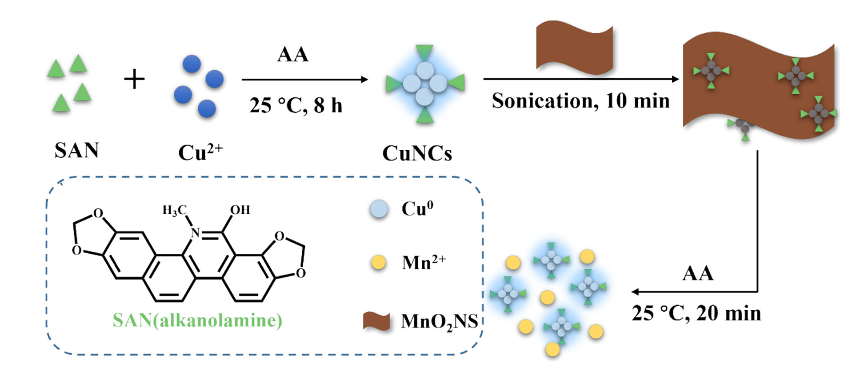
Fig. 1. Schematic illustration of synthesis of SAN-CuNCs and detection of AA based on SAN-CuNCs/MnO2NS (Inset: the chemical structure of SAN in the alkanolamine form).
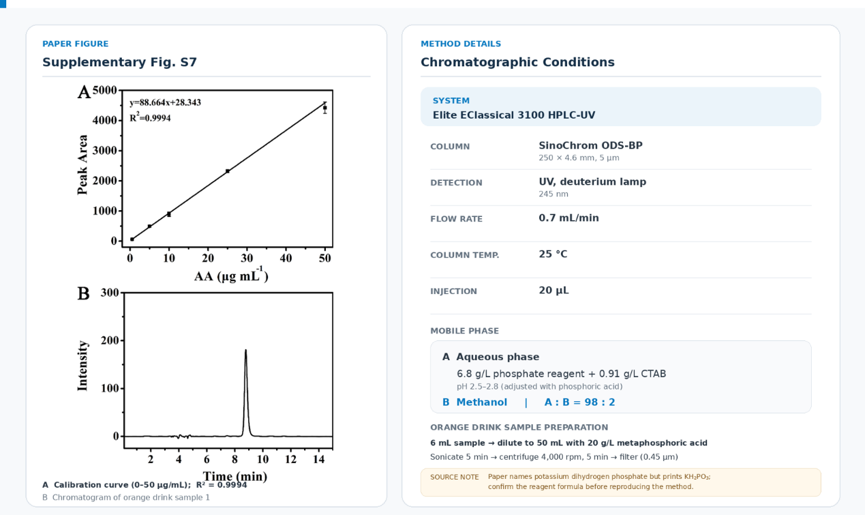
To verify the accuracy of the novel fluorescence sensor in complex matrices, the research team employed an Elite EClassical 3100 system equipped with a SinoChrom ODS-BP (5 μm, 4.6 × 250 mm) column to establish a standard comparison reference. Using a phosphate/CTAB aqueous solution and methanol (98:2, v/v) as the mobile phase, with a flow rate of 0.7 mL/min and an injection volume of 20 μL, vitamin C in orange juice was quantitatively analyzed at a wavelength of 245 nm. The linearity was excellent in the range of 0.5–50.0 μg/mL (R² = 0.9994, relevant data shown in Supplementary Fig. S7). Through comparative analysis of real samples of orange juice, the Vitamin C content measured by the novel fluorescence sensor and HPLC were highly consistent (p > 0.1), strongly validating the feasibility of the sensor.
Fig. S7. (A) Linear relationship between the peak area and AA concentration (0, 0.5, 5.0, 10.0, 25.0, and 50.0 μg mL-1). (B) The chromatogram of the sample-1 of orange drink.
With a mobile phase containing as much as 98% aqueous phase, the Elite EClassical 3100 HPLC-UV system, coupled with the SinoChrom ODS-BP column, delivered reliable separation and sensitive detection, effectively meeting the key requirements for the quantitative analysis of vitamin C in complex sample matrices. This application demonstrates the complementary capabilities of Elite's HPLC system and column in food analysis, while providing a set of chromatographic conditions and an analytical method that can serve as a useful reference for related ascorbic acid analyses.
Further Reading
"Reliable HPLC analysis depends on the combined performance of the instrument, chromatographic column, analytical conditions, and sample preparation. Understanding these factors is essential for achieving accurate and reproducible quantitative results, particularly when analyzing complex samples."
Title: Fluorescence “turn-on” of sanguinarine-templated copper nanoclusters for sensing ascorbic acid in orange drinks and tablets
Journal:Food Chemistry,2025,491,145160