Bromisoval, carbromal, and carisoprodol are all prohibited ingredients explicitly listed in cosmetic regulations. These substances were previously used as sedatives, hypnotics, or muscle relaxants. Improper addition to cosmetics may pose health risks to consumers. This article, in accordance with the national standard GB/T 40899-2021 Determination of prohibited substances bromisoval, carbromal, and carisoprodol in cosmetics—High performance liquid chromatography, provides an in-depth introduction to the accurate determination of these three prohibited substances using Elite Technology’s high performance liquid chromatography (HPLC), offering technical support for cosmetics manufacturers to establish reliable quality control systems.
Interpretation of GB/T 40899-2021
Standard Title: Determination of prohibited substances bromisoval, carbromal, and carisoprodol in cosmetics—High performance liquid chromatography
Scope of Application: Applicable to aqueous, lotion, and cream-type cosmetics.
Limits of Detection and Quantification: Bromisoval and carbromal, LOD 1 mg/kg, LOQ 5 mg/kg; Carisoprodol, LOD 10 mg/kg, LOQ 20 mg/kg.
This standard provides a unified and authoritative method for testing. Although no maximum residue limit is set (as these are prohibited substances and should theoretically not be detectable), the test results serve as a scientific basis for enterprise self-inspection and regulatory enforcement.
Elite HPLC Solution
Based on GB/T 40899-2021, Elite Technology offers a complete testing solution.
Instrument Configuration
Elite EClassical 3200L HPLC, equipped with a UV detector and an evaporative light scattering detector (ELSD), enabling simultaneous detection of multiple substances.
Chromatographic Conditions
Column: Elite Supersil ODS2 (5 μm, 4.6×150 mm)
Mobile phase: Acetonitrile/water = 40/60
Flow rate: 1.0 mL/min
Detection: Bromisoval and carbromal: UV at 210 nm;
Carisoprodol: ELSD (nebulizer cooling mode, evaporation temperature 40°C, nitrogen carrier gas, cylinder outlet pressure 50 psi, carrier gas flow rate 2.5 mL/min, sensitivity 8)
Column temp.: 30°C
Experimental Results
Figures 1 and 2 show the chromatograms of the standard solutions under the above conditions.
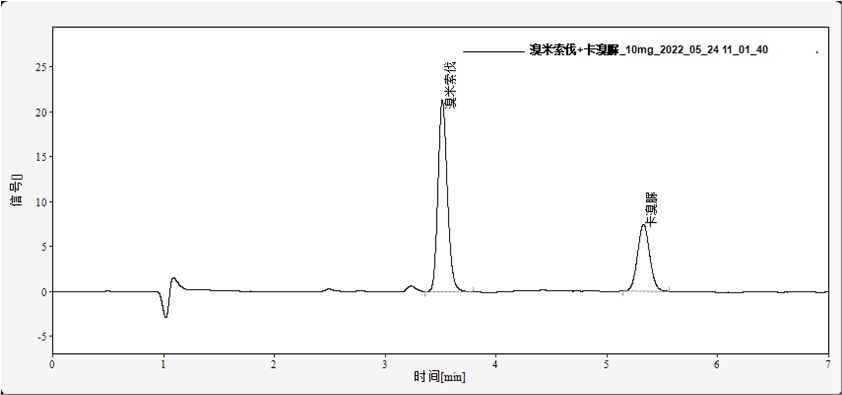
Figure 1. Chromatogram of bromisoval and carbromal standard solution at 10 mg/L each.
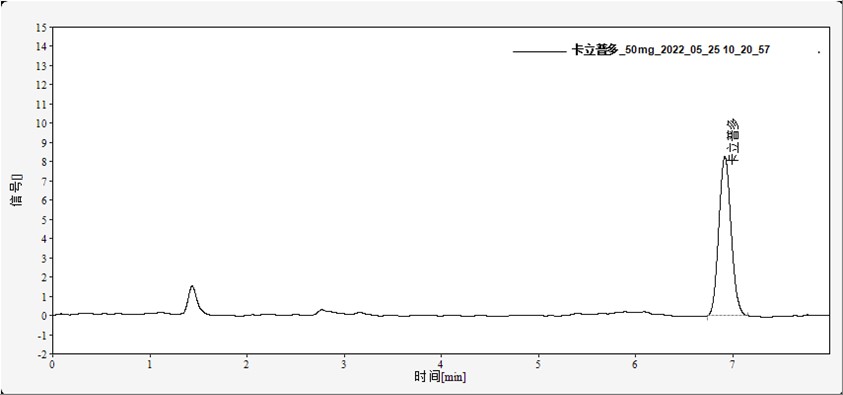
Figure 2. Chromatogram of carisoprodol standard solution at 50 mg/L.
Linearity and Linear Range
Bromisoval and carbromal: Excellent linearity over 10–500 mg/L (R² ≥ 0.9995).
Carisoprodol: Stable linearity over 50–500 mg/L (R² = 0.9997).
Method Repeatability
After five consecutive injections, the RSDs of retention time and peak area were all < 0.35%, demonstrating high stability.
Method Detection Limits (LOD)
As shown in Table 1, the method exhibits higher sensitivity in practice, enabling early detection of trace contamination.
Table 1. Method Detection Limits (S/N=3)
|
Compound
|
Method LOD (mg/kg)
|
GB/T 40899-2021 Requirement (mg/kg)
|
|
Bromisoval
|
0.27
|
1
|
|
Carbromal
|
0.78
|
1
|
|
Carisoprodol
|
3.39
|
10
|
Sample Determination
A hand cream sample was tested using this method. The results showed that carbromal and carisoprodol were not detected, while bromisoval was found at approximately 0.19%. This confirms that the method is effective for qualitative and quantitative analysis of target substances in real cosmetic matrices.
Conclusion
In summary, the Elite EClassical 3200L HPLC system equipped with UV and ELSD detectors, together with the Supersil ODS2 column, fully meets the requirements of GB/T 40899-2021 for the determination of bromisoval, carbromal, and carisoprodol in cosmetics. The method offers high sensitivity, good reproducibility, and simple operation, making it suitable for routine quality control in cosmetics enterprises and regulatory testing by authorities, thus safeguarding cosmetic safety.