A liquid chromatograph is an analytical instrument composed of six core parts: a solvent reservoir, a high‑pressure pump, an injection system, a chromatographic column, a detector, and a waste bottle. This instrument meets the purification needs of routine laboratories. It can be configured with detectors such as UV‑Vis or diode array detectors to build isocratic systems or high‑pressure binary gradient systems, making it suitable for extracting and separating complex samples. It is widely used in pharmaceuticals, chemicals, food, biochemistry, environmental protection, and many other industries.
From a practical application perspective, different industries have slightly different requirements for liquid chromatography:
The pharmaceutical industry focuses on the instrument’s ability to separate drug impurities, especially trace impurities, to ensure drug safety.
The food industry places greater emphasis on detection efficiency to cope with batch screening of pesticide residues and additives in food samples. Environmental applications require the instrument to be compatible with complex sample matrices such as water and soil, ensuring accurate separation of pollutants.
These industry characteristics also make the configuration of the liquid chromatograph more targeted. For example, environmental applications often pair the system with high‑sensitivity detectors, while food testing can upgrade to an autosampler module to improve efficiency.
Basic Principle of Liquid Chromatography
Liquid chromatography is mainly used for the separation and purification of substances. Its core objective is to isolate and obtain one or more high‑purity compounds from a mixture. “Preparative” means obtaining a sufficient amount of a single component that meets purity requirements for scientific research or other practical applications. This technology combines analytical liquid chromatography with large‑scale separation, significantly improving practicality and cost‑effectiveness. In practice, preparative scale and cost control are two key indicators for evaluating a liquid chromatography system.
It is important to note that preparative scale and cost control are not independent; they must be dynamically balanced according to actual needs. For example, when a research laboratory conducts pilot studies, it may only require a “milligram‑scale” preparation, and a small column can be chosen to reduce mobile phase consumption and thus control cost. At the pilot or production scale, “gram‑scale” or even “kilogram‑scale” preparation is required, necessitating larger columns and efficient fluid delivery systems. Although the initial equipment investment is higher, the cost per unit is reduced by increasing the amount prepared per run. Furthermore, cost control must also consider consumable lifetime. For instance, a high‑quality stationary phase may have a slightly higher purchase price, but its stable separation efficiency and long service life make it more economical in the long run.
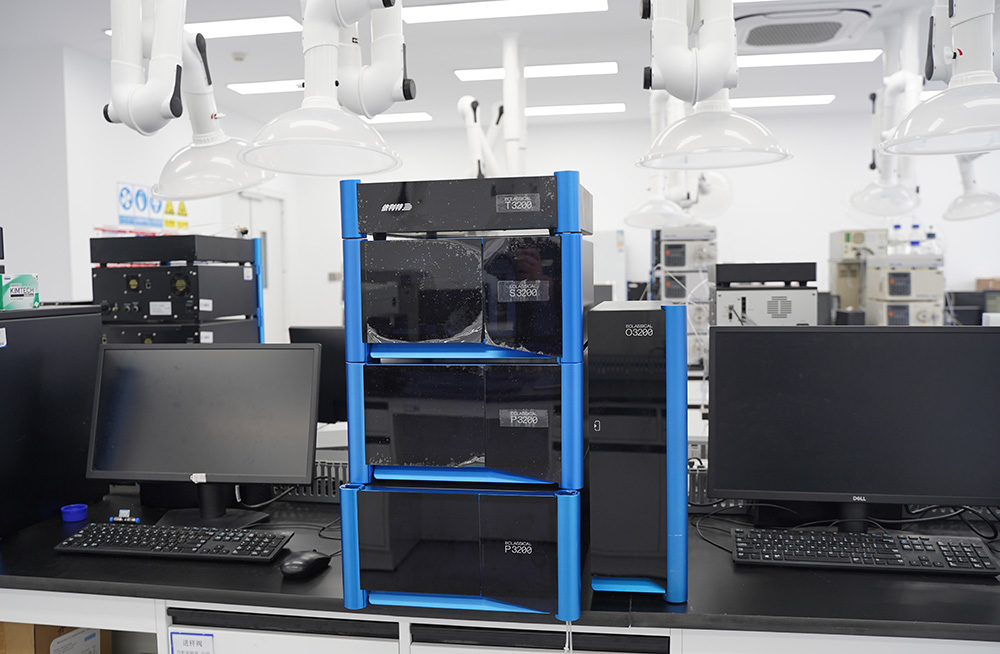
Three Core Systems of a Liquid Chromatography
- Separation System
This part includes the chromatographic column, connecting tubing, and a thermostatic device. Columns are usually made of stainless steel, thick‑walled glass, or titanium alloy, with common internal diameters of 2‑5 mm and lengths of 10‑50 cm. The column is packed with a stationary phase of 5‑10 μm particles. The stationary phase matrix is often silica gel or resin materials with high mechanical strength, porosity, and large specific surface area. The surface of these stationary phases is coated or chemically modified with organic functional groups, ligands, etc., giving them high selectivity for substances with different structures.
In the practical use of the separation system, the role of the thermostatic device is often overlooked, but it is critical for separation stability. Temperature fluctuations change the viscosity of the mobile phase, thereby affecting sample retention times in the column. Especially for heat‑sensitive samples (e.g., proteins and enzymes in biochemistry), constant temperature control prevents sample inactivation due to temperature changes, ensuring the activity and purity of the separated sample. In addition, the choice of connecting tubing must match the column specifications. Too narrow tubing can increase system pressure, while too wide tubing can cause sample dispersion. It is recommended to use inert tubing with an inner diameter compatible with the column to minimise sample adsorption and carryover.
- Injection System
Most of these instruments use a septum syringe or a high‑pressure injection valve to ensure a consistent and stable injection volume, which improves reproducibility and accuracy.
From the perspectives of operational convenience and application scenarios, the two injection methods have their own advantages:
The septum syringe is simple, low‑cost, and suitable for low‑frequency injection with small sample volumes (e.g., research pilot studies). However, the septum must be replaced regularly to avoid leakage or contamination due to aging.
The high‑pressure injection valve can withstand high pressure and offers high injection precision, making it suitable for high‑frequency, large‑batch sample analysis (e.g., quality control). It also supports autosampler upgrades, reducing manual errors. When choosing, consider the daily sample throughput and precision requirements to balance efficiency and cost.
- Fluid Delivery System
This system consists of a high‑pressure pump, a mobile phase reservoir, and a gradient device. The high‑pressure pump delivers the mobile phase stably within a pressure range of 15‑60 MPa, offering flexible adjustment and stable flow. The high‑pressure environment suppresses sample diffusion in the column and increases migration speed, thereby improving separation efficiency, sample recovery, and activity retention. With the gradient device, operators can flexibly adjust the polarity, ionic strength, and pH of the eluent, or switch to competitive inhibitors or denaturants, to optimise the separation of different classes of compounds.
In the maintenance and use of the fluid delivery system, the care of the high‑pressure pump directly affects the instrument’s lifespan. It is recommended to choose a pump head material compatible with the mobile phase (e.g., acid‑resistant pump heads for acidic mobile phases) and to clean the pump body regularly to prevent residual mobile phase from crystallising and blocking the tubing. The mobile phase reservoir should be kept away from light and sealed. For volatile or light‑sensitive mobile phases (e.g., methanol, acetonitrile), use brown glass bottles and seal them to prevent composition changes that could affect separation. In addition, gradient device parameters should be set according to sample characteristics. For example, when separating a mixture with widely different polarities, a “gradient elution” mode can be used to gradually adjust the mobile phase polarity, allowing precise separation of different components and avoiding incomplete elution or overlapping peaks.