In the laboratory, Dr. Li was frowning. He needed to purify high-purity active ingredients from a complex plant extract, which required preparative chromatography. But what he saw was hampering his efficiency: manual injection was time-consuming and its accuracy was hard to guarantee; the adjacent fraction collector needed someone to watch the chromatographic peaks and manually switch the test tubes – a moment of inattention and the target component could escape into the waste bottle. Cross-contamination, human error, long working hours...... these are long-standing pain points in the industry.“If only there were an instrument that could automatically inject samples and intelligently identify and precisely collect fractions!”Dr. Li’s remark echoed the thoughts of countless researchers and industry professionals.
This pain point was exactly the focus of Elite Technology’s R&D team. Having worked in the field of chromatography for many years, they knew very well that in conventional preparative chromatography workflows the autosampler and the fraction collector are often two separate instruments. Although each has mature functions, working independently leads to a fragmented workflow and prevents truly automated“sample in-separation-target out”operation. Low efficiency, reliance on manual attendance, and inflexible methods all limit the throughput of purification.
The Birth of an Integrated Design
Facing these challenges, the Elite R&D team decided to break the mold – to develop an instrument that integrates autosampler and fraction collector functions into one unit, aiming for“high efficiency, precision, convenience, and reliability.”The design concept was clear: 1+1 > 2. But this was by no means a simple physical assembly. The team first conceived the“brain”and the“body”:
Intelligent Brain (Software Control System)
Develop a unified host workstation software that can simultaneously set and manage complex injection programs (sample volume, position, sequence) and fraction collection strategies (triggering based on time, signal threshold, peak slope, etc.), eliminating the tedious need to operate two separate instruments.
Robust Body (Precision Mechanical Structure)
The key was how to make a single“robotic arm”that can both accurately grab (injection) and flexibly place (collection). The solution: innovatively use high-speed servo motors to independently drive the X, Y, and Z axes. Imagine a robotic arm that can move quickly and precisely to any point within a defined tray area, with the injection needle and collection valve integrated at its tip.
Details Make It Reliable
The core stage of the instrument is the tray base plate. Here, the R&D team incorporated multiple thoughtful designs.
Smart Leak-Prevention System
A precise network of liquid‑guiding channels is designed around the perimeter and at the bottom of the tray. In case of a leak, liquid is quickly guided to the lowest drain channel and discharged through a waste port. Crucially, a leak sensor is built into this drain channel; once liquid is detected, an immediate alarm is sent to the workstation, allowing timely intervention.
Precise Positioning
The base is equipped with sturdy tray positioning pins, ensuring that trays of various sizes stay firmly in place. More cleverly, four coordinate calibration points are provided. Calibrating only these four points guarantees the absolute position accuracy of every well on any subsequent tray – this is essential for precise injection and collection.
Open, Flexible Space
The instrument has an open design and can accommodate up to six sample trays of different sizes. From microtiter 96-well plates (0.5 mL) to large 1 L sample bottles (double 96-well plate design), it covers formats including 96-, 75-, 70-, 30-, and 3-well, meeting needs from micro-scale exploration to preparative-scale purification.
Algorithms for Position and Decision
For the robotic arm to work accurately and collect from numerous wells across multiple trays, a coordinate algorithm is the soul. The team developed a two-dimensional coordinate system algorithm. A global coordinate system is established based on the instrument base and the robotic arm’s home position. A local coordinate system is then created for each tray placed. For calculation, the coordinates of a target well in its local coordinate system are converted and added to the global coordinate system, yielding the absolute coordinates relative to the robotic arm’s home position. This algorithm ensures that no matter how the trays are combined or where they are placed, the robotic arm can always locate the target position precisely.。
Intelligent Fraction Collection
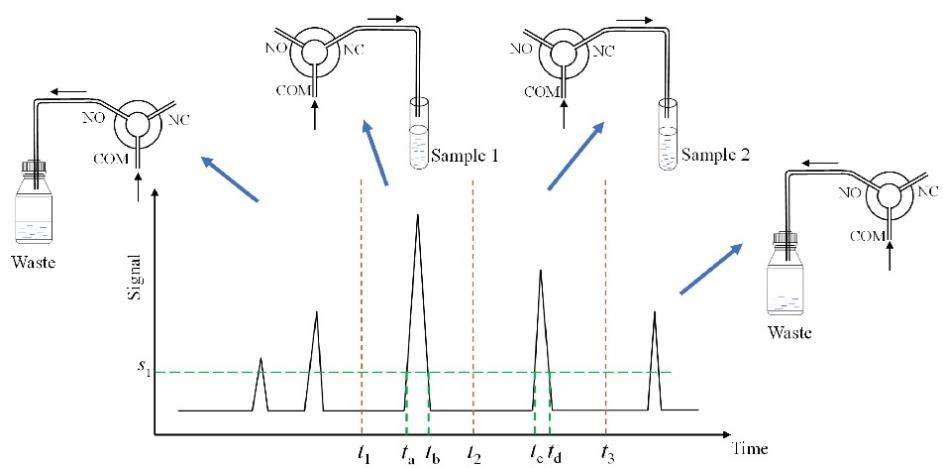
The instrument supports multiple triggering modes; the collection principle is illustrated in the figure below.
Time Triggering:Collect within a preset time window.
Threshold Triggering:Start collecting when the detector signal intensity exceeds a set value (s).
Combined Time + Threshold (more accurate):For example, set to collect“Sample 1”within the time window t1-t2, but only actually start the collection valve (connect NC port) if the signal intensity also reaches the threshold s during that period; otherwise, the eluent is treated as waste (NO port open). This effectively prevents collecting non-target or low-concentration fractions, improving the purity and recovery of the target compound.
Instrument Performance – Excellent
Injection accuracy
Under different volumes, the error is controlled within ±1%, demonstrating excellent repeatability, which lays the foundation for reliable separation.
|
Set Injection Volume (mL)
|
Actual Injection Volume (mL)
|
Error (%)
|
|
1
|
1.0009
|
+0.56
|
|
2
|
2.0066
|
+0.33
|
|
10
|
9.9363
|
-0.64
|
|
*Tested according to national standard GB/T 38125‑2019 by gravimetric method (water); errors are all < ±1 %, meeting requirements.*
|
Separation and Purification Efficiency
Stevioside and rebaudioside A, high-value components of steviol glycosides, were chosen as test samples. The instrument automatically injected 10 mL of sample and used the “time + threshold” method to precisely collect the target fractions. As shown in the table below, the purities were all above 93 %, outperforming the conventional three-step resin method reported in the literature (~92.9 %). This demonstrates the instrument’s excellent capability for fast separation, stable output, and precise collection, significantly improving product purity and efficiency.