A team from the Changchun Institute of Applied Chemistry, Chinese Academy of Sciences, and collaborators developed a fibrin-affinitive, hypoxia-activatable dual-targeting exatecan nanomedicine (FT11-AExT-NPs). By using vascular disrupting agents (VDAs) or surgery to disrupt tumor blood vessels, the researchers induced local fibrin deposition and exacerbated hypoxia, creating a “dosing window”. In a mouse model of triple-negative breast cancer, this combination therapy achieved a tumor suppression rate of up to 98.0% and a cure rate of 66.7%, providing an innovative strategy for solid tumor treatment. The study was published in the Journal of Controlled Release, a leading pharmaceutical journal published by Elsevier (2025 Impact Factor: 12.4).
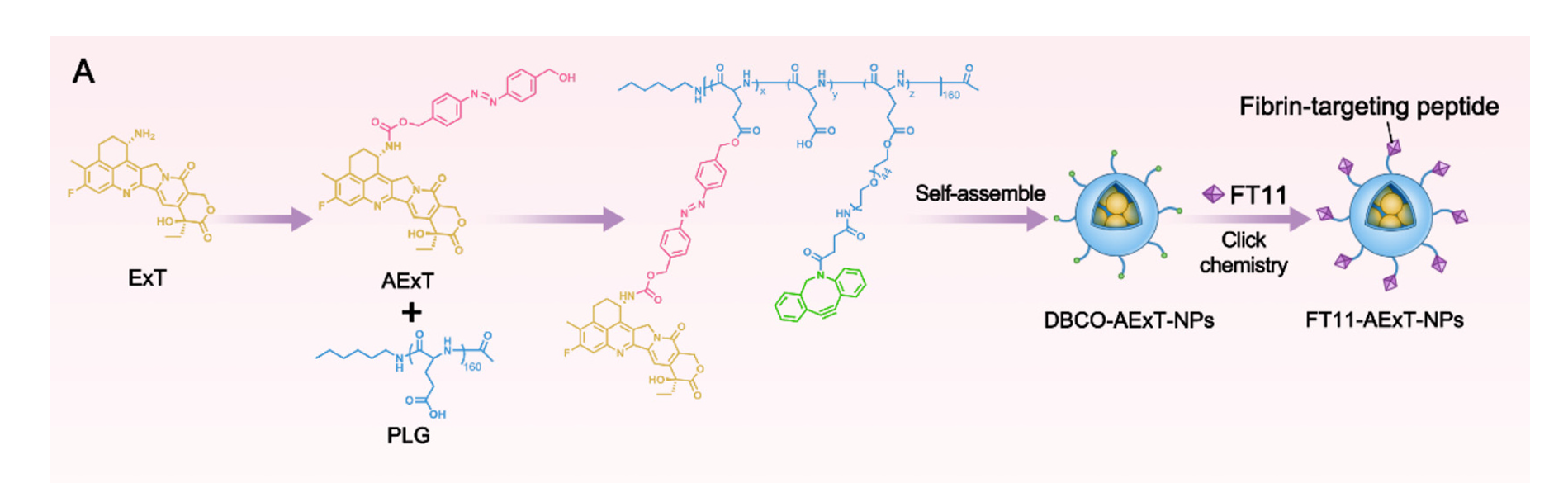
Scheme 1. Schematic of nanoprodrug design, targeting, and activation. (A) Design and synthesis of a fibrin-affinitive, hypoxia activatable nanoprodrug of Exatecan (FT11-AExT-NPs).
In the evaluation of in vitro drug release, the research team employed the Elite EClassical 3100 high-performance liquid chromatography system, equipped with a Supersil ODS2 reversed-phase column, using methanol/water or acetonitrile/water (45/55, v/v) as the mobile phase. At a detection wavelength of 254 nm, they precisely quantified the conversion of the prodrug (AExT-NPs) into exatecan (ExT) under simulated hypoxia (Na₂S₂O₄) and catalysis by quinone oxidoreductase 1 (NQO1) (results detailed in Fig. 1G and Fig. 1H). The data showed that under hypoxic conditions with NQO1 catalysis, the cumulative release of ExT reached approximately 41.1% within 24 hours, while AExT-NPs remained highly stable under normoxic conditions. This demonstrates the excellent hypoxia-specific activation capability of the nanoprodrug, which is a crucial prerequisite for the success of subsequent in vivo targeted therapy.
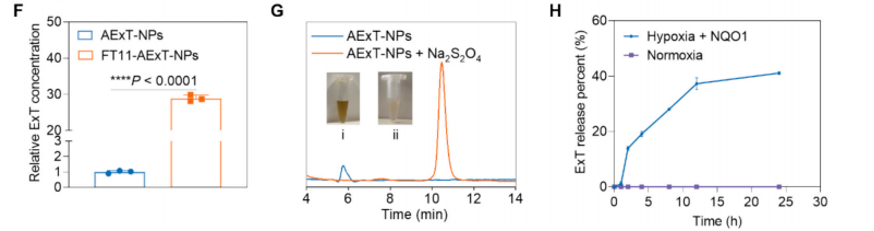
Fig. 1G HPLC chromatogram of Na₂S₂O₄-triggered reduction of AExT-NPs; (H) cumulative ExT release following NQO1 treatment. Both analyses were performed using the Elite EClassical 3100 with a Supersil ODS2 column and UV–Vis detection at 254 nm.
Building on these findings, the research team further evaluated AExT-NPs in 4T1 tumor cells cultured under hypoxic and normoxic conditions for 48 hours. Elite EClassical 3100 system, equipped with a Supersil ODS2 column and UV–Vis detection at 310 nm, was used to quantify the amount of ExT generated within the cells. The results showed that ExT generation reached 89.5% under hypoxic conditions, compared with a maximum of only 7.4% under normoxic conditions, further confirming the hypoxia-selective activation of the nanoprodrug in a cellular environment.
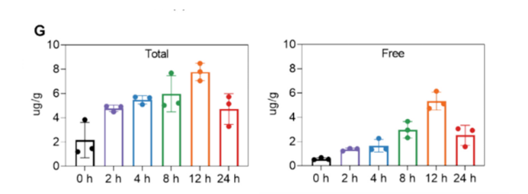
Furthermore, to investigate the dosing window and biodistribution, the HPLC system was used with isocratic elution of methanol/water (45/55, v/v) to precisely determine the concentrations of free ExT and total ExT in mouse tumors and major organs (heart, liver, spleen, lungs, and kidneys) at 310 nm, revealing the targeted enrichment and release kinetics of the drug in vivo. The results for tumor tissue are shown in Fig. 3G.
Fig. 3. (G) Total (above) and free (below) ExT content within the tumor in Figure E. Data points are mean ± s.d. (n = 3).
The EClassical 3100 HPLC system (with UV–Vis detector) and Supersil ODS2 reversed-phase column, provide quantitative analysis, across prodrug reduction, drug release, cellular hypoxia response and in vivo drug distribution. This combination demonstrated the value of Elite’s HPLC system and column working together in complex biomedical research applications, providing reliable chromatographic separation and sensitive detection. Also demonstrates the tremendous potential of HPLC in biopharmaceutical research and development.
Further Reading-
“Analytical HPLC plays an essential role throughout pharmaceutical research and development, from the identification and quantification of active ingredients to impurity monitoring, drug release evaluation, and stability studies. Preparative liquid chromatography complements these analytical workflows by enabling the isolation and purification of target compounds, supporting the development process from laboratory research to larger-scale production.”
Title: Nanomedicines for Solid Tumors Vascular disruption-triggered physiological cascade enables a therapeutic window for fibrin-hypoxia dual-targeting nanomedicines in solid tumors
Journal:Journal of Controlled Release,2026,395,115013