In the process of modernizing traditional Chinese medicine (TCM), efficient extraction, accurate quantification, and comprehensive quality evaluation of active components are critical technical challenges. Recently, two studies by the team of Dr. Xu Ling at Hubei University of Medicine, published in leading journals in the fields of food science and pharmaceutical analysis, have focused on mulberry leaves and Fructus cnidii, respectively. Both studies made extensive use of Elite high-performance liquid chromatography (HPLC) systems, demonstrating the capabilities of these domestically manufactured instruments.
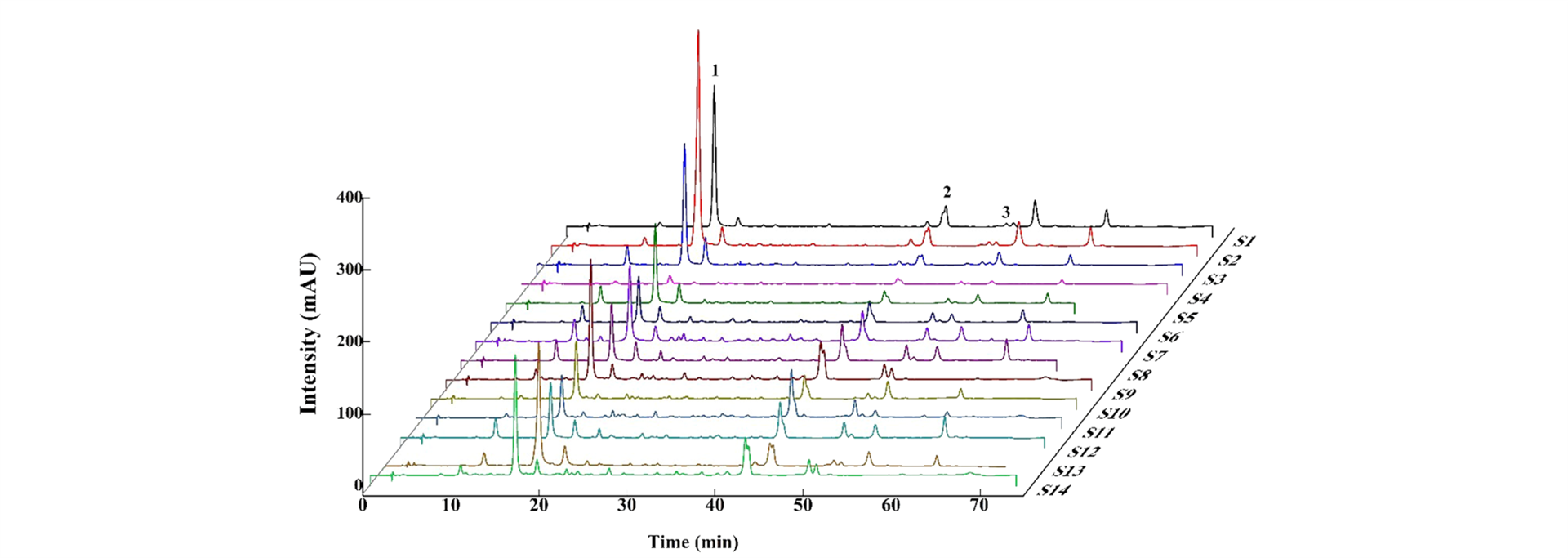
In the study published in the Journal of Food Composition and Analysis, the team established an ultrasound-assisted extraction method and an HPLC fingerprint for chlorogenic acid, rutin, and astragalin from mulberry leaves. An Elite E-Classic 3100 HPLC equipped with UV detector (UV3100) was employed, while response surface methodology was used to optimize the extraction process. The Elite instrument, with its stable gradient elution performance and excellent detection sensitivity, supported the separation and accurate quantification of the three analytes in a complex matrix (Fig. 1, chromatograms of standards and samples showing symmetrical peaks with no tailing). More importantly, the system was used to establish HPLC fingerprints for 14 batches of mulberry leaves from different origins and harvest periods (Fig. 2), identifying 23 common peaks with similarity values above 85.7%. The excellent retention-time reproducibility (RSD < 0.5%) and peak-area stability of the Elite instrument provided a solid foundation for reliable fingerprint matching, offering an efficient technical platform for comprehensive quality evaluation of mulberry leaf materials.
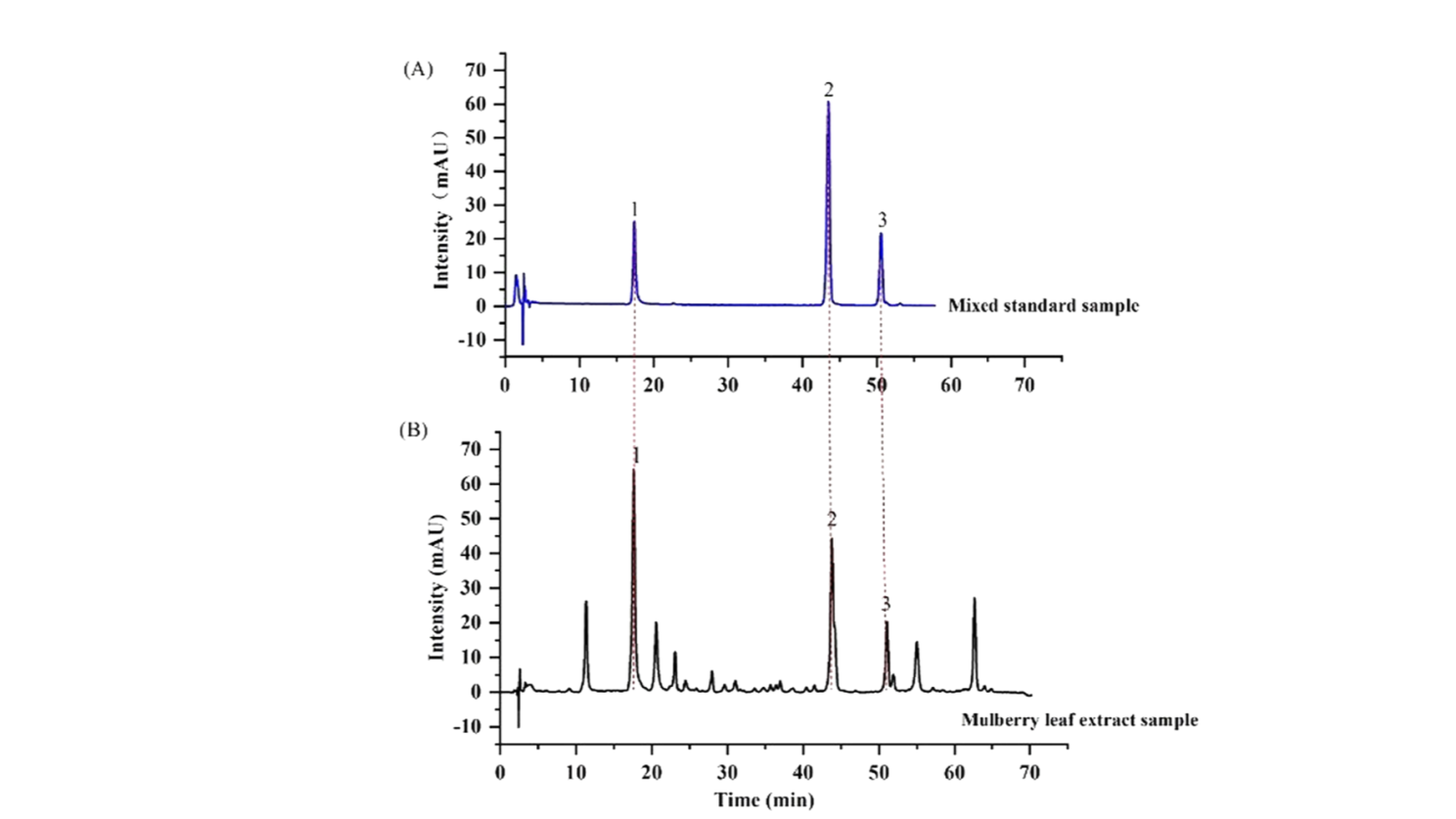
Fig. 1. Chromatogram of mixed standard sample in methanol (A) and Mulberry leaf extract sample (B) the concentration of chlorogenic acid 65.7 μg/mL, rutin 104.56 μg/mL, and astragalin 11.06 μg/mL in Mulberry leaf extract sample.
Fig. 2. Chromatographic fingerprint of Mulberry leaves samples at different harvest stages (S1-S8) and different production areas (S9-S14).
In another work published in Analytical Methods, the team focused on the large-scale extraction of osthole from Fructus cnidii. Elite Eclassical 3100 HPLC system equipped with UV detector (UV3100) was used to monitor extraction efficiency, and the Box–Behnken response surface methodology was applied to optimize methanol reflux extraction parameters (Fig. 3). The high-precision pump flow and stable column-temperature control of the Elite instrument supported accurate determination of osthole peak areas under each experimental condition, ultimately leading to the optimal process: extraction for 1 hour with a liquid-to-solid ratio of 14:1 at 64 °C using 75.8% methanol, yielding an average osthole extraction rate of 14.66%. The relative deviation between the experimental result and the model-predicted value was approximately 1%. Furthermore, HPLC-MS was employed to further analyze the extracted compound.
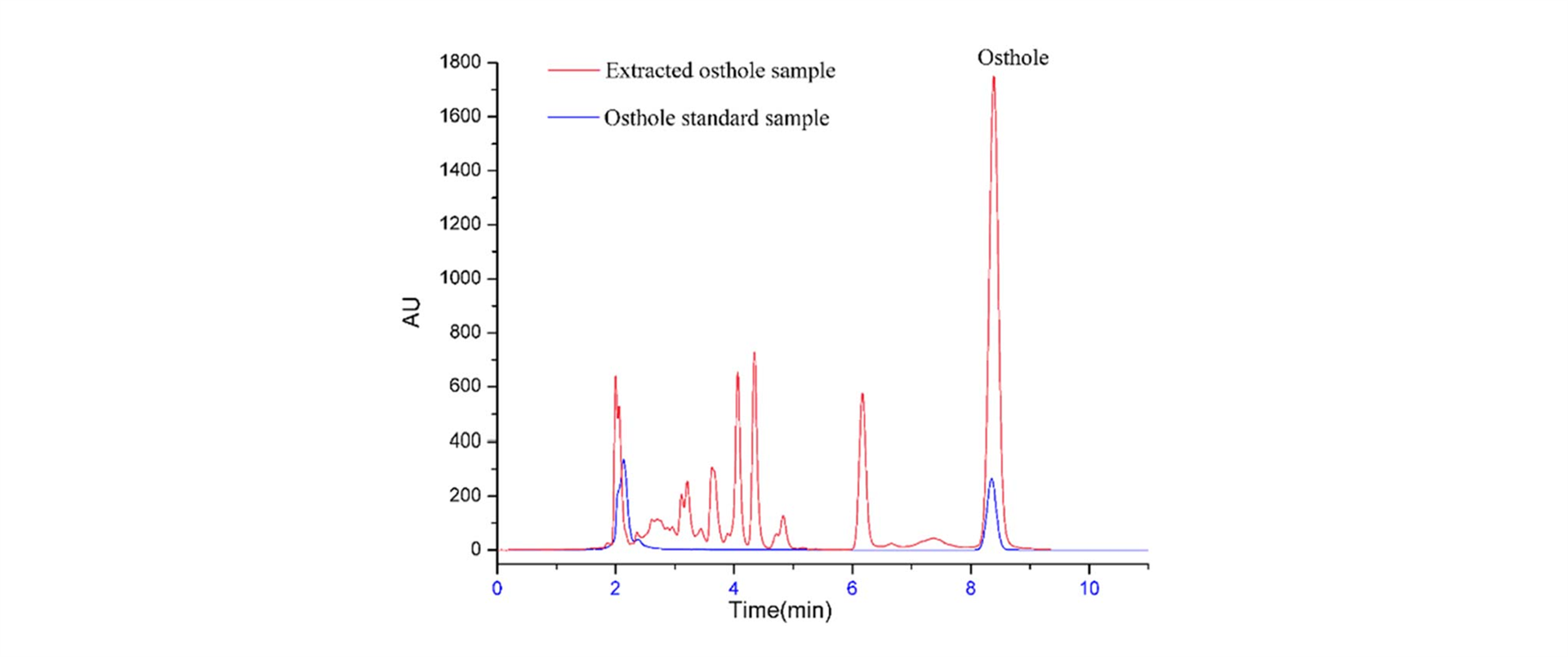
Fig. 3 HPLC-UV chromatograms (314 nm) of osthole standard (50 mg/mL) versus extracted osthole sample (commercial Cnidium monnieri extract). The extracted osthole sample was made by extraction of 2 g Cnidium monnieri with 32 mL methanol-aqueous
oth studies demonstrate that Elite HPLC not only meets the precision and reproducibility requirements for routine quantitative analysis, but also plays an important role in complex applications such as fingerprint profiling and process optimization. With reliable hardware performance and the flexibility to support different analytical methods, Elite HPLC helps improve TCM quality evaluation and supports the development and utilization of active ingredients for larger-scale production.
Further Reading-
“While analytical HPLC helps researchers quantify active compounds and establish quality fingerprints in traditional Chinese medicine, preparative liquid chromatography can support the isolation and purification of target compounds from complex natural-product mixtures. Understanding how to select preparative systems, configure fraction collection, and maintain key components can help researchers plan the transition from analytical method development to compound purification and larger-scale preparation.”
Title 1: Analysis of chlorogenic acid and two flavonoids in mulberry leaves of different harvest periods and origins and HPLC fingerprint study for quality control. | Journal: Journal of Food Composition and Analysis, 2024, 132, 106284
Title 2: Economic and facile extraction and analysis of osthole in Fructus cnidii for large-scale production. | Journal: Analytical Methods, 2025, 17 (19), 3953-3962