In liquid chromatography analysis, the column serves as the "heart" of the separation process. Its performance directly affects the accuracy, reproducibility, and efficiency of analytical results. For a long time, domestically manufactured columns have faced challenges in high-end applications. However, Elite Technology, drawing on thirty years of chromatographic expertise, has launched the Supersil Premium C18 column. Leveraging groundbreaking microfluidic manufacturing technology and outstanding separation performance, it offers a cost-effective choice that rivals imported brands in fields such as pharmaceutical analysis, food safety, and environmental monitoring.
I. Microfluidic Technology: Revolutionizing Column Manufacturing from the Source
Traditional column manufacturing generally relies on "one-pot" synthesis, which yields particles with a broad size distribution and poor batch-to-batch consistency. The process requires months of sieving to obtain particles of the desired size, resulting in significant material waste. Moreover, pore size control is challenging and often necessitates a cumbersome pore-swelling process. In contrast, Elite's proprietary microfluidic silica microsphere manufacturing technology confines the reaction within micron-scale independent spaces. Each microfluidic channel functions as a microscale reactor, where the silane precursor ratio is precisely controlled to achieve one-to-one conversion.
The core advantages of this technology include:
Extremely uniform particle size: Coefficient of variation (CV) < 3%, eliminating the need for sieving. The production cycle is only one week, with 100% conversion efficiency and zero waste, making it green and economical.
Precisely controllable pore size: The confined space of the microfluidic channels supports complex pore-forming systems, allowing direct preparation of silica microspheres with target pore sizes without subsequent pore-swelling steps.
Excellent batch-to-batch consistency: Parallel multi-channel scale-up ensures that every batch of media performs identically.
II. Performance Evaluation of the Supersil Premium C18 Column
Test Conditions
Mobile phase: Methanol : Water = 85 : 15 (v/v)
Flow rate: 1.0 mL/min
Detection: UV at 254 nm
Injection volume: 10 μL
Under the above chromatographic conditions, the Supersil Premium C18 column and two newly purchased, same-specification columns from imported brands (labeled as S and M) were used to separate a mixture of uracil, acetophenone, toluene, ethylbenzene, and fluorene. Figure 1 shows the chromatogram obtained with the Supersil Premium C18 column. Table 1 compares the column efficiency for the five compounds across the three columns.
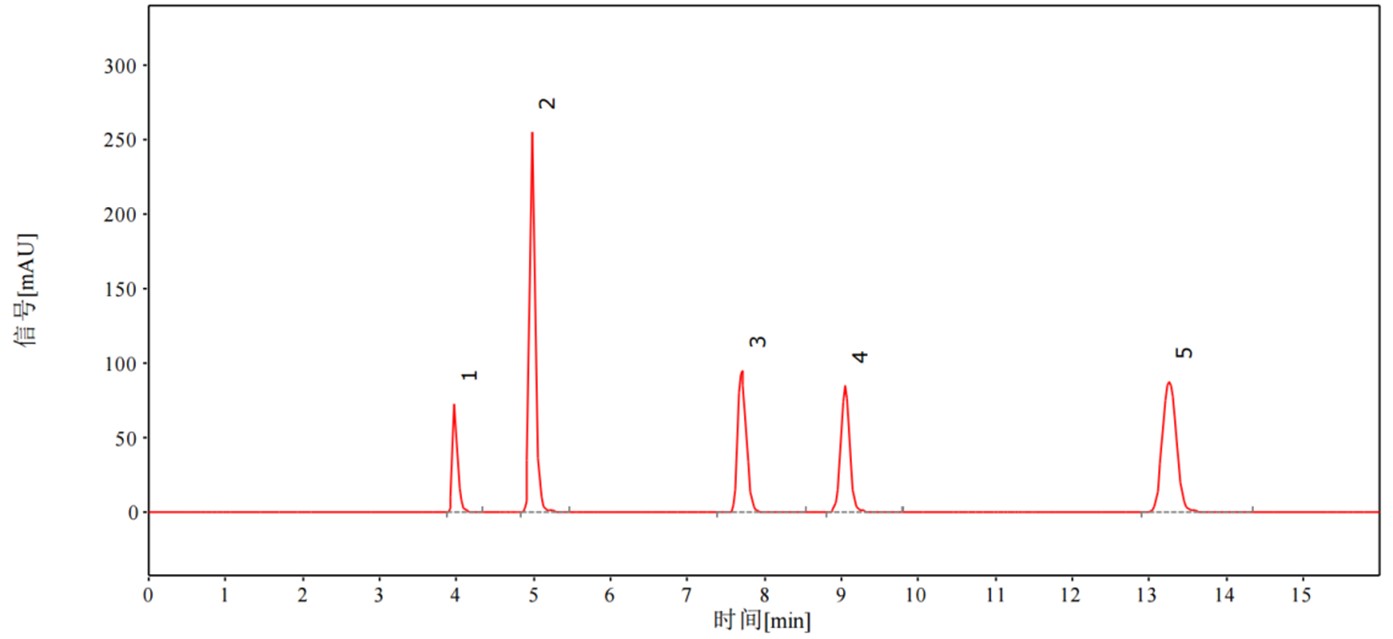
Figure 1. Chromatogram obtained with the Elite Supersil Premium C18 column (Peaks: 1-uracil, 2-acetophenone, 3-toluene, 4-ethylbenzene, 5-fluorene)
|
Compound
|
Supersil Premium C18 Column Efficiency (N/m)
|
Brand S Column Efficiency (N/m)
|
Brand M Column Efficiency (N/m)
|
Supersil Premium C18 Advantage
|
|
Uracil
|
73,028
|
46,544
|
33,100
|
56%~121% higher
|
|
Acetophenone
|
87,616
|
60,540
|
47,664
|
45%~84% higher
|
|
Toluene
|
103,968
|
76,460
|
67,712
|
36%~54% higher
|
|
Ethylbenzene
|
107,136
|
76,660
|
71,036
|
40%~51% higher
|
|
Fluorene
|
111,748
|
77,172
|
70,968
|
45%~58% higher
|
Table 1. Comparison of Column Efficiency for Three Columns of the Same Specifications
As shown in Table 1, under identical test conditions, the Supersil Premium C18 significantly outperforms the two same-specification commercial columns for all five compounds, with a remarkable 45%~58% improvement for the difficult-to-separate compound fluorene.
III. Rigorous Pharmacopoeia Application Cases: Resolution and Tailing Factor Fully Meet Requirements
The Supersil Premium C18 demonstrates excellent performance in the analysis of multiple pharmacopoeia-listed substances. Typical application examples, along with chromatograms and key data, are presented below.
Warfarin Sodium (Chinese Pharmacopoeia Method)
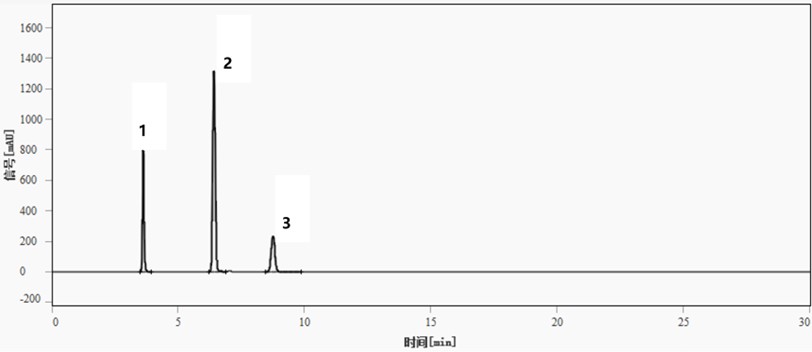
Figure 2. Supersil Premium C18 chromatogram for warfarin sodium system suitability test (Peak 1: 4-hydroxycoumarin; Peak 2: benzylideneacetone; Peak 3: warfarin sodium)
Table 2. Supersil Premium C18 System Suitability Data for Warfarin Sodium
|
Compound
|
Retention Time (min)
|
Theoretical Plates
|
Tailing Factor
|
Resolution
|
Pharmacopoeia Requirement
|
|
4-Hydroxycoumarin
|
3.616
|
16,295
|
1.20
|
—
|
—
|
|
Benzylideneacetone
|
6.418
|
20,372
|
1.05
|
19.12
|
≥10.0
|
|
Warfarin Sodium
|
8.755
|
17,302
|
1.00
|
10.48
|
≥5.0
|
The Chinese Pharmacopoeia requires that in the system suitability test for warfarin sodium, the number of theoretical plates calculated for the warfarin sodium peak should be no less than 2000, the resolution between the 4-hydroxycoumarin peak and the benzylideneacetone peak should be no less than 10.0, and the resolution between the benzylideneacetone peak and the warfarin sodium peak should be no less than 5.0. The results demonstrate that the Supersil Premium C18 column provides a stable baseline, symmetrical peaks, and complete separation, fully meeting the pharmacopoeia requirements.
Lansoprazole (Chinese Pharmacopoeia Method)
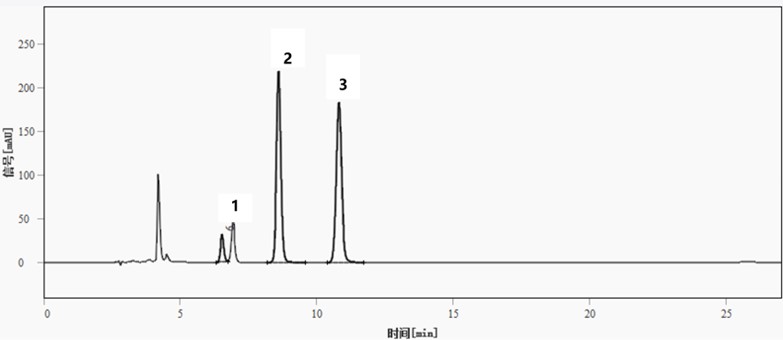
Figure 3. Supersil Premium C18 chromatogram for lansoprazole system suitability test (Peak 1: Degradation product 1; Peak 2: Degradation product 2; Peak 3: Lansoprazole)
Table 3. Supersil Premium C18 System Suitability Data for Lansoprazole
|
Compound
|
Retention Time (min)
|
Theoretical Plates
|
Tailing Factor
|
Resolution
|
Pharmacopoeia Requirement
|
|
Degradation Product 1
|
6.532
|
13,129
|
1.05
|
—
|
—
|
|
Degradation Product 2
|
8.601
|
13,641
|
1.08
|
7.92
|
>3.0
|
|
Lansoprazole
|
10.808
|
14,332
|
1.06
|
6.74
|
>3.0
|
The Chinese Pharmacopoeia requires that the resolution between lansoprazole and its two major degradation product peaks be greater than 3.0 in the system suitability test. The results confirm that the Supersil Premium C18 meets the pharmacopoeia requirements.
Summary of Other Application Cases
As shown in Table 4 and Figure 4, the Supersil Premium C18 column consistently delivers excellent separation efficiency, symmetrical peak shapes, and reliable resolution across various pharmaceutical analyses, meeting and exceeding pharmacopoeia and routine quality control requirements.
Table 4. Supersil Premium C18 System Suitability Data for Multiple Drugs
|
Drug
|
Compound
|
Retention Time (min)
|
Column Efficiency (N/m)
|
Tailing Factor
|
Resolution
|
Pharmacopoeia Requirement
|
|
Nisoldipine
|
Impurity I
|
14.077
|
18,812
|
1.00
|
—
|
—
|
|
|
Impurity II
|
17.181
|
18,912
|
1.00
|
6.82
|
—
|
|
|
Nisoldipine
|
18.730
|
18,042
|
1.02
|
2.93
|
Resolution ≥ 1.5
|
|
Doxofylline
|
Theophylline
|
4.375
|
18,045
|
0.96
|
—
|
—
|
|
|
Doxofylline
|
10.354
|
21,369
|
0.95
|
28.92
|
Resolution ≥ 1.5
|
|
Capecitabine
|
Impurity I
|
3.065
|
14,463
|
1.11
|
—
|
—
|
|
|
Impurity II
|
3.365
|
14,487
|
1.14
|
2.84
|
—
|
|
|
Capecitabine
|
19.045
|
66,938
|
0.89
|
77.21
|
Resolution ≥ 1.5
|
|
|
Impurity III
|
21.088
|
79,744
|
1.82
|
6.89
|
—
|
|
Aripiprazole
|
Impurity I
|
17.476
|
15,151
|
1.09
|
—
|
—
|
|
|
Impurity II
|
33.755
|
17,341
|
0.97
|
20.44
|
—
|
|
|
Aripiprazole
|
44.062
|
22,214
|
1.20
|
9.34
|
Resolution ≥ 1.5
|
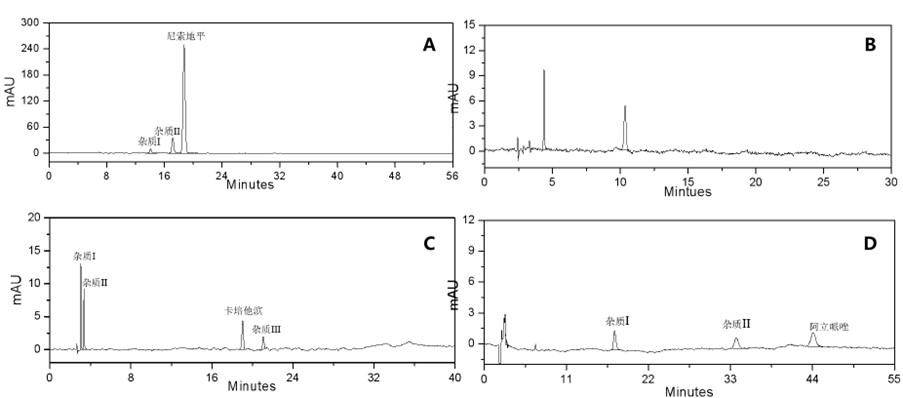
Figure 4. Supersil Premium C18 system suitability chromatograms for (A) nisoldipine, (B) doxofylline, (C) capecitabine, and (D) aripiprazole.
From groundbreaking innovation in microfluidic media manufacturing to rigorous quality control and comprehensive pharmacopoeia validation, the Supersil Premium C18 sets a new standard for domestically produced columns. Choosing Supersil Premium C18 means you get: higher column efficiency, better peak shapes, stronger reproducibility, and superior cost-performance.