In a recent study published in Food Bioscience (IF 9.8), a research team from Sun Yat-sen University applied the “sensomics” approach for the first time to systematically decode the major bitter‑tasting compounds in bitter gourd. To successfully achieve this pioneering taste-decoding process, the researchers integrated Elite’s preparative LC and ELSD technologies into their isolation workflow. Specifically, the authors utilized an Elite P3500 semi-preparative HPLC system (equipped with a UV 3100 detector and an F3100 fraction collector) to perform large-scale preparative separation of the active sub-fraction IV-17 after MPLC, successfully collecting 17 sub-fractions (Figure 2B).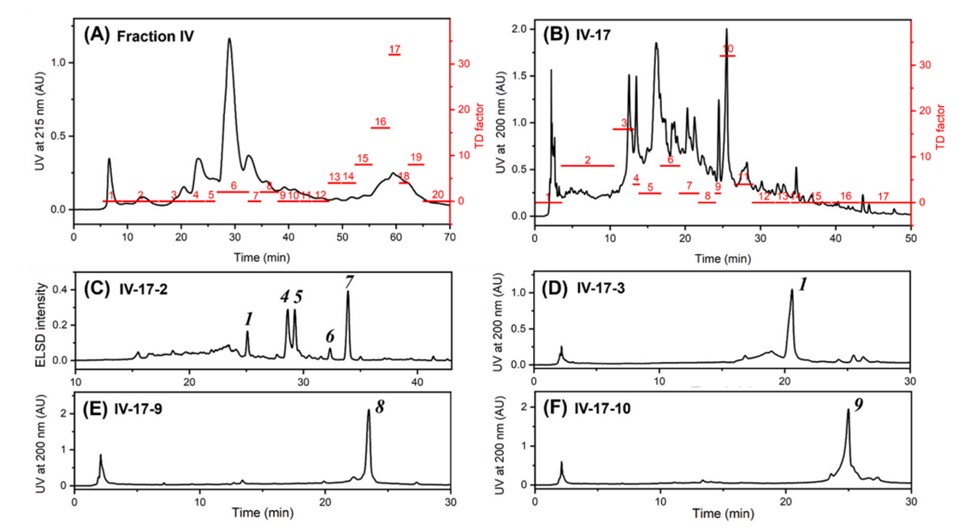
For sub-fraction IV-17-2, which exhibited a weak UV signal, they further employed an Elite D3270 evaporative light scattering detector (ELSD) for real-time on-line monitoring (Figure 2C). This dual-detector setup ultimately facilitated the isolation and identification of nine cucurbitane-type triterpenoid bitter compounds. Moreover, the preparative system was also used to prepare isomerized products (e.g., converting momordicoside L to momordicoside K), providing key samples to verify the formation of artifacts during extraction.
The highly stable separation performance of the Elite preparative LC system, combined with the orthogonal detection capability of the ELSD for non-UV-absorbing analytes, delivers a comprehensive and streamlined solution for complex natural product purification (Figure 2D-F). This work provides core experimental support for elucidating the bitter taste basis of bitter gourd, revealing its acid-catalyzed isomerization mechanisms, and correcting long-standing misunderstandings about pseudo-natural components.
📖 Paper Reference:
- Title: Discovery of major bitter-tasting compounds from bitter gourd (fruit of Momordica charantia L.) by application of the sensomics approach
- Journal: Food Bioscience 65 (2025) 106107