In liquid chromatography analysis, every accurate separation and every reliable set of data depend on a stable, efficient fluid delivery system. The direct‑drive ultra‑high pressure pump (hereafter referred to as the direct‑drive pump), employing a belt‑less, gear‑less servo motor direct‑drive technology, brings unprecedented precision, stability, and durability to HPLC and UHPLC, making it a core tool for modern analytical laboratories to improve detection efficiency and data reliability.
I. Direct‑Drive Pump: Breaking Tradition, Reconstructing the Fundamentals of Fluid Delivery
Traditional HPLC pumps mostly use a “motor + belt/gear” transmission structure, where the motor power is transmitted through a pulley or gear set and a cam to the pump plunger. During long‑term operation, such structures inevitably suffer from belt wear, gear backlash, and transmission efficiency losses, leading directly to flow fluctuations, pressure instability, and consequently affecting chromatographic peak resolution and reproducibility, even causing data deviations.
The direct‑drive pump fundamentally solves these problems. It adopts a design where the motor with closed‑loop feedback is directly coupled to the plunger, completely eliminating intermediate transmission components. The motor power acts directly on the plunger, achieving “zero transmission loss and zero backlash error” precise drive. This structural innovation brings two core advantages to chromatographic analysis:
- Extreme Flow Precision and Stability
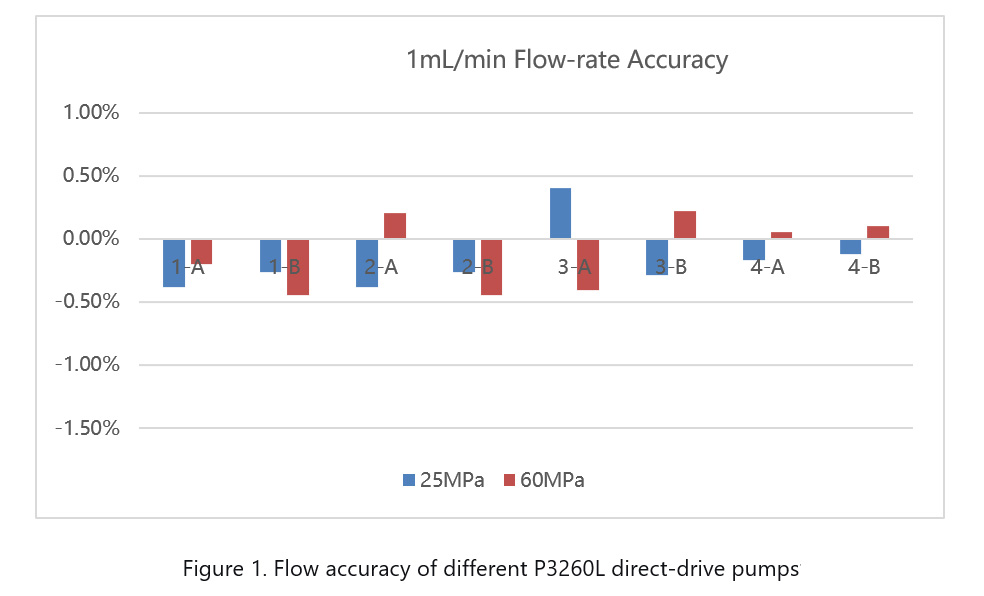
The closed‑loop control algorithm of the direct‑drive motor allows real‑time precise regulation of the plunger speed and stroke, keeping flow fluctuations far lower than those of traditional pumps. During long‑term continuous operation (7 × 24 hours), the Elite P3260L direct‑drive pump maintains extremely high flow stability, ensuring that the retention times of chromatographic peaks for every sample injection are highly consistent, data reproducibility is maximised, and the stringent requirements of pharmacopoeias and national standards are perfectly met.
Table 1. Flow Accuracy and Stability of the P3260L Direct‑Drive Pump (60 MPa)
|
|
Flow Rate (mL/min)
|
0.2
|
0.5
|
1.0
|
2.0
|
|
Pump A
|
Average flow (mL/min)
|
0.1998
|
0.4999
|
0.9995
|
2.0012
|
|
|
Flow error (%)
|
–0.1045
|
–0.0127
|
–0.500
|
0.0600
|
|
|
Flow stability (%)
|
0.0880
|
0.0500
|
0.0326
|
0.0496
|
|
Pump B
|
Average flow (mL/min)
|
0.1994
|
0.4989
|
1.0007
|
2.0038
|
|
|
Flow error (%)
|
–0.2864
|
–0.2127
|
0.0664
|
0.1909
|
|
|
Flow stability (%)
|
0.0638
|
0.0569
|
0.0377
|
0.0686
|
- Lower Pulsation, Better Separation
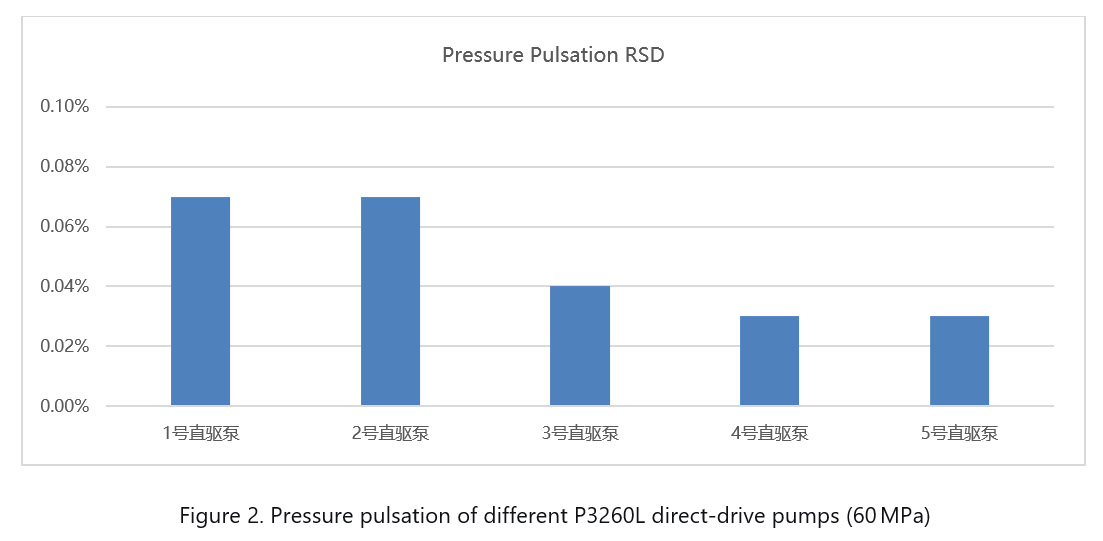
Traditional belt/gear transmissions generate periodic pulsation due to mechanical clearance, leading to increased baseline noise and distorted peaks. This effect is magnified especially at low flow rates and high‑sensitivity detection (e.g., trace analysis), seriously interfering with results. The direct‑drive structure of the Elite P3260L eliminates mechanical pulsation at the source. Combined with high‑precision plunger seals and check valve designs, it achieves near‑“zero pulsation” fluid delivery, resulting in a smoother baseline, sharper peaks, and significantly improved resolution and sensitivity for complex samples.
II. P3260L Direct‑Drive Pump: A Benchmark for Domestic HPLC Pumps
As a leading company in the domestic liquid chromatography instrument field, Elite has been deeply involved in direct‑drive pump technology for over a decade. Relying on self‑developed direct‑drive motor control algorithms, high‑precision pump head processing technology, and integrated fluid system design, Elite has launched the P3260L direct‑drive pump for different analytical scenarios, making it the preferred choice for UHPLC systems.
- Core Technical Highlights for Outstanding Performance
High‑precision closed‑loop feedback direct‑drive stepper motor: Equipped with a high‑torque direct‑drive stepper motor and a 16‑bit high‑precision encoder for full closed‑loop position feedback control. It collects the actual rotor position in real time and dynamically corrects deviations, keeping plunger stroke control error below 0.001 mm. This fundamentally eliminates step loss and position drift, guaranteeing highly precise and stable flow output.
Integrated pump head design: Uses high‑wear‑resistant sapphire plungers and PEEK seal assemblies, combined with a dead‑volume‑free flow path design. The pressure range covers 0–130 MPa, compatible with both conventional HPLC and UHPLC high‑pressure requirements, while effectively reducing solvent carryover and improving gradient elution accuracy.
Intelligent pulsation suppression system: Incorporates a dual‑plunger series compensation structure and intelligent algorithm that dynamically compensates for minute pressure fluctuations generated by plunger motion. Even at an ultra‑low flow rate of 0.01 mL/min, it maintains a stable baseline, meeting the demands of trace analysis, LC‑MS coupling, and other high‑end applications.
Full‑scenario compatibility: Supports isocratic and gradient modes, binary high‑pressure and quaternary low‑pressure gradient elution, and is compatible with aqueous, organic, and buffer solvents. It suits a wide range of chromatographic analysis scenarios, from pharmaceutical analysis, environmental monitoring, and food testing to life sciences.
- Application Scenarios: Empowering Laboratory Efficiency
Pharmaceutical quality control: In drug content uniformity and related substances testing, the high stability of the direct‑drive pump ensures consistent chromatographic peak retention times, with data reproducibility RSD < 0.5 %, perfectly meeting the precision requirements of the Chinese Pharmacopoeia and helping pharmaceutical companies pass GMP certification.
Environmental trace analysis: For trace analysis such as organic pollutants in water and pesticide residues in soil, the low pulsation of the direct‑drive pump significantly reduces baseline noise, increasing detection sensitivity by more than 30 %. It can accurately detect target substances at the ppb level, meeting stringent environmental monitoring standards.
Food and agricultural product safety: In the detection of food additives, veterinary drug residues, and mycotoxins, the high flow accuracy of the direct‑drive pump ensures consistency in batch sample testing. Combined with fast gradient elution, the single‑sample analysis time is reduced by 20 %, greatly improving laboratory throughput.
Life science research: In the separation of biological macromolecules such as proteins, peptides, and nucleic acids, the stable delivery of the direct‑drive pump provides a constant pressure environment for the column, effectively extending column life while improving resolution, helping researchers obtain more reliable experimental data.
III. The Future of Direct‑Drive Pumps: Intelligence and Integration, Leading New Trends in Chromatography
With the development of laboratory automation and intelligence, direct‑drive pumps are continuously evolving. Future direct‑drive pumps will deeply integrate technologies such as IoT and AI algorithms to enable remote monitoring, intelligent fault diagnosis, automatic maintenance reminders, and other features, making instrument operation and maintenance smarter. At the same time, they will be deeply integrated with columns, detectors, autosamplers, and other modules to create an integrated intelligent chromatography system, achieving full automation from sample injection to data output, further freeing laboratory manpower and improving detection efficiency.
For any analytical laboratory, choosing a stable, reliable, and efficient fluid delivery system means choosing a high‑quality liquid chromatography. With its solid domestic technological strength, Elite provides a cost‑effective alternative for laboratories, and safeguarding the reliability of every chromatographic analysis with precision and stability.