Elite's HPLC Solution Breakthrough Research on Mechanofluorochromic Materials
In the age of AI, physical anti-counterfeiting technologies are becoming increasingly important. The combination of mechanically induced fluorescence color changes and stimuli-responsive materials offers new possibilities for anti-counterfeiting labels and information encryption.
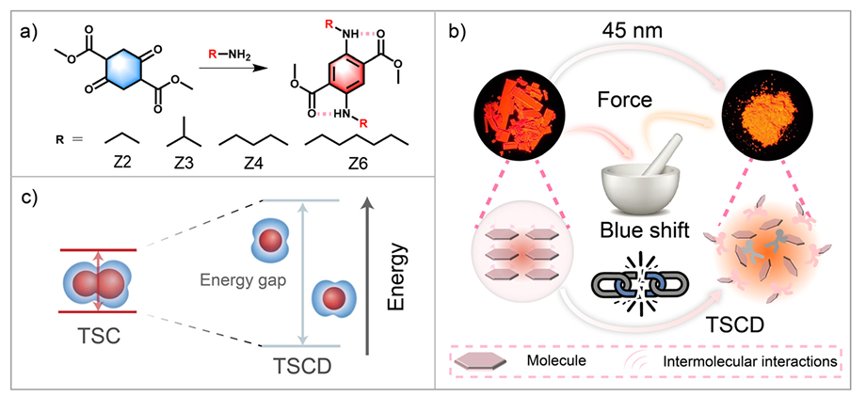
A team from Guilin University of Technology and collaborators has published the article "Achieving blue-shifted mechanofluorochromism via through-space conjugation decoupling" in Materials Horizons (2025 Impact Factor: 11.4), a leading journal in materials science published by the Royal Society of Chemistry (RSC). This study challenges the traditional approach of designing mechanofluorochromic (MFC) materials solely by "enhancing" intermolecular interactions and proposes for the first time a "through-space conjugation decoupling (TSCD)" strategy—a counterintuitive approach that deliberately weakens intermolecular interactions to achieve functional regulation, an approach that had not been previously explored. Guided by three synergistic design criteria, the research team synthesized a series of D–π–A fluorescent small molecules (Z2, Z3, Z4, and Z6).
Scheme 1 Chemical structures of four as-synthesized compounds (a) exemplified chromic behavior and proposed mechanism showing fluorescenceblue shift upon mechanical force (b) comparison of energy levels
Among them, Z3 exhibited an emission wavelength of 637 nm in its crystalline state, with a photoluminescence quantum yield (PLQY) as high as 39.77%, and underwent a remarkable blue shift to 592 nm (Δλ = 45 nm) upon grinding. Systematic mechanistic studies combining X-ray diffraction, time-resolved photoluminescence, and theoretical calculations confirmed that the crystalline-to-amorphous transition weakened through-space conjugation, thereby widening the energy gap. This work provides new ideas for the design of next-generation blue-shifted MFC materials.
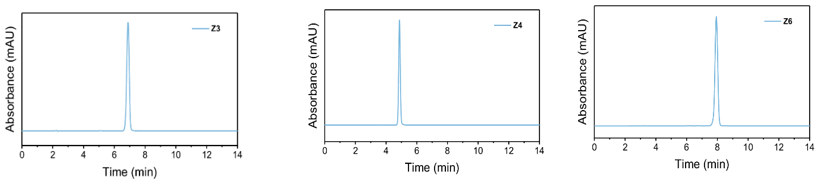
In this study, the Elite EClassical 3100 high-performance liquide chromatograph, equipped with a Supersil ODS2 column, was employed for critical purity control. Using 100% methanol or a methanol–water mixture as the mobile phase and 254 nm as the detection wavelength, the research team verified the purity of three target compounds: Z3, Z4, and Z6. The results showed that the chromatograms for all three compounds featured clear major peaks with no obvious impurity peaks, providing chromatographic evidence of their quality and purity. The relevant chromatograms are provided in the paper's Supplementary Information (Fig. S9 for Z3, Fig. S14 for Z4, and Fig. S19 for Z6).
Fig. S9. HPLC of compound Z3 (methanol : water = 90:10, v/v, as the mobile phase; detection at 254 nm); Fig. S14. HPLC of compound Z4; Fig. S19. HPLC of compound Z6
The stable and reliable operation of the Elite EClassical 3100 high-performance liquid chromatograph, combined with the excellent separation selectivity of the Supersil ODS2 C18 reversed-phase column—which is suitable for analyzing acidic, basic, and neutral compounds—provided an excellent chromatographic solution for the analysis and quality characterization of the new fluorescent materials in this study. At this critical purity-control stage, the combination helped ensure sample purity and supported subsequent absorption/emission spectroscopy, fluorescence lifetime and quantum yield measurements, XRD, and TD-DFT calculations, thereby providing a sound foundation for further investigation of the TSCD mechanism.
Further Reading-
“Reversed-phase chromatography is one of the most widely used modes of HPLC, with C18 columns serving as a versatile choice for many analytical applications. Understanding the separation principles and the differences between reversed-phase and normal-phase chromatography can help researchers select the appropriate separation mode for their samples and analytical goals.” ——