Monitoring the blood concentration of the antipsychotic drug amisulpride is critical in the treatment of schizophrenia. Elite Technology has developed a novel method based on an integrated multi-column two-dimensional liquid chromatography (2D-LC) system that can detect amisulpride in serum in just 12 minutes. This work has been published in the journal Chinese Journal of Chromatography, offering a superior option for clinical therapeutic drug monitoring.
What are the pain points of traditional detection methods?
Amisulpride is a second-generation antipsychotic drug with an effective therapeutic concentration range of 100–320 ng/mL. Insufficient concentration leads to poor efficacy, while excessive concentration may cause severe side effects. Commonly used detection methods face the following challenges:
- The concentration of the target drug component in serum is at the ng/mL level, requiring highly sensitive detection techniques.
- Serum contains diverse components, making sample pretreatment complex. Traditional pretreatment methods involve steps such as liquid-liquid extraction or solid-phase extraction to purify the sample, followed by nitrogen evaporation and reconstitution. These procedures are not only time-consuming (single analysis often exceeds 30 minutes) but also prone to sample loss.
- Although liquid chromatography-mass spectrometry (LC-MS) offers high sensitivity, the instrumentation is expensive, and the use of isotope internal standards increases routine testing costs.
Elite Solution: Integrated Multi-Column 2D-LC
This approach employs heart-cutting technology. By utilizing two reversed-phase separation columns with slightly different hydrophobicities and a strong cation exchange trap column, trace amounts of amisulpride in serum samples are effectively detected on the Elite 2D-LC system.
Workflow
The workflow is illustrated below. Pumps A, B, and C deliver mobile phases A, B, and C, respectively, and the entire system is automated using the chromatography workstation.
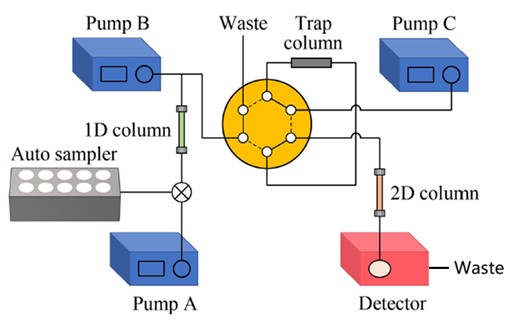
Impurity Removal Process: Under initial conditions, after injection, Pump A operates, and the switching valve is in the solid-line path. Non-target components eluted from the first-dimensional column (1D column) are directed to waste via the switching valve.
Enrichment Process: Pump A continues to operate. Before the target analyte begins to elute, the valve switches to the dashed-line path, connecting the outlet of the first-dimensional column to the trap column. At the same time, the flow rate of Pump B, connected via a tee to the outlet of the first-dimensional column, increases to dilute the elution strength of the solvent from the first dimension.
Analysis Process: After sample enrichment, the valve switches back to the solid-line path. Pump C operates, eluting the target analyte from the trap column onto the second-dimensional column (2D column) for further separation.
Sample Pretreatment – As Simple as Direct Injection
Add three volumes of a perchloric acid-methanol mixture to the serum sample to precipitate proteins. Vortex for 2 minutes, centrifuge at 10,000 r/min for 5 minutes, and inject the supernatant directly.
Supports large-volume injection (300 μL). By optimizing the solvent composition, the solvent effect from large-volume injection is avoided, significantly improving detection sensitivity.
Three-Column Synergy for Precise Separation
First Dimension: A Supersil ODS2 column with weaker hydrophobicity is used for rapid preliminary separation of serum components. The mobile phase is acetonitrile/phosphate buffer (pH 3.0), allowing fast elution of the target.
Trap Dimension: A Supersil SCX (10 mm) strong cation exchange column acts as a“filter”to precisely capture positively charged amisulpride, avoiding interference from impurities.
Second Dimension: A base-deactivated, highly hydrophobic SinoChrom ODS-BP column is specifically optimized for the separation of basic compounds, achieving complete separation of amisulpride from residual impurities. Under pH 7.0 conditions, sample analysis is completed within 12 minutes, as shown below.
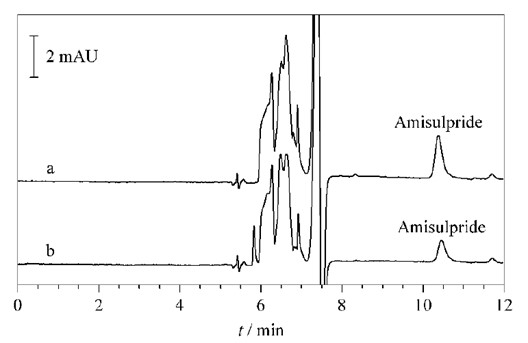
Figure. Chromatograms of spiked serum samples at different concentrations (amisulpride). (a) Spiked at 100 ng/mL; (b) Spiked at 50 ng/mL
Core Innovation: Interface Technology Improves Trap Efficiency
In conventional two-dimensional chromatography, when the sample is transferred from the first dimension to the trap column, a high organic phase ratio often leads to loss of the target analyte. This system, through its“2D-LC interface”design, uses an auxiliary pump to deliver pH 3.0 phosphate buffer, reducing the organic phase ratio and maintaining a stable pH. This ensures that amisulpride remains positively charged and is efficiently retained on the trap column. The Kromstation chromatography workstation controls all modules, and the entire analytical process is automated using a six-port valve for switching, enabling unattended operation.
Key Performance Data
Wide Linear Range: Over the range of 10–200 ng/mL, the linear correlation coefficient r = 0.9998, covering clinically relevant concentrations.
Sensitivity Achieved: The limit of detection (LOD) is 7.28 ng/mL, and the limit of quantification (LOQ) is 24.27 ng/mL, well below the 100 ng/mL lower limit recommended by the AGNP guidelines.
Stable Recovery: At spiked concentrations of 50 ng/mL and 100 ng/mL, recoveries are stable between 73.7% and 76.8%, with good reproducibility.
These experimental data demonstrate that the method fully meets clinical monitoring requirements.
Clinical Value
Therapeutic Drug Monitoring (TDM) is a core tool for achieving“personalized dosing,”and efficient, low-cost detection methods are essential for its widespread adoption. The advantages of this multi-column 2D-LC system directly address clinical pain points:
- Full Automation: The Kromstation chromatography workstation controls all modules, enabling automated analysis, reducing human error, and ensuring reliable results.
- Rapid Detection: Results in 12 minutes, suitable for batch sample processing, improving clinical workflow efficiency.
- Simple Operation: No complex pretreatment, easy to perform.
Cost-Effective: No expensive mass spectrometry equipment required; low daily use and maintenance costs, making it suitable for batch testing even in primary hospitals.