The first time you walk into a lab, you may be drawn to instruments with interwoven tubing and screens displaying curving signals, but also feel confused. Unlike beakers or test tubes that you can just pick up and use, or a microscope that gives you an intuitive image, the high performance liquid chromatograph (HPLC) is nonetheless a basic instrument in modern analytical chemistry labs. As a fundamental analytical tool in fields such as analytical chemistry, environmental science, and biomedicine, mastering it not only helps you successfully complete experiments and advance research projects, but also helps you build a systematic “scientific analytical mindset”. Today, let’s get to know HPLC in a relaxed way: what it is, how to use it, and what practical problems it can solve.
What is HPLC?
Don’t let the long name “high performance liquid chromatograph” scare you. Think of it as a “super‑accurate substance sorter”. Its core function is to help us separate mixtures, find out which components are in the mixture, and determine how much of each component is present.
For example, you want to know whether a traditional Chinese medicine extract contains a certain active ingredient and whether its content meets the standard, or to test whether the sweetener in a beverage exceeds the limit, or to analyse whether a lake water sample contains trace pollutants. All such “figure out what is in the sample” needs can be met by HPLC. Its working principle is simple: a sample solution containing multiple components is carried by the mobile phase (you can think of it as a transport liquid) through a column (like a sorting channel). Because different substances move through the column at different speeds, they exit the column one by one. A detector connected after the column records them as “chromatographic peaks”, which are used to identify what the substances are and to calculate their amounts based on peak heights or areas.
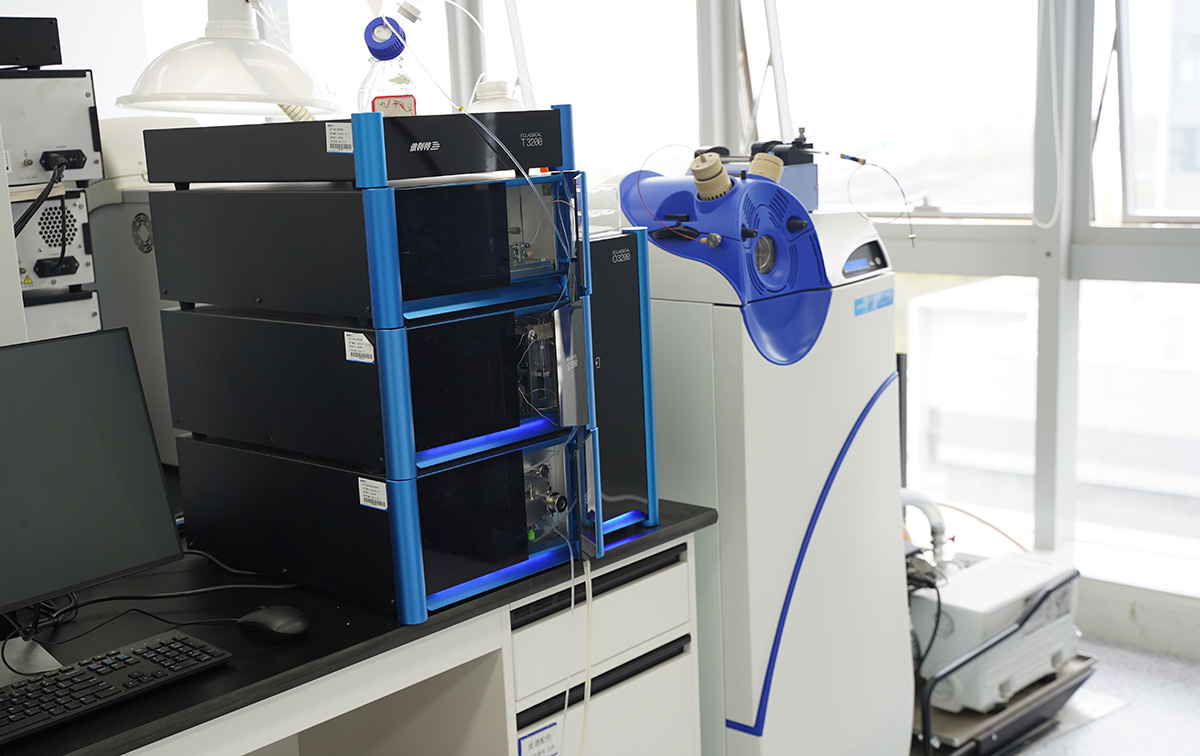
At the beginner level, you don’t need to master all the principles in depth. Just remember the core functions of HPLC: qualitative analysis (determining what components are in the sample) and quantitative analysis (determining how much of each component is present). That is enough for most basic experiments and early‑stage research.
Table 1: Core HPLC Components and Their Functions
|
Component
|
Main Function
|
Beginner’s Analogy
|
|
Pump
|
Delivers mobile phase at a precise flow rate
|
“Water pump” – pushes the transport liquid
|
|
Injector
|
Introduces sample into the mobile phase
|
“Feeding port” – where the sample enters
|
|
Column
|
Separates different components in the sample
|
“Sorting channel” – where the separation happens
|
|
Detector
|
Records signals of the separated components
|
“Eye” – sees what comes out and makes peaks
|
|
Data system
|
Processes and outputs the chromatogram
|
“Recorder” – turns signals into a picture
|
Common HPLC Applications
Experimental needs vary across different fields, but the core problem HPLC solves always revolves around “component analysis”. Look at the scenarios below – does any match your research direction?
Basic analytical experiments: practicing the core operations
This is how most people first encounter HPLC. Usually you start with “standard sample testing”. For example, take a vitamin C solution of known concentration, inject it into the HPLC to obtain its chromatogram, and then back‑calculate the concentration from the “peak area” to verify the instrument’s accuracy.
These experiments focus on helping you become familiar with the basic workflow: how to mix water and methanol in the right ratio to prepare mobile phase, how to install the column correctly, how to inject the sample solution, and how to interpret the peak shapes and data on the chromatogram. These operations are like “learning to balance first when learning to ride a bike” – all more complex experiments later rely on these basic skills.
Environmental / food analysis: solving real detection problems
If your interest is in environmental science, you might work on “water pollutant detection”. For example, researchers collect water samples from a river near a factory suspected of industrial wastewater contamination. After pretreatment steps such as filtration and extraction, the water samples are analysed by HPLC to detect phenolic compounds, hydrocarbons, and other pollutants. One study found phenol levels in a river above the normal standard using HPLC, providing crucial evidence for subsequent river remediation and determining whether the water quality met standards.
If you focus on food‑related research, you will likely encounter “food additive detection”. For instance, when testing a brand of fruit juice, HPLC can measure preservatives (e.g., potassium sorbate) and sweeteners (e.g., aspartame) to check if they comply with safety regulations. A food regulatory authority once discovered that a certain brand of fruit juice had excessive potassium sorbate through HPLC testing, thus safeguarding consumer food safety.
The key points in these experiments are sample pretreatment (how to remove impurities to avoid contaminating the instrument) and data interpretation (how to find target peaks in a complex chromatogram and exclude interfering signals). They give you a direct feeling of how the instrument solves real‑world detection needs.
Advancing research projects: supporting data generation
When carrying out research projects (e.g., thesis work, research studies), HPLC becomes an important “data support tool”. For example:
Drug synthesis research: Use HPLC to check the purity of a synthesised product and determine whether impurities are present (too many impurities will affect subsequent experimental results). When developing a new antihypertensive drug, researchers used HPLC to repeatedly monitor the purity of the synthesised drug, optimising the synthesis process to ensure the drug’s efficacy and safety.
Biological sample analysis: For example, measure the levels of metabolites in serum or urine, compare differences between experimental groups, and provide data to support research conclusions. In a diabetes study, researchers used HPLC coupled with mass spectrometry to detect specific metabolites in the serum of different patients, discovering biomarkers associated with diabetes progression.
Material performance research: Analyse the adsorption effectiveness of a new adsorbent material for pollutants by using HPLC to measure the pollutant concentration in solution before and after adsorption, thereby verifying the material’s performance. A research team developed a novel activated carbon material for adsorbing heavy metals and organic pollutants in water; using HPLC, they clearly showed the reduction in pollutant concentration after adsorption, strongly demonstrating the material’s high adsorption efficiency.
At this point, you will find that HPLC is no longer a “strange instrument in the lab”, but a key helper that produces reliable data and moves your research forward.
Table 2: HPLC Application Scenarios
|
Field
|
Typical Task
|
What HPLC Does
|
|
Pharmaceutical
|
Purity testing of drug substances / products
|
Quantifies active ingredients and related substances
|
|
Environmental
|
Analysis of pollutants in water, soil, air
|
Detects trace organic contaminants (pesticides, PAHs, phenols)
|
|
Food
|
Determination of additives, nutrients, contaminants
|
Measures preservatives, sweeteners, vitamins, mycotoxins
|
|
Clinical / biomedical
|
Analysis of biomarkers in serum, urine, etc.
|
Quantifies metabolites, therapeutic drugs, etc.
|
|
Materials
|
Evaluation of adsorbents, catalysts, etc.
|
Measures concentration changes before / after treatment
|
Tips to Avoid Common Pitfalls When Using HPLC
When you start operating HPLC, it is easy to overlook details that may cause experiment failure (e.g., no chromatogram, distorted peaks). Keep these tips in mind to reduce trouble:
Mobile phase preparation: details determine success
The mobile phase is the “power core” of HPLC. A mistake in its preparation can ruin the whole experiment. For example, when preparing a “methanol‑water (50:50)” mobile phase, you must use chromatography‑grade reagents (ordinary‑grade reagents contain impurities that produce interfering peaks). Mix them strictly according to the required ratio. After preparation, you must degas the mobile phase (use an ultrasonic bath to remove dissolved air bubbles, which cause unstable pump pressure and chaotic peak shapes).
Many beginners try to save time by using analytical‑grade reagents or skipping degassing – only to find that after hours of work they obtain no useful data, wasting even more time.
Injection operation: slow and accurate
Injection is one of the steps most prone to error. If you use a manual injector:
First rinse the syringe with the sample solution (to remove air or residual liquid inside the needle that could affect the result).
Push the plunger at a steady speed – not too fast, not too slow.
After injection, promptly remove the needle to avoid contaminating the instrument’s internal tubing.
If you use an autosampler, check in advance whether the sample vial contains sufficient solution and whether the injection volume is set correctly. Someone once did not check the sample volume; the autosampler needle aspirated air, and the instrument ran empty for half an hour before the problem was noticed, delaying the entire experiment.
Cleaning after the experiment: protect the instrument and help the next user
After using HPLC, you must clean the column and the system according to the standard procedure. For example, if you used a mobile phase containing salts, you must first flush the system thoroughly with pure water, then store the column in methanol (salt residues can crystallise and block the column, causing errors the next time the instrument is started).
Many people, eager to analyse their data after finishing an experiment, skip the cleaning step. This not only shortens the column’s lifetime but also may affect results of the next run, and you might even be responsible for the cost of replacing worn parts.
Table 3: HPLC Operation Pitfalls and Maintenance Tips
|
Area
|
Common Pitfall
|
Tip to Avoid It
|
|
Mobile phase
|
Using non‑chromatography‑grade reagents
|
Always use HPLC‑grade solvents and filter (0.45 µm)
|
|
Skipping degassing
|
Degas by sonication (5‑10 min) or use on‑line degasser
|
|
Injection
|
Air bubbles in the syringe
|
Rinse syringe with mobile phase or sample before drawing
|
|
Insufficient sample volume
|
Ensure vial has enough solution for all planned injections
|
|
Post‑run cleaning
|
Not flushing salts after use
|
Flush with water, then with methanol/water, then store in organic solvent
|
|
Leaving column in buffer for long periods
|
Never store column in buffer; replace with organic solvent
|
What Mastering HPLC Means to You – Beyond Just “Using an Instrument”
You might think, “As long as I can finish my experiments, I don’t need to understand it deeply.” But in fact, mastering HPLC brings you much more than just operational skills.
Develops rigorous thinking
HPLC demands attention to detail – one mistake can cause data deviation. Regular use builds a habit of “checking procedures before experiments, recording data during operation, and reviewing problems afterwards”. This rigour is valuable in any research or job.
Teaches scientific logic
Through HPLC experiments, you gradually learn the mindset of “using an instrument to test a hypothesis” (e.g., you hypothesise that a sample contains a certain component; HPLC detects a corresponding peak, confirming the hypothesis). This is the core logic of scientific research.
Enhances your competitiveness
Whether you pursue further studies (supervisors prefer researchers who can use basic research instruments) or enter industry (e.g., R&D positions in testing labs or pharmaceutical companies, where HPLC proficiency is a major plus), this skill gives you an advantage.
For someone new to the lab, the HPLC is not an “unapproachable precision device” but a “practical partner” that helps you explore science and accumulate experience. When you first start, you will inevitably encounter abnormal chromatograms, instrument errors, and other problems. But as long as you are patient, think things through, and ask experienced people for advice, you will gradually move from “confused and unfamiliar” to “skilled and confident”.