To get started with liquid chromatography, you must first master these fundamental concepts. Whether you are trying to understand the principles or perform subsequent operations, this knowledge will help you avoid many detours.
I. Core Definition: What is a Liquid Chromatography?
Simply put, a liquid chromatography is an instrument that works on the principle of “liquid separation + analysis”. Its most intuitive feature is the use of a liquid as the “mobile phase”, while the “stationary phase” that provides the fixing action can take various forms – common examples include filter paper, thin‑layer plates, or packed beds. Over the years, as chromatographic techniques have developed, different methods have been named according to the form of the stationary phase. For example, using filter paper is called paper chromatography, using a thin‑layer plate is called thin‑layer chromatography, and using a packed bed column is called column liquid chromatography. In daily laboratory practice, column liquid chromatography is the most common type because of its high separation efficiency and wide applicability. When we talk about “liquid chromatography analysis”, we are usually referring to this type.
II. System Components: Core Parts and Their Functions
A complete liquid chromatography system typically includes the following core parts: a solvent reservoir, a pump, an injector, a chromatographic column, a detector, and a recorder. Each component has its own role, and none can be omitted for proper operation:
Solvent reservoir: the “storage station” for the mobile phase; it must keep the mobile phase clean and free of impurities.
High‑pressure pump: the “power heart” of the system; it delivers a stable pressure so that the mobile phase flows at a constant rate through the entire flow path.
Injector: the “sample entry point”; it accurately introduces a small volume of sample into the mobile phase.
Column: the “separation core”; all separation of sample components takes place here.
Detector: the “signal catcher”; it identifies the eluting components in real time.
Recorder: the “result presenter”; it converts the detector’s signals into an interpretable chromatogram.
During operation, the mobile phase in the solvent reservoir is steadily delivered by the high‑pressure pump throughout the system. The sample solution is injected into the mobile phase via the injector and then carried into the column – the stationary phase. The key separation principle is that each component in the sample has a different “distribution coefficient” between the mobile phase and the stationary phase. The distribution coefficient can be understood as the “preference” of a component for one phase over the other: some components prefer the stationary phase and stay in it longer; others prefer the mobile phase and move forward quickly with it.
III. Working Principle: From Injection to Result
Thus, as the components move through the column, they undergo repeated cycles of “adsorption” and “desorption” between the two phases. After many such cycles, the migration speeds of different components become significantly different, and eventually they separate, eluting one after another from the column. When these separated components pass through the detector, their concentrations are converted into electrical signals that are sent to the recorder and finally presented as a clear chromatogram. In summary: the sample, dissolved in the mobile phase, enters the column. As it passes through the stationary phase (the packing material), the different degrees of adsorption cause the components to elute in a different order. When we analyse the chromatogram, we use the “elution order” (retention time) and the “peak size” (peak area) to determine which components are present in the sample and their respective amounts.
IV. Common Separation Mode: Reversed‑Phase Chromatography
In the commonly used reversed‑phase mode, the stationary phase is less polar than the mobile phase – for example, the stationary phase is often an alkyl‑bonded silica, while the mobile phase typically consists of solvents such as acetonitrile or methanol. This is the most characteristic feature of reversed‑phase chromatography and is the key to its ability to separate most samples. In this mode, components elute in order of their polarity: less polar components have stronger affinity for the stationary phase (which is also less polar) – they “attract each other like good friends” – and therefore stay longer on the column, eluting later; thus they appear later in the chromatogram. Conversely, more polar components have weaker affinity for the stationary phase and prefer to move with the more polar mobile phase, so they elute early. For example, when analysing traditional Chinese medicine, many active ingredients with low polarity will elute later in reversed‑phase chromatography. By adjusting the polarity of the mobile phase, we can change the elution order and achieve better separation.
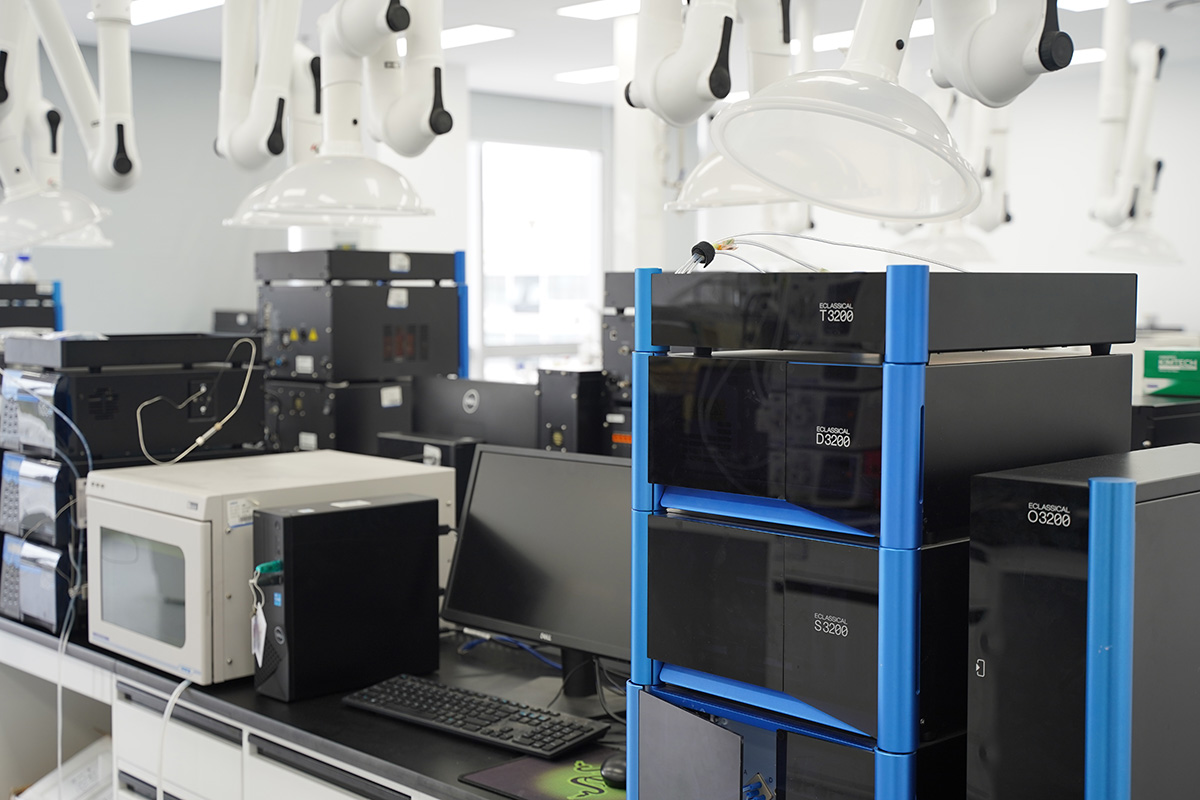
Common Knowledge Points for Everyday Reference
Ultra‑High‑Speed Analysis
Many modern liquid chromatography can withstand pressures up to 140 MPa, and this is not just a random specification – it is what makes ultra‑high‑speed separation truly possible. In the past, with lower pressure limits, the flow rate could not be too high, otherwise the pressure would exceed the limit, prolonging separation time. Now, with higher pressure tolerance, the flow rate can be increased appropriately; an analysis that used to take one hour may now be completed in 20 minutes. Moreover, because the system can handle higher pressures, even mobile phases that tend to increase pressure (e.g., aqueous phases with slightly higher salt content) can be used with confidence. This gives us more flexibility in choosing analytical methods, especially when analyzing complex samples (such as multiple additives in food or trace pollutants in environmental water) or developing new methods.
High‑Resolution Analysis
High‑resolution analysis depends on the optimisation of several instrument components:
- Newly developed columnswith theoretical plate numbers exceeding 50,000 and pressure tolerance up to 140 MPa make truly high‑resolution analysis possible. The theoretical plate number is a key indicator of a column’s separation ability: the higher the value, the better the separation, allowing even closely related components (e.g., structural isomers) to be clearly resolved.
- New‑generation binary pumpsare equipped with variable‑stroke independent plungers and a low‑volume dual‑thread mixer. These two design features significantly improve mixing performance, making the mobile phase composition more precise and delivery more stable. Poor mixing of the mobile phase can cause baseline drift and affect detection results; stable delivery makes the chromatogram smoother and the data more reliable.
- The instrument uses a 10 mm total‑reflection capillary flow cell, which effectively reduces the effect of extra‑column dispersion. Extra‑column dispersion is the broadening of a component zone after it leaves the column but before it reaches the detector, which leads to wider peaks and reduced resolution. This flow cell minimises that problem, so the final separation resolution is higher.
High‑Sensitivity Analysis
For applications that require detecting trace substances (e.g., trace impurities in pharmaceuticals, trace hormones in blood), high sensitivity is essential:
- The diode array detectoris equipped with a 65 mm flow cell, offering extremely high sensitivity that performs well in trace substance analysis. The length of the flow cell affects detection sensitivity: a 65 mm length allows the component to remain in the detector longer, producing a stronger signal, so even very low‑concentration components can be accurately detected.
- The new optical systemhas been optimised to effectively reduce noise and signal drift, ensuring reliable results even at high sensitivity. High noise can cause baseline fluctuations and lead to false positives/negatives; signal drift affects the accuracy of peak areas. The optimised optical system makes detection more stable and reduces data errors.
- The autosampleroffers several cleaning modes and is equipped with a standard back‑flush function for the injection port, greatly reducing the risk of sample carryover that could affect subsequent analyses. If the injector has carryover, components from a previous sample may contaminate the next run, causing false‑positive results. Multiple cleaning modes and the back‑flush function keep carryover extremely low, ensuring the independence of each analysis.
Precautions for Use
Finally, here are a few precautions that will help protect the instrument and ensure good detection results:
The mobile phase must be HPLC‑grade; if an aqueous phase is used, it is recommended to use deionized water of 20 MΩ or higher. Impurities in ordinary reagents will contaminate the column and detector and produce spurious peaks in the chromatogram, interfering with the analysis. Deionized water of 20 MΩ or higher prevents ions in the water from clogging the column or affecting the detection signal – for example, calcium and magnesium ions in water may react with components of the mobile phase and form precipitates.
After degassing the mobile phase, do not shake it vigorously, as this may introduce bubbles that will affect subsequent operations. Bubbles in the flow path cause pressure instability, can create “false peaks” in the detector, and may even damage the high‑pressure pump. Therefore, after degassing, transfer the mobile phase gently and keep it still.
All liquids that will pass through the column must be carefully filtered (typically through a 0.22 μm or 0.45 μm membrane) to prevent impurities from clogging the column. The packing particles in the column are very fine; once solid impurities enter, they become lodged in the interstitial spaces, causing the back-pressure to rise and the separation performance to deteriorate. In severe cases, the column may be permanently damaged.
Do not set the system pressure too high. It is recommended to keep it below 2000 psi (approximately 13.79 MPa) to better protect the column and the entire instrument system and to extend their service life. Excessive pressure can deform the column packing particles and damage the pump seals, increasing the probability of instrument failure. During routine use, monitor the pressure and stop the system promptly if an anomaly is observed.