Issued on August 1, 2025, and scheduled to take effect on August 1, 2027, GB 26572-2025 "Requirements for Restriction of Hazardous Substances in Electrical and Electronic Products" is China's first mandatory national standard for the restriction of hazardous substances in electrical and electronic products. The standard expands the list of controlled substances from 6 to 10 categories. In addition to the original substances—polybrominated biphenyls (PBBs) and polybrominated diphenyl ethers (PBDEs)—it adds four phthalates, namely bis(2-ethylhexyl) phthalate (DEHP), dibutyl phthalate (DBP), benzyl butyl phthalate (BBP), and diisobutyl phthalate (DIBP), with a maximum concentration limit of 0.1% in homogeneous materials. This marks the entry of China's RoHS control into a new phase of mandatory and systematic regulation.
Based on the EClassical 3200L high performance liquid chromatography platform, Elite Technology offers solutions that comply with GB 26572-2025 and EU RoHS 2.0 Directive requirements, specifically targeting the precise determination of the four phthalates and PBBs/PBDEs.
I. Simultaneous Determination of Four Phthalates (BBP, DIBP, DBP, DEHP)
Phthalates (PAEs) are widely used as plasticizers to impart flexibility to polymers such as PVC. They are commonly found in toys, food packaging materials, medical devices, personal care products, and electronic equipment. Due to their ability to migrate from products into the environment and the human body, phthalates can act as endocrine disruptors, posing health risks.
Chromatographic Conditions
Experimental Results
Typical Chromatogram
Under the above chromatographic conditions, a mixed standard solution of the four phthalates at a concentration of 20 μg/mL each achieved effective separation meeting quantitative requirements (Figure 1).
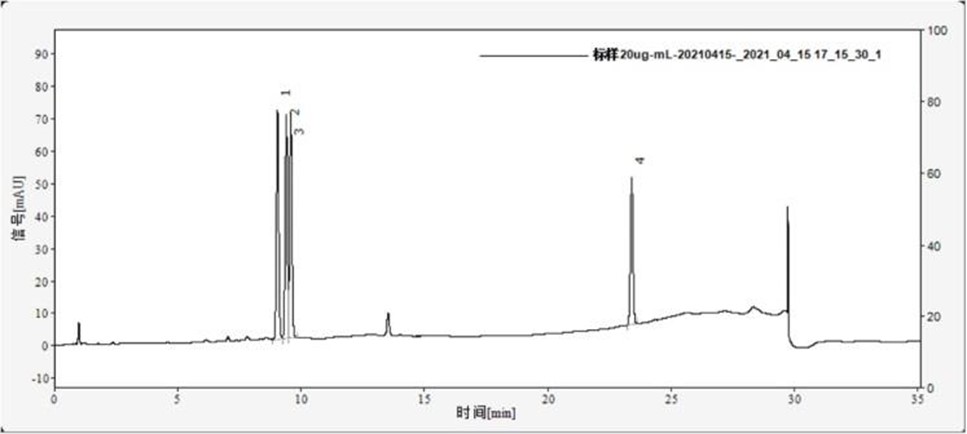
Figure 1. Chromatogram of four phthalate standard samples (Peak 1: BBP; Peak 2: DIBP; Peak 3: DBP; Peak 4: DEHP)
Linearity
Working standard solutions at concentrations of 1, 10, 20, 50, and 100 μg/mL were injected. Calibration curves were constructed by plotting peak area against concentration. Linear equations and correlation coefficients are shown in Table 1. All compounds show excellent linearity (R ≥ 0.9999) over the range of 1–100 μg/mL.
Table 1. Linear Equations
Detection and Quantification Limits
Based on signal-to-noise ratios (LOD at S/N = 3, LOQ at S/N = 10), the instrument and method detection limits were determined (Table 2). The method detection limits are below 8 mg/kg, far superior to the RoHS 2.0 limit of 0.1% (1000 mg/kg), demonstrating high sensitivity.
Table 2. Detection and Quantification Limits
Sample Analysis
A sample from an electronic product was analyzed following the described procedure. The chromatogram (Figure 2) and quantitative results (Table 3) show the presence of DIBP (125 mg/kg) and DEHP (4290 mg/kg), while BBP and DBP were not detected. The results confirm the applicability of the method for real samples.
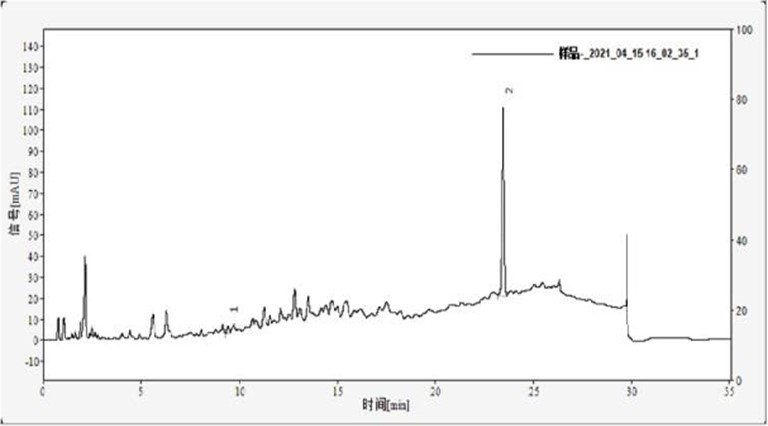
Figure 2. Chromatogram of a commercial electronic product (Peak 1: DIBP, Peak 2: DEHP)
Table 3. Analytical Results of a Positive Sample
Conclusion
The HPLC method established using the EClassical 3200 system and the dedicated phthalate column enables rapid and sensitive simultaneous determination of BBP, DIBP, DBP, and DEHP. This method complies with the requirements of GB 26572-2025 "Requirements for Restriction of Hazardous Substances in Electrical and Electronic Products" and the RoHS 2.0 standard, offering a reliable tool for compliance testing of electrical and electronic products.
II. Determination of Polybrominated Biphenyls (PBBs) and Polybrominated Diphenyl Ethers (PBDEs)
PBBs and PBDEs are widely used as flame retardants in electrical and electronic products, including circuit boards, cables, plastic casings, keyboards, and monitors. These compounds are persistent organic pollutants that can leach out during use or disposal, causing environmental contamination and potential health risks.
Chromatographic Conditions
Experimental Results
Mixed standard solutions of PBBs and PBDEs were analyzed under the above conditions. The chromatograms (Figures 3 and 4) show good separation of the individual congeners. PBB peaks corresponding to mono- to decabrominated biphenyls, and PBDE peaks corresponding to mono- to decabrominated diphenyl ethers, are well resolved.
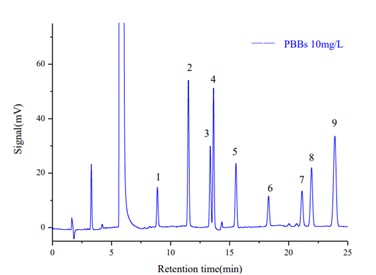
Figure 3. Chromatogram of PBBs standard (10 mg/L). Peaks: 1) 2-Bromobiphenyl, 2) 2,5-Dibromobiphenyl, 3) 2,4,6-Tribromobiphenyl, 4) 2,2',5,5'-Tetrabromobiphenyl, 5) 2,2',4,5',6-Pentabromobiphenyl, 6) 2,2',4,4',6,6'-Hexabromobiphenyl, 7) Octabromobiphenyl, 8) Nonabromobiphenyl, 9) Decabromobiphenyl
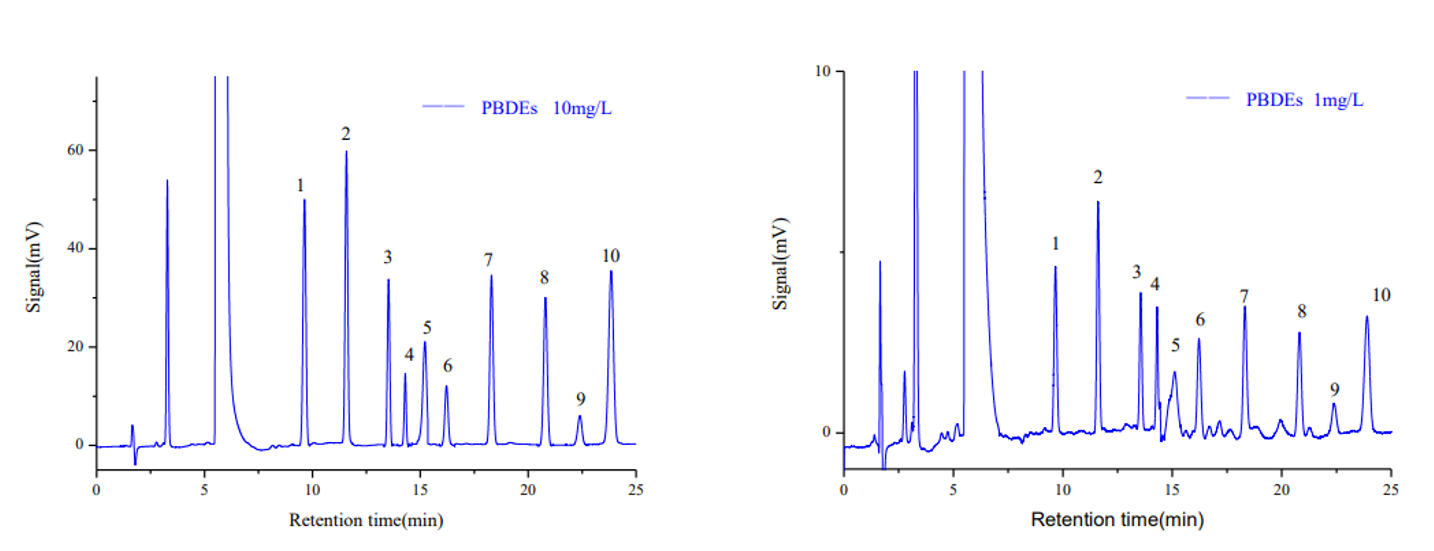
Figure 4. Chromatograms of PBDEs standard (10 mg/L and 1 mg/L). Peaks: 1) 4-Bromodiphenyl ether, 2) 4,4'-Dibromodiphenyl ether, 3) 3,3',4-Tribromodiphenyl ether, 4) 3,3',4,4'-Tetrabromodiphenyl ether, 5) 2,2',3,4,4'-Pentabromodiphenyl ether, 6) 2,2',3,3',4,4'-Hexabromodiphenyl ether, 7) 2,3,3',4,4',5,6-Heptabromodiphenyl ether, 8) 2,3,3',4,4',5,5',6-Octabromodiphenyl ether, 9) 2,2',3,3',4,4',5,6,6'-Nonabromodiphenyl ether, 10) Decabromodiphenyl ether
Sample Analysis
Wire samples from an electronic product were analyzed following the described procedure. Figure 5 demonstrates the presence of PBBs and PBDEs in the sample, confirming the applicability of the method for real samples.
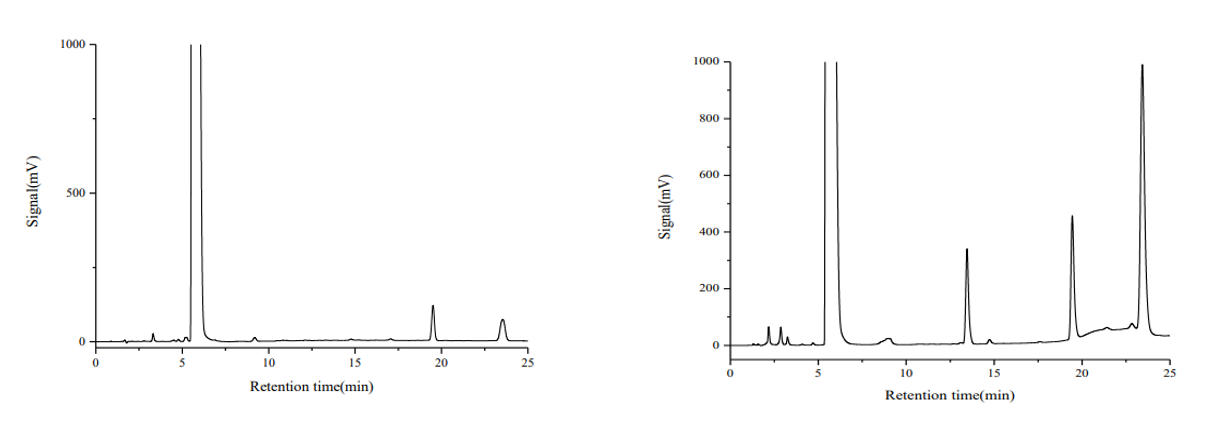
Figure 5. Chromatograms of PBBs (left) and PBDEs (right) in a wire sample
Conclusion
The promulgation of GB 26572-2025 imposes higher requirements on hazardous substance control across the electrical and electronic product supply chain. Leveraging over thirty years of accumulated liquid chromatography expertise, Elite Technology provides comprehensive solutions covering sample preparation, chromatographic analysis, hardware configuration, and software compliance, helping enterprises easily meet the challenges of the new national standard and safeguard green product compliance.