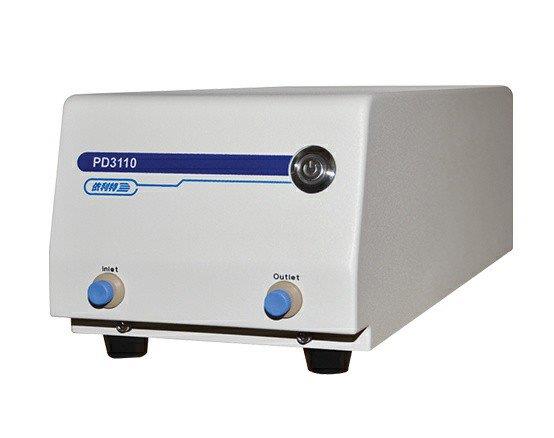

The PD3110 Photochemical Derivation system is a reagent-free, post-column derivatization device that uses 254 nm ultraviolet irradiation to enhance the fluorescence intensity of target analytes. It is specifically designed for the detection of aflatoxins (B1, G1) and sulfonamides and is officially included in the China Pharmacopoeia as a standard method. The system offers low operational cost, low toxicity, and excellent ease-of-use compared to traditional chemical derivatization, requiring no additional reagent pumps or mixing. Its compact design allows straightforward inline connection between any HPLC column and fluorescence detector.

| Parameter | Specification |
| UV Lamp Wavelength | 254 nm |
| Reaction Module Volume | 0.5 mL |
| Maximum Operating Pressure | 300 psi (2.0 MPa) |
| Power Supply | AC 220 V, 50 Hz |
| Power Consumption | 11 W |
| UV Lamp Lifetime | ≈ 4000 h |
| Wetted Materials | PEEK tubing, PEEK fingertight fittings |
The PD3110 Photochemical Derivation system is used for post-column fluorescence enhancement of aflatoxins B1 and G1 and other UV-responsive compounds. By exposing the column eluent to 254nm UV light inside a 0.5mL knitted reactor coil, it reverses the fluorescence quenching effect caused by aqueous mobile phases, enabling sensitive detection by a fluorescence detector. Typical performance improvements include ~7-fold increase in peak area/height for aflatoxin G1 and ~3.5-fold for aflatoxin B1. The device operates continuously without reagent consumption, making it an ideal solution for routine mycotoxin analysis in pharmaceutical, food, and environmental testing laboratories.