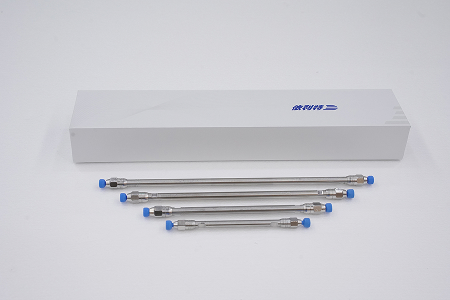
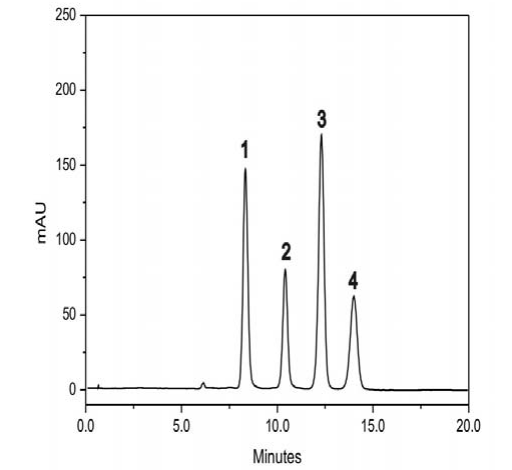
The Amber Sugar series of chromatographic columns is specially designed for the high-efficiency separation and preparation of water-soluble or partially water-soluble organic compounds, and is applicable to the separation of bio-organic small molecules in saccharides, organic acids, polypeptides and cellular metabolites.
Structural schematic diagram of
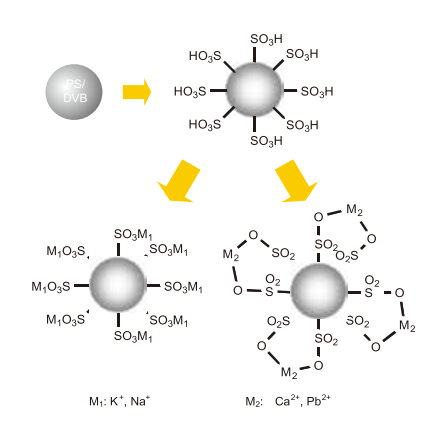
Various Ion Forms
The availability of multiple selectable ion forms for Amber Sugar resins enables the Amber Sugar series columns to be widely used for the separation of sugar molecules, sugar alcohols and other water-soluble substances in various matrices. For example, arabinose, ribitol and arabitol are difficult to separate on H-form columns, yet achieve baseline separation on Ca-form columns; xylose, galactose and mannose elute as an overlapping peak on Ca-form columns, while they can be eluted sequentially as individual peaks on Pb-form columns.
Table 1 Selection of Different Ion Forms
| Ion | application |
|---|
| H | Fermentation products, fruit juices containing organic acids, alcohols and saccharides |
| Ca | Saccharides in high-fructose corn syrup; especially suitable for the separation of monosaccharides, disaccharides, trisaccharides, tetrasaccharides and sugar alcohols |
| Pb | Pentoses and hexoses in wood products; dairy products containing sucrose, lactose, etc. |
| K | Sucrose, honey, corn syrup, beet sugar and other sugar-containing plant products. |
| Na | Oligosaccharides, especially in the presence of a high concentration of inorganic sodium ions (e.g., honey) |
Excellent Stability
The superior manufacturing process and advanced packing technology of Amber Sugar columns ensure their high stability. The resin remains stable in pure water and other aqueous buffer systems even under elevated temperature conditions.
Low Cross-Linking Degree
The low cross-linking degree of the resin in Amber Sugar chromatographic columns enables moderate swelling in the mobile phase—a typical mode for performing most separation tasks, especially under high-temperature conditions. Such swelling optimizes the specific surface area, permeability, capacity and selectivity during separation, and modulates the ionic strength. The lower the cross-linking degree of the PS/DVB particles, the more open the resin structure, thus ensuring excellent permeability even for high-molecular-weight polysaccharides.