HPLC Determination of Furfural in Transformer Oil
- Analyte: Furfural
- System: EClassical 3200 HPLC System with D3210 UV-Vis Detector
- Column: Supersil ODS2 (5 μm, 4.6 × 250 mm)
- Highlight: A sensitive and reliable HPLC method for furfural analysis in transformer oil, compliant with DL/T 1355-2014.
Introduction
Oil-immersed transformers are critical components in power grids, containing large amounts of insulating oil and paper. Over time, both the oil and paper degrade, reducing insulation effectiveness and affecting transformer safety and performance. While insulating oil can be replaced or regenerated during transformer service, the degradation of insulating paper is irreversible and serves as a key indicator for determining whether a transformer needs replacement. The paper insulation in power transformers is primarily composed of cellulose. When cellulose degrades, it produces D-glucose monomers, which further decompose under transformer operating conditions to form a series of oxygen-containing heterocyclic compounds dissolved in the transformer oil. Furfural is the main oxygen-containing heterocyclic compound generated from the degradation of cellulose macromolecules. Since new transformer oil contains no furfural and non-cellulosic insulating materials do not produce furfural upon aging, the presence of furfural in transformer oil is uniquely indicative of paper insulation aging. Therefore, determining furfural content in oil can effectively assess the aging status of paper insulation. This solution, based on the power industry standard DL/T 1355-2014, presents an HPLC method for the determination of furfural in transformer oil.
Standards and Reagents
Standard
Furfural standard (Purity ≥ 99%)
Reagents
Methanol (HPLC grade), Deionized water (18.2 MΩ·cm).
Furfural stock solution (1 mg/mL)
Accurately weigh 0.1042 g of furfural standard into a 100 mL volumetric flask. Dissolve in methanol and dilute to volume with methanol. Mix well.
Furfural working solutions
Pipette 200 μL of the stock solution into a 100 mL volumetric flask. Dilute to volume with methanol to obtain a 2 μg/mL solution.
From this 2 μg/mL solution, pipette 0.5 mL, 0.25 mL, 0.1 mL, and 0.05 mL into separate centrifuge tubes and dilute each to 1 mL with methanol to obtain concentrations of 1.0, 0.5, 0.2, and 0.1 μg/mL, respectively.
Sample Pretreatment
According to DL/T 1355-2014, transformer oil samples are subjected to appropriate extraction and purification procedures (e.g., liquid-liquid extraction or solid-phase extraction) and then diluted with methanol to a suitable concentration. The final solution is filtered through a 0.45 μm membrane before HPLC analysis.
Instruments and Equipment
HPLC System
EClassical 3200 configured withP3220 high-pressure pump, D3210 UV-Vis detector, S3210 autosampler, O3220 column oven, T3200 solvent bottle tray, Kromstation CDS
Pretreatment equipment
Solvent filtration apparatus, vacuum pump, ultrasonic cleaner, vortex mixer, analytical balance, etc.
Chromatographic Conditions
Column: Supersil ODS2 (5 μm, 4.6 × 250 mm)Column
Mobile phase: Methanol / Water = 50 / 50 (v/v)
Flow rate: 1.0 mL/min
Detection wavelength: 277 nm
Injection volume: 10 μL
Column temperature: 40°C
Experimental Discussion and Results
Typical Chromatogram
A 1.0 μg/mL furfural standard solution was analyzed under the above conditions. The chromatogram is shown in Figure 1. Chromatographic parameters are summarized in Table 1.The analysis is rapid and the column efficiency is satisfactory.
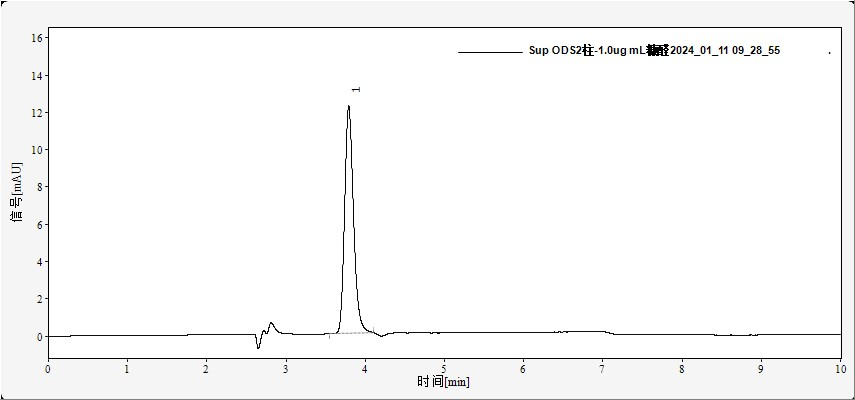
Figure 1. Typical chromatogram of furfural standard (1.0 μg/mL)
Table 1. Chromatographic parameters for furfural
| Peak No. |
Compound |
Retention Time (min) |
Peak Area (mAU·s) |
Plate Number (N) |
Asymmetry |
| 1 |
Furfural |
3.79 |
95.43 |
22740 |
1.34 |
Linearity
Furfural working solutions at concentrations of 0.1, 0.2, 0.5, 1.0, and 2.0 μg/mL were analyzed. The linear equation is Y = 97.0213X 0.2092, the correlation coefficient R=0.9998 . The calibration curve showed excellent linearity over the range of 0.1–2.0 μg/mL.
Detection Limit
Based on a signal-to-noise ratio of 3, the instrument detection limit is 5.45 ng/mL, and the method detection limit is calculated to be 0.68 ng/mL, which is better than the industry standard requirement of 0.001 mg/L.
A furfural solution at 4 ng/mL was injected to determine the detection limit. The chromatogram is shown in Figure 3, and the corresponding parameters are given in Table 2.
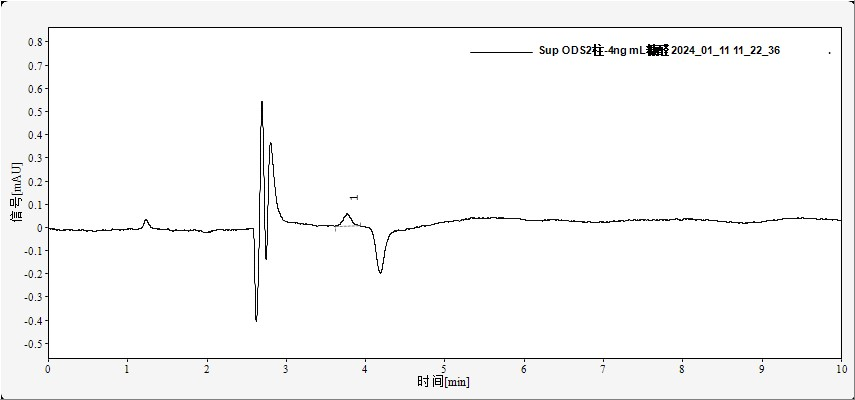
Figure 2. Chromatogram of furfural at 4 ng/mL (LOD)
Table 3. Detection limit data for furfural
| Peak No. |
Compound |
Retention Time (min) |
Peak Area (mAU·s) |
Plate Number (N) |
Asymmetry |
S/N |
| 1 |
Furfural |
3.76 |
0.39 |
25560 |
1.21 |
2.2 |
Conclusion
The proposed HPLC method using the EClassical 3200 system with a Supersil ODS2 column meets the requirements of the power industry standard DL/T 1355-2014 for the determination of furfural in transformer oil. It offers fast analysis, high sensitivity, and excellent linearity over the concentration range of 0.1–2.0 μg/mL, making it suitable for routine monitoring of paper insulation aging in transformers.