HPLC Determination of Echinacoside in Cistanche Herb
- Analyte: Echinacoside
- System: EClassical 3200 HPLC System with UV Detector
- Column: Hypersil ODS2 (5μm, 4.6×150 mm)
- Highlight: A reliable HPLC method for echinacoside analysis in cistanche with good separation and efficiency, meeting pharmacopoeial requirements.
Introduction
Echinacoside is a natural phenylethanoid glycoside widely present in Cistanche species, a traditional Chinese medicine known for its tonic and anti-aging properties. It exhibits various pharmacological activities including antioxidant, anti-inflammatory, neuroprotective, and hepatoprotective effects. According to the Chinese Pharmacopoeia, proper chromatographic separation and system suitability are essential for accurate quantification of echinacoside in Cistanche. This report presents an HPLC method for the determination of echinacoside in Cistanche herb, confirming that the peak meets pharmacopoeial requirements and is well separated from other components.
Standards and Reagents
Standards: Echinacoside (CAS 82854-37-3)
Reagents: deionized water (18.2 MΩ·cm), methanol (HPLC grade), formic acid (AR), other solvents and chemicals as required for sample pretreatment (e.g., extraction solvents, filtration membranes)
Reference solution: provided by the client (already prepared), filtered through a 0.45 μm membrane before injection.
Sample Preparation
Accurately weigh 1.0015 g of Cistanche powder into a 100 mL volumetric flask. Add 50 mL of methanol/water (1:1, v/v), soak for 30 min, and sonicate for 40 min. Mix well, allow to cool to room temperature, dilute to volume with the same solvent, and mix. Take the supernatant and filter through a 0.45 μm membrane.
Instruments and Equipment
HPLC System: EClassical 3200 equipped with quaternary pump, UV-vis detector, autosampler, column oven, solvent bottle tray, Kromstation CDS.
Pretreatment equipment: analytical balance (0.0001 g sensitivity), ultrasonic cleaner, centrifuge, solvent filtration apparatus, membrane filters, pipettes, etc.
Chromatographic Conditions
Column: Hypersil ODS2 (5μm, 4.6 × 150 mm)
Mobile Phase: A: Methanol; B: 0.1% formic acid aqueous solution, in gradient (Table 1).
Flow Rate: 1.0 mL/min
Detection: UV at 330 nm
Injection Vol.: 10 μL
Column Temp.: 30°C
Table 1. Gradient program
| Time (min) |
A% |
B% |
| 0 |
26.5 |
73.5 |
| 17 |
26.5 |
73.5 |
| 20 |
29.5 |
70.5 |
| 27 |
29.5 |
70.5 |
| 28 |
26.5 |
73.5 |
| 38 |
26.5 |
73.5 |
Experimental Results
Standard Separation
The reference solution was analyzed under the above conditions. Two main peaks were observed, echinacoside (peak 1) and verbascoside (peak 2). A representative chromatogram is shown in Figure 1, chromatographic parameters are summarized in Table 2.
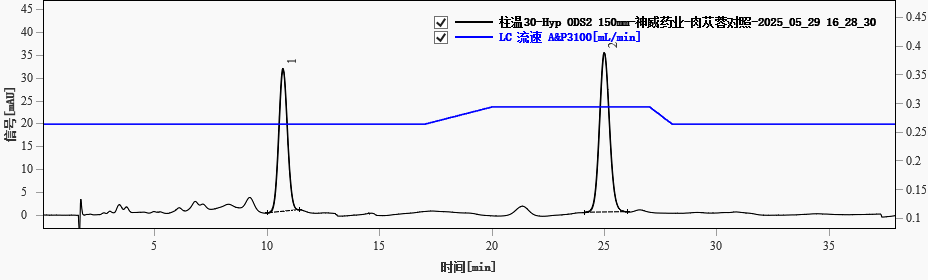
Fig. 1. Chromatogram of echinacoside reference solution. Peak 1-echinacoside 2-verbascoside
Table 2. Chromatographic parameters of echinacoside and verbascoside
| Peak |
Compound |
Retention Time (min) |
Peak Height (mAU) |
Peak Area (mAU·s) |
Asymmetry Factor |
Plate Number (N) |
Resolution |
| 1 |
Echinacoside |
10.712 |
31.318 |
843.863 |
1.076 |
3604 |
– |
| 2 |
Verbascoside |
25.007 |
34.973 |
1094.395 |
1.129 |
14933 |
18.662 |
System Suitability
According to the ChP, the theoretical plate number for the echinacoside peak should not be less than 3000. Both the reference and sample peaks (3604 N and 3596 N, respectively) meet this requirement. The resolution between echinacoside and verbascoside is excellent (>18), confirming good separation.
Sample Analysis
The Cistanche sample was analyzed under the same conditions. The echinacoside peak eluted at approximately 10.638 min, with good peak shape and separation from other components (Figure 2). Chromatographic parameters are given in Table 3.
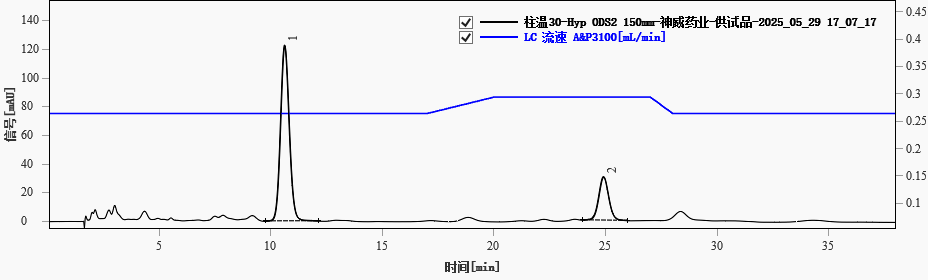
Fig. 2. Chromatogram of a Cistanche sample, Peak 1-echinacoside 2-verbascoside
Table 3. Chromatographic parameters of echinacoside in Cistanche sample
| Peak |
Compound |
Retention Time (min) |
Peak Height (mAU) |
Peak Area (mAU·s) |
Asymmetry Factor |
Plate Number (N) |
Resolution |
| 1 |
Echinacoside |
10.638 |
122.314 |
3339.762 |
1.179 |
3596 |
– |
| 2 |
Verbascoside |
24.931 |
30.182 |
939.398 |
1.124 |
15315 |
18.870 |