HPLC Determination of Aromatic Hydrocarbon in Middle Distillates
- Analyte: Mono-aromatic hydrocarbons, Di-aromatic hydrocarbons (PAHs)
- System: EClassical 3200 HPLC System with RI-201H Refractive Index Detector (RID)
- Column: EliteUQ D-AH Diesel Aromatic Hydrocarbon Analysis Dedicated Column (4.6 × 250 mm)
- Highlight: A dedicated HPLC-RID system for accurate determination of mono- and di-aromatic hydrocarbons in diesel, compliant with NB/SH/T 0806-2022.
Introduction
Polycyclic aromatic hydrocarbons (PAHs) are compounds containing two or more fused benzene rings. They originate from both natural sources and human activities, primarily the incomplete combustion of fossil fuels such as coal, oil, and natural gas. PAHs are of significant concern due to their toxicity, mutagenicity, and carcinogenicity, posing risks to human health including damage to the respiratory, circulatory, and nervous systems, as well as the liver and kidneys. Therefore, accurate determination of aromatic hydrocarbon content in middle distillates like diesel is essential. This solution presents a dedicated HPLC-RID system using the EliteUQ D-AH column, following the NB/SH/T 0806-2022 standard, for reliable analysis of aromatic hydrocarbons in petroleum fractions.
Standards and Reagents
Solvents:n-Heptane (HPLC grade), Cyclohexane (purity >99%),
Standard compounds: o-Xylene (purity>98%), 1-Methylnaphthalene (purity>98%), Dibenzothiophene (purity>95%), 9-Methylanthracene (purity>95%), Dodecylbenzene (purity>98%), Phenanthrene (purity>98%), Hexamethylbenzene (purity>98%), Naphthalene (purity>98%).
Other materials: Volumetric flasks (100 mL), disposable pipettes, 0.45 μm PTFE membrane filters, etc.
Standard Solution Preparation
SPS System Performance Verification Standard Solution
Prepare according to Table 1. Accurately weigh the specified amounts of each compound into a 100 mL volumetric flask, dissolve and dilute to volume with n-heptane.
Table 1. Preparation of SPS System Performance Verification Standard Solution
| No. |
Compound Name |
Weighed Mass (g) |
Solvent (n-Heptane, mL) |
Concentration (mg/mL) |
| 1 |
Cyclohexane |
1.0 ± 0.1 |
100 |
10 |
| 2 |
o-Xylene |
0.5 ± 0.05 |
100 |
5 |
| 3 |
Dibenzothiophene |
0.05 ± 0.005 |
100 |
0.5 |
| 4 |
9-Methylanthracene |
0.05 ± 0.005 |
100 |
0.5 |
| 5 |
Dodecylbenzene |
0.1±0.01 |
100 |
1 |
| 6 |
Hexamethylbenzene |
0.1±0.01 |
100 |
1 |
| 7 |
Naphthalene |
0.1±0.01 |
100 |
1 |
*Note: Accurately weigh the specified amounts into a 100 mL volumetric flask, dissolve and dilute to volume with n-heptane.*
DAH Calibration Standard SolutionsPrepare four calibration standards (A, B, C, D) according to Table 2. Accurately weigh the specified amounts of cyclohexane, o-xylene, 1-methylnaphthalene, and phenanthrene into separate 100 mL volumetric flasks, dissolve and dilute to volume with n-heptane.
Table 3-2. Preparation of DAH Calibration Standard Solutions
| Standard Solution |
Cyclohexane (g) |
o-Xylene (g) |
1-Methylnaphthalene (g) |
Phenanthrene (g) |
| A |
5.0 |
4.0 |
4.0 |
0.4 |
| B |
2.0 |
1.0 |
1.0 |
0.2 |
| C |
0.5 |
0.25 |
0.25 |
0.05 |
| D |
0.1 |
0.05 |
0.02 |
0.01 |
*Note: Accurately weigh the specified amounts of each compound into separate 100 mL volumetric flasks, dissolve and dilute to volume with n-heptane. These solutions are used for calibration of mono- and di-aromatic hydrocarbons.*
All standard solutions should be stored in sealed containers and protected from light.
Sample Pretreatment
Accurately weigh approximately 1.0 g of diesel sample into a 10 mL volumetric flask. Dilute to volume with n-heptane to obtain a sample concentration of 100 mg/mL. Filter through a 0.45 μm PTFE membrane filter before HPLC analysis.
Instruments and Equipment
HPLC System: EClassical 3200 configured with P3220 binary high-pressure pump, S3210 autosampler, T3200 solvent bottle tray, O3230L column oven, RI-201H refractive index detector, Kromstation CDS.
Column: EliteUQ D-AH Diesel Aromatic Hydrocarbon Analysis Dedicated Column (4.6 × 250 mm)
Additional components: column oven switching kit (2D), degassing kit, System tool kit.
Pretreatment equipment: Analytical balance, ultrasonic bath, volumetric flasks, membrane filters, etc.
Chromatographic Conditions
Column: EliteUQ D-AH Diesel Aromatic Hydrocarbon Analysis Dedicated Column (4.6 × 250 mm)
Mobile phase: n-Heptane
Flow rate: 1.0 mL/min
Detection: Refractive Index (RID)
Injection Volume: 20 μL
Column temp.: 30°C
Experimental Discussion and Results
SPS System Performance Verification
After system equilibration, 20 μL of the SPS system performance verification standard solution was injected. As shown in Figure 1 and Table 3, all seven compounds were baseline separated with good peak shapes.
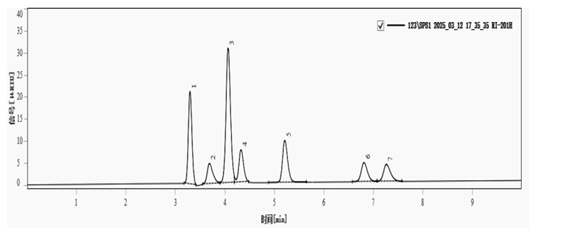
Fig.1. SPS standard solution separation chromatogram. Peak 1~7, cyclohexane, dodecylbenzene, o-xylene, hexamethylbenzene, naphthalene, dibenzothiophene, and 9-methylanthracene
Table 3. SPS System Performance Verification Chromatographic Parameters
| Peak |
Compound |
Retention Time (min) |
Peak Height (mAU) |
Peak Width at Half (min) |
Peak Area (μRID·s) |
Asymmetry (As) |
Plate Number (N/m) |
Resolution (Rs) |
| 1 |
Cyclohexane |
3.292 |
20.932 |
0.075 |
107.249 |
1.428 |
42684 |
0.000 |
| 2 |
Dodecylbenzene |
3.683 |
4.563 |
0.125 |
36.639 |
1.800 |
19240 |
2.305 |
| 3 |
o-Xylene |
4.058 |
30.492 |
0.100 |
196.058 |
1.445 |
36496 |
1.962 |
| 4 |
Hexamethylbenzene |
4.325 |
7.269 |
0.100 |
49.139 |
0.750 |
41452 |
1.570 |
| 5 |
Naphthalene |
5.208 |
9.481 |
0.108 |
69.588 |
1.400 |
51216 |
4.991 |
| 6 |
Dibenzothiophene |
6.808 |
4.276 |
0.133 |
37.484 |
1.308 |
57784 |
7.794 |
| 7 |
9-Methylanthracene |
7.258 |
3.814 |
0.150 |
37.489 |
1.615 |
51888 |
1.870 |
The performance verification met all requirements of NB/SH/T 0806-2022: All resolution values > 1.5;resolution between cyclohexane and o-xylene calculated as 5.153 (requirement ≥ 5.0); backflush time (B) calculated as 6.988 min based on dibenzothiophene and 9-methylanthracene retention times; baseline drift < 0.5% (actual 0.006%).
Backflush Application
With the backflush valve activated, the chromatogram of the SPS standard solution showed elution of tri-aromatics as sharp peaks, as shown in Figure 2. The backflush time was set at 6.988 min based on the previous calculation.
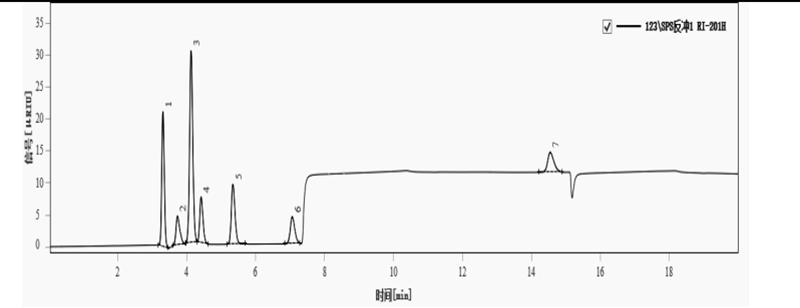
Fig.2. Chromatogram of system performance validation standard solution (valve backwash). Peak 1~7, cyclohexane, dodecylbenzene, o-xylene, hexamethylbenzene, naphthalene, dibenzothiophene, and 9-methylanthracene
Calibration Curves
The DAH calibration standards (A, B, C, D) were injected in order of increasing concentration. Calibration curves for key aromatic compounds showed excellent linearity (Table 4). All correlation coefficients were greater than 0.999, indicating excellent linearity over the calibration range.
Table 4. Calibration curves for key aromatic compounds
| Compound |
Linear Equation |
Correlation Coefficient (r) |
| o-Xylene |
y = 70.6405x - 16.0207 |
0.9999 |
| 1-Methylnaphthalene |
y = 132.050x + 29.5339 |
0.9998 |
| Phenanthrene |
y = 164.561x + 913.042 |
0.9993 |
Diesel Sample Analysis
The prepared diesel sample (100 mg/mL) was analyzed under the same conditions. Chromatograms are shown in Figures 3. Quantitative results are summarized in Table 5.
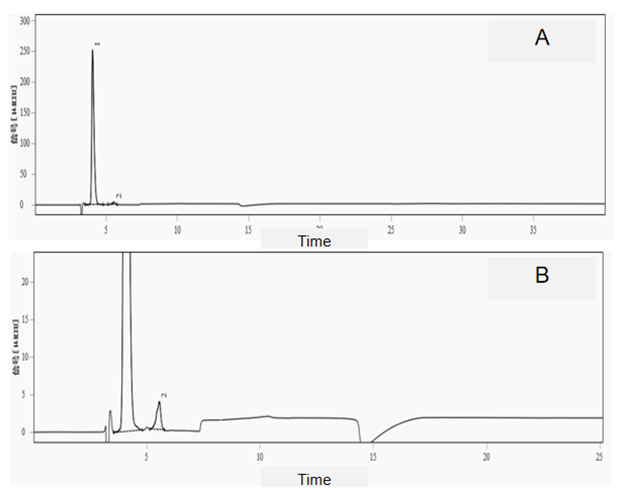
Fig.3. Chromatogram (A) and enlarged chromatogram (B) of the prepared diesel sample
Table 5. Diesel Sample Chromatographic Parameters and Results
| Peak |
Compound Type |
Retention Time (min) |
Peak Height (mAU) |
Peak Area (μRID·s) |
Content (mg/mL) |
Asymmetry (As) |
Plate Number (N/m) |
Resolution (Rs) |
| 1 |
Mono-aromatics |
4.050 |
251.610 |
2766.115 |
35.857 |
2.454 |
145000 |
0.000 |
| 2 |
Di-aromatics |
5.567 |
3.723 |
48.252 |
0.266 |
0.516 |
17168 |
4.982 |
According to NB/SH/T 0806-2022, the mono-aromatic hydrocarbon content was calculated as 35.86% (within the standard requirement of 4%–40%), and the di-aromatic hydrocarbon content was 0.266% (within the requirement of 0–20%). Both results comply with the standard specifications.
Conclusion
The constructed HPLC-RID system, equipped with the EliteUQ D-AH dedicated column, fully meets the requirements of NB/SH/T 0806-2022 for the determination of aromatic hydrocarbons in diesel. The system demonstrates excellent resolution, linearity, and reproducibility, making it suitable for routine quality control and regulatory compliance testing of middle distillates.