Organophosphate flame retardants (OPFRs) are widely used in plastics and textiles, but they can leach into the environment and pose health risks due to their toxicity and persistence. This method, developed following GB/T 24279.2-2021 and SN/T 3787-2014, employs LC-MS/MS for the determination of tris(2-chloroethyl) phosphate (TCEP) and tri-o-cresyl phosphate (TOCP) in textile samples.
Standards
TCEP and TOCP standards, Purity ≥ 98%.
Reagents
Acetone, analytical grade; Acetonitrile, HPLC grade; Deionized Water, ≥ 18.2 MΩ·cm).
Other materials
Glass reaction vials, rotary evaporator, syringe filters (0.22 μm), etc.
Standard Solution Preparation
Stock solutions: Prepare individual stock solutions of TCEP and TOCP at 1000 μg/mL in acetonitrile.
Mixed working solutions: Dilute the stock solutions with acetonitrile to obtain desired calibration concentrations (e.g., 1–100 ng/mL).
According to GB/T 24279.2-2021:
- Cut the textile sample into small pieces (approximately 5 mm × 5 mm) and homogenize.
- Accurately weigh about 1 g (to 0.01 g) into a 40 mL glass vial with a screw cap.
- Add 20 mL of acetone and sonicate at approximately 40°C for 40 min.
- Transfer the extract to a 100 mL concentration flask. Add another 20 mL of acetone to the residue and sonicate for an additional 20 min.
- Combine the two extracts and concentrate to near dryness using a rotary evaporator.
- Dissolve the residue in 2.0 mL of acetonitrile, vortex, and filter through a 0.22 μm syringe filter. The filtrate is ready for LC-MS/MS analysis.
LC System
EClassical 3200L HPLC system equipped with a binary pump, autosampler, and column oven..
Mass Spectrometer
MS²Vertical 9100 triple quadrupole mass spectrometer with ESI source.
Column: Supersil ODS2 (2.1 × 100 mm, 3 μm).
Mobile phase: A: 5 mM ammonium acetate); B: Acetonitrile, in gradient
Flow rate: 0.3 mL/min
Column temp.: 40°C
Injection volume: 3 μL
Table 1. Gradient program
Mass Spectrometry Conditions
Ionization mode: ESI positive (ESI+)
Spray voltage: 4800 V
Ion source temp.:300°C
Curtain gas: 20 psi (N₂)
Nebulizer gas: 20 psi (N₂)
MRM parameters:
Typical Chromatograms
The MRM chromatograms of TCEP and TOCP at 100 ng/mL are shown in Figure 1. Both compounds exhibit symmetrical peaks with good sensitivity and sufficient data points for accurate quantification.
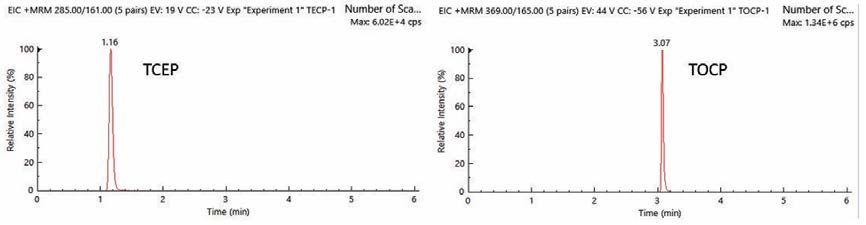
Figure 1. MRM chromatograms of TCEP and TOCP at 100 ng/mL
Linearity and Sensitivity
Calibration curves prepared over the range of 1–100 ng/mL show excellent linearity with correlation coefficients > 0.999. The method achieves detection limits below the regulatory requirements.
The LC-MS/MS method using the EClassical 3200 and MS²Vertical 9100 system provides a rapid, sensitive, and reliable approach for the determination of TCEP and TOCP in textile samples, meeting the requirements of relevant standards.