Minoxidil is a potassium channel opener primarily used to treat hypertension and, more commonly, to stimulate hair growth. It is often added to hair care products such as shampoos, creams, and lotions. However, excessive use can lead to systemic side effects, including hypertrichosis, and it is therefore strictly regulated. In China, minoxidil is listed as a prohibited substance in cosmetics under the Safety and Technical Standards for Cosmetics. The national standard GB/T 35837-2018 specifies an HPLC method for its determination. This article presents a complete HPLC solution using Elite's instruments, suitable for the analysis of minoxidil in various cosmetic matrices.
Standard: minoxidil (purity≥99%)
Other reagents: methanol (HPLC grade), trifluoroacetic acid (TFA, Analytical grade), deionized water (18.2 MΩ·cm), sodium chloride (analytical grade), other solvents and chemicals as required for sample pretreatment (e.g., extraction solvents, filtration membranes)
Stock solution (100 mg/L): Accurately weigh 10 mg (to 0.0001 g) of minoxidil, dissolve in 70% methanol (methanol/water = 70/30, v/v), and dilute to 100 mL in a volumetric flask. Store at 4°C.
Working standard solutions: Dilute the stock solution with 70% methanol to obtain concentrations of 0.5, 1.0, 5.0, 10.0, and 20.0 mg/L. Prepare fresh as needed.
HPLC System: EClassical 3200L equipped with quaternary pump, UV-vis detector, autosampler, column oven, solvent bottle tray, Kromstation CDS.
Pretreatment equipment: analytical balance (0.0001 g sensitivity), ultrasonic cleaner, centrifuge, solvent filtration apparatus, membrane filters, pipettes, etc.
Column: Supersil ODS2 (5 μm, 4.6 × 250 mm)
Mobile Phase: Methanol / 0.3% trifluoroacetic acid in water = 45 : 55 (v/v)
Flow Rate: 1.0 mL/min
Detection: UV at 230 nm
Injection Vol.: 10 μL
Column Temp.: 30°C
Standard Separation
A typical chromatogram of a 20.0 mg/L minoxidil standard is shown in Figure 1-2 (refer to original document). The retention time is approximately 6.26 min, with an asymmetry factor of 1.13 and a theoretical plate number of 38,100 N/m, indicating good peak shape and column efficiency.
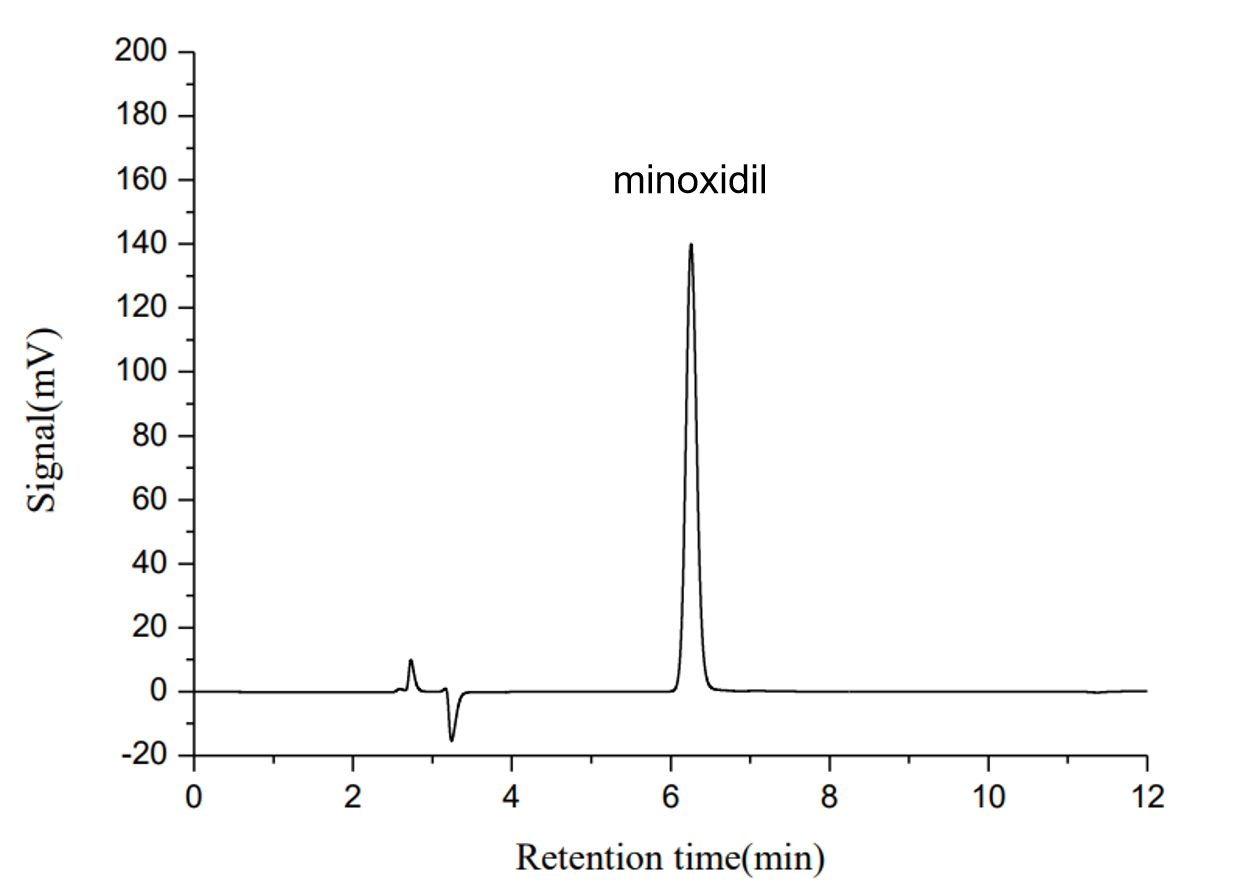
Fig. 1. Chromatogram of minoxidil standard (20 mg/L each)
Method Performance
Linearity and Detection Limit
Linearity: Calibration curves were constructed using working standard solutions at 0.5, 1.0, 5.0, 10.0, and 20.0 mg/L. The linear regression equation isY=67.8177x+2.1842, R=0.9998, demonstrating excellent linearity over the range of 0.5–20 mg/L.
Detection Limit (LOD) and Quantification Limit (LOQ): Based on a signal-to-noise ratio of 3, the method LOD is 0.26 mg/kg (0.26 μg/g), which is significantly lower than the requirement of GB/T 35837-2018 (5 mg/kg).At S/N = 10, the LOQ is 0.86 mg/kg, also well below the national standard limit.
Method Accuracy and Precision
Recovery and repeatability were evaluated by spiking a blank shampoo sample at three concentration levels (0.5, 5.0, and 20.0 mg/L). The results are summarized in Table 1. The recoveries ranged from 88.4% to 102.7%, and RSD values were below 5%, confirming good accuracy and precision.
Table 1. Method recovery and repeatability
Sample Analysis
A commercial shampoo sample was analyzed under the same conditions. No minoxidil was detected (Figure 1-3 and Table 1-8 in the original document), indicating compliance with regulatory requirements.