Determination of Glyphosate by HPLC with UV Detection
- Analyte: Glyphosate
- System: EClassical 3200 HPLC System with UV-vis Detector
- Column: Supersil SAX or Hypersil SAX (5 μm, 4.6 × 250 mm)
- Highlight: Simple and effective HPLC method for glyphosate determination with good separation from impurities.
Introduction
Glyphosate is a non-selective, non-residual herbicide widely used in agriculture for control of perennial weeds in rubber, tea, fruit, and sugarcane plantations. Its determination in pesticide formulations is essential for quality control. This solution presents an ion-exchange HPLC method with UV detection for glyphosate analysis using Supersil SAX or Hypersil SAX columns.
Standards and Reagents
Standard and Reagents
Glyphosate(High purity reference standard), Potassium dihydrogen phosphate (analytical grade), Phosphoric acid (for pH adjustment), Deionized Water (18.2 MΩ·cm)
Standard Solution Preparation
Glyphosate stock solution: Accurately weigh an appropriate amount of glyphosate standard, dissolve in mobile phase, and dilute to a known concentration (e.g., 1000 mg/L).
Working standard solutions: Dilute the stock solution with mobile phase to obtain desired concentrations for calibration.
Sample Pretreatment
For pesticide formulation samples, dissolve an appropriate amount in mobile phase, dilute to volume, and filter through a 0.45 μm membrane before injection. For residue analysis, appropriate extraction and cleanup procedures should be applied.
Instruments and Equipment
HPLC System
EClassical 3100 system configured with P3100 high-pressure pump, UV3100 UV-Vis detector, S3100 autosampler (or Rheodyne 7725i manual injector), O3100 column oven, Chromatography data station
Pretreatment equipment
Analytical balance, ultrasonic bath, membrane filters, etc.
Chromatographic Conditions
Column: Supersil SAX (5 μm, 4.6 × 250 mm) or Hypersil SAX (5 μm, 4.6 × 250 mm)
Mobile phase: 9 g/L potassium dihydrogen phosphate solution, pH adjusted to 2.1 with phosphoric acid
Flow rate: 1.0 mL/min
Detection wavelength: 195 nm
Injection volume: 10 μL
Column temperature: Ambient
Experimental Discussion and Results
Typical Chromatograms
Glyphosate was analyzed using both Supersil SAX and Hypersil SAX columns under the same conditions. The chromatograms (Figures 1) show good peak shape and baseline separation of glyphosate from any impurities present in the standard solution. Both columns provide satisfactory performance for glyphosate analysis. The strong anion-exchange (SAX) chemistry is well-suited for the ionic nature of glyphosate under acidic mobile phase conditions.
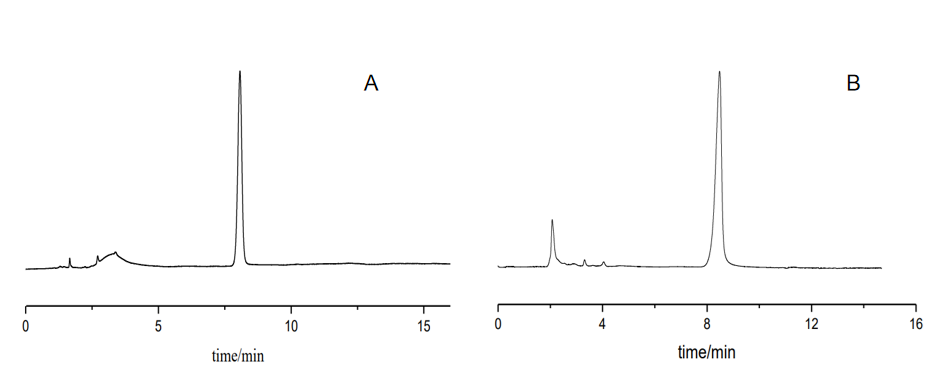
Figure 4: Glyphosate chromatograms
(A) Supersil SAX (5 μm, 4.6 × 250 mm) column and (B) Hypersil SAX (5 μm, 4.6 × 250 mm) column
Conclusion
The ion-exchange HPLC method using Supersil SAX or Hypersil SAX columns provides simple and effective determination of glyphosate. Both columns offer good peak shape and separation from impurities, making them suitable for quality control of glyphosate formulations.