Determination of Four Phthalate Esters (BBP, DIBP, DBP, DEHP) by HPLC
- Analyte: BBP, DIBP, DBP, DEHP
- System: EClassical 3200 HPLC System with UV3210 Detector
- Column: EliteROHS Phthalate Esters Analysis Dedicated Column
- Highlight: A rapid and sensitive HPLC method for simultaneous determination of four phthalate esters compliant with RoHS 2.0 requirements.
Introduction
Phthalate esters (PAEs) are widely used as plasticizers to impart flexibility to polymers such as PVC. They are commonly found in toys, food packaging materials, medical devices, personal care products, and electronic equipment. Due to their ability to migrate from products into the environment and the human body, phthalates can act as endocrine disruptors, posing health risks. The European RoHS 2.0 Directive (2011/65/EU) restricts the use of four phthalates: bis(2-ethylhexyl) phthalate (DEHP), dibutyl phthalate (DBP), benzyl butyl phthalate (BBP), and diisobutyl phthalate (DIBP), with a maximum concentration limit of 0.1% in homogeneous materials. This regulation has been effective since July 22, 2019. In China, the group standard T/CESA 1063–2019 specifies an HPLC method for the determination of these four phthalates in electrical and electronic products. This solution presents an HPLC method using the EClassical 3200 system with a dedicated column for simultaneous determination of BBP, DIBP, DBP, and DEHP, meeting the requirements of RoHS 2.0 and relevant standards.
Standards and Reagents
Standards
BBP, DIBP, DBP, DEHP (purity ≥ 99%)
Reagents
Acetonitrile (HPLC grade), Ethyl acetate (analytical grade, for sample preparation), Deionized water (18.2 MΩ·cm)
Other materials
Volumetric flasks (1, 5, 10, 100 mL), 50 mL stoppered tubes, pipettes, PTFE membrane filters (0.45 μm), etc.
Standard Solution Preparation
Mixed stock solution (2000 μg/mL each): Accurately weigh 50 mg each of BBP, DIBP, DBP, and DEHP into a 25 mL volumetric flask. Dissolve and dilute to volume with acetonitrile. Mix well.
Working standard solutions: Dilute the stock solution with acetonitrile to obtain concentrations of 1, 10, 20, 50, and 100 μg/mL. Prepare fresh as needed.
Sample Pretreatment
- Cut the sample into small pieces (≤1 mm particles).
- Accurately weigh about 1.0000 g of the prepared sample into a 50 mL stoppered tube.
- Add 30 mL of acetonitrile and sonicate for 70 min.
- Cool to room temperature, filter the extract into a 100 mL volumetric flask.
- Wash the tube and residue several times with acetonitrile, combining the washings into the same flask. Dilute to volume with acetonitrile.
Filter an aliquot through a 0.45 μm PTFE membrane filter before HPLC analysis.
Instruments and Equipment
HPLC System:EClassical 3200 configured with P3220 high-pressure pump, UV3210 UV-Vis detector, O3220 column oven, Rheodyne 7725 manual injector (or S3210 autosampler optional), Chromatography data station, TP3200 solvent tray
Pretreatment equipment: Analytical balance, ultrasonic cleaner, solvent filtration apparatus, vacuum pump, etc.
Chromatographic Conditions
Column:EliteROHS Phthalate Esters Analysis Dedicated Column
Mobile phase: A: Acetonitrile (containing 1% water); B: Water, in gradient (Table 1)
Table 1. Gradient program
| Time (min) |
A% |
B% |
| 0 |
58 |
42 |
| 3 |
58 |
42 |
| 8 |
83 |
17 |
| 16 |
83 |
17 |
| 22 |
100 |
0 |
| 26 |
100 |
0 |
| 26.1 |
58 |
42 |
Flow rate: 2.0 mL/min
Detection wavelength: 225 nm
Injection volume: 20 μL
Column temperature: 35°C
Experimental Discussion and Results
Typical Chromatogram
A mixed standard solution at 20 μg/mL was analyzed under the above conditions. The chromatogram (Figure 1) shows baseline separation of the four phthalates. Chromatographic parameters are summarized in Table 2.
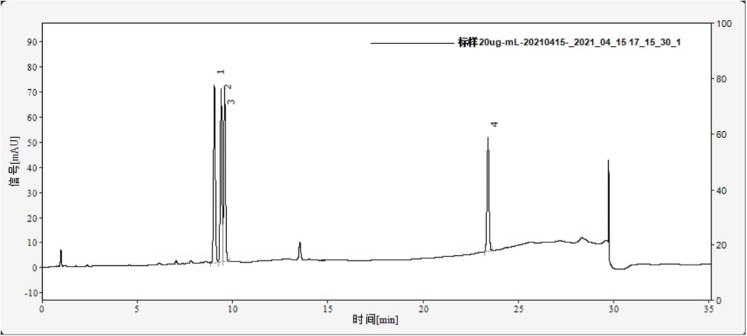
Figure 1. chromatogram of four phthalate standard samples
Table 2. Chromatographic parameters of four phthalate esters
| Peak |
Compound |
Concentration (μg/mL) |
Retention Time (min) |
Peak Area (mV·s) |
Resolution |
| 1 |
BBP |
20 |
9.04 |
453.58 |
– |
| 2 |
DIBP |
20 |
9.40 |
336.99 |
2.20 |
| 3 |
DBP |
20 |
9.58 |
303.79 |
1.20 |
| 4 |
DEHP |
20 |
23.41 |
271.01 |
55.45 |
Linearity
Working standard solutions at concentrations of 1, 10, 20, 50, and 100 μg/mL were injected. Calibration curves were constructed by plotting peak area against concentration. Linear equations and correlation coefficients are given in Table 3. All compounds show excellent linearity (R ≥ 0.9999) over the range of 1–100 μg/mL.
Table 3. Linear equations
| Compound |
Linear Equation |
Correlation Coefficient (R) |
| BBP |
y = 18.25x – 6.25 |
1.0000 |
| DIBP |
y = 18.05x – 6.94 |
1.0000 |
| DBP |
y = 17.44x – 7.24 |
0.9999 |
| DEHP |
y = 12.76x – 2.37 |
1.0000 |
Detection and Quantification Limits
Based on signal-to-noise ratios (S/N = 3 for LOD, S/N = 10 for LOQ), the instrument and method detection limits were determined (Table 4). The method detection limits are below 8 mg/kg, which is well within the RoHS 2.0 requirement of 0.1% (1000 mg/kg), demonstrating high sensitivity.
Table 4. Detection and quantification limits
| Compound |
Instrument LOD (μg/mL) |
Instrument LOQ (μg/mL) |
Method LOD (mg/kg) |
Method LOQ (mg/kg) |
| BBP |
0.02 |
0.07 |
2.0 |
6.7 |
| DIBP |
0.02 |
0.07 |
2.0 |
6.7 |
| DBP |
0.02 |
0.07 |
2.0 |
6.7 |
| DEHP |
0.03 |
0.12 |
3.0 |
10.0 |
Sample Analysis
A sample from an electronic product was analyzed following the described procedure. The chromatogram (Figure 2) and quantitative results (Table 5) show the presence of DIBP (125 mg/kg) and DEHP (4290 mg/kg), while BBP and DBP were not detected. The results confirm the applicability of the method for real samples.
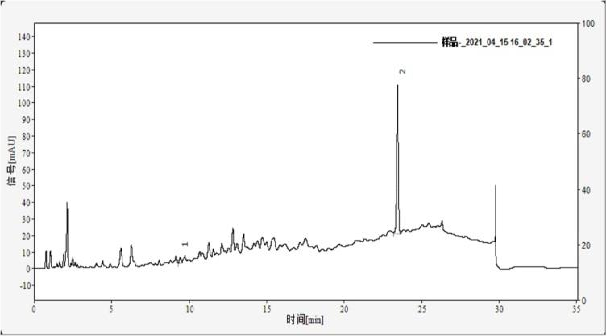
Figure 2. chromatogram of acommercial electronic products. Peak 1-DIBP, 2-DEHP
Table 5. Analytical results of a positive sample
| Compound |
Content (mg/kg) |
Retention Time (min) |
Peak Area (mV·s) |
| DIBP |
125 |
9.39 |
21.05 |
| DEHP |
4290 |
23.43 |
666.76 |
Conclusion
The proposed HPLC method using the EClassical 3200 system with a dedicated phthalate column achieves rapid and sensitive simultaneous determination of BBP, DIBP, DBP, and DEHP. It meets the requirements of RoHS 2.0 and relevant standards, offering a reliable tool for compliance testing in electrical and electronic products.