Determination of Formaldehyde in Leather and Textiles for Automotive Interiors by HPLC
- Analyte: Formaldehyde
- System: Agress 1100 HPLC System with UV Detector
- Column: SinoPak C18 (5 μm, 4.6 × 150 mm)
- Highlight: Sensitive and reliable HPLC method for formaldehyde determination in leather and textiles, compliant with GB/T 19941.1-2019 and GB/T 2912.3-2009.
Introduction
Formaldehyde is widely used in industrial processes and can be present in automotive interior materials such as leather seats and textiles. Exposure to formaldehyde can cause irritation to the skin, eyes, and respiratory tract, and is a known human carcinogen. Chinese standards regulate formaldehyde emissions in vehicles (GB/T 27630-2011) and specify test methods for leather and textiles (GB/T 19941.1-2019, GB/T 2912.3-2009). This solution presents an HPLC method for the determination of formaldehyde after derivatization with 2,4-dinitrophenylhydrazine (DNPH), suitable for quality control of automotive interior materials.
Standards and Reagents
Standards
Formaldehyde solution (37%, by mass), 2,4-Dinitrophenylhydrazine (DNPH, Analytical grade)
Reagents
Sodium dodecyl sulfate (SDS, analytical grade), Phosphoric acid (analytical grade), Acetonitrile (HPLC grade), deionized water (18.2 MΩ·cm)
Other materials
Volumetric flasks (500 mL, 1000 mL), stoppered conical flasks (250 mL), glass fiber filters, 0.45 μm polyamide membrane filters, etc.
Standard Solution Preparation
Formaldehyde stock solution: Pipette 5.0 mL of the 37% formaldehyde solution into a 1000 mL volumetric flask containing about 100 mL of distilled water. Dilute to volume with distilled water. Determine the exact concentration by titration or use a certified value.
Formaldehyde standard solution: Pipette 0.5 mL of the accurately known stock solution into a 500 mL volumetric flask containing about 100 mL of distilled water. Shake well and dilute to volume with distilled water. This working standard is used for calibration.
Sample Pretreatment
Extraction
Accurately weigh about 2 g (to 0.0001 g) of the leather or textile sample into a 250 mL stoppered conical flask. Add 50 mL of SDS solution preheated to 40°C. Close the flask and shake gently in a water bath at 40 ± 0.5°C for 60 ± 2 min. Immediately filter the warm extract through a glass fiber filter into a clean conical flask. Allow the filtrate to cool to room temperature.
Derivatization
Pipette 4 mL of acetonitrile, 5 mL of the filtered extract, and 0.5 mL of DNPH solution into a 10 mL volumetric flask. Dilute to volume with water and shake thoroughly. Let stand for 60 min (but not exceeding 180 min). Filter the derivatized solution through a 0.45 μm membrane filter before HPLC injection.
Instruments and Equipment
HPLC System
Agress 1100 configured with P1100 high-pressure pump, D1100 UV-Vis detector, Rheodyne 7725i manual injector, VB1100 valve bracket, Column oven (O1100, optional), Elitapex chromatography data station
Pretreatment equipment
Water bath shaker, glass fiber filters, membrane filters, analytical balance, etc.
Chromatographic Conditions
Column: SinoPak C18 (5 μm, 4.6 × 150 mm)
Mobile phase: Acetonitrile/Water = 60/40 (v/v)
Flow rate: 1.0 mL/min
Detection: UV at 350 nm (for DNPH derivatives)
Injection volume: 10 μL
Column temp.: 30°C
Experimental Discussion and Results
Typical Chromatogram
A formaldehyde standard solution was derivatized and analyzed. The chromatogram (Figure 1) shows two peaks: excess DNPH reagent (retention time ~2.41 min) and the formaldehyde-DNPH derivative (retention time ~3.56 min). The derivative peak is well separated from the reagent peak, allowing accurate quantification. Chromatographic parameters were shown in Table 1.
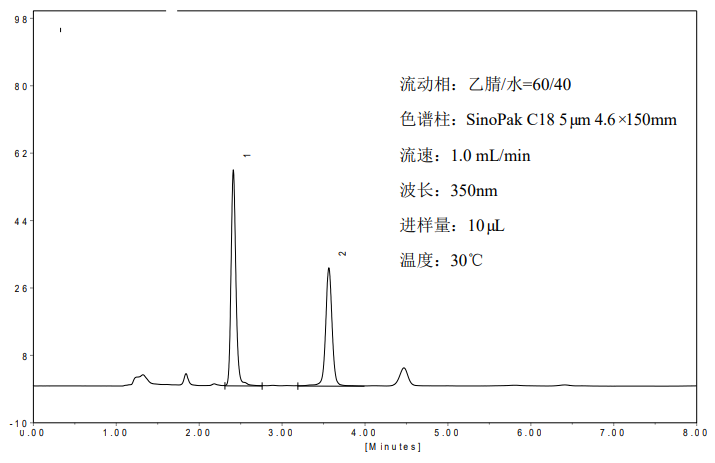
Fig. 1. Chromatogram of derived formaldehyde standard, peak 1-DNPH reagent, 2-formaldehyde-DNPH
Table 1. Chromatographic parameters
| Peak |
Component |
RT (min) |
Peak Area (mV·s) |
Tailing Factor |
| 1 |
DNPH 2,4-Dinitrophenylhydrazine |
2.41 |
321.17 |
1.02 |
| 2 |
Formaldehyde derivative |
3.56 |
691.02 |
1.02 |
Conclusion
The HPLC method using an Agress 1100 system with a SinoPak C18 column provides effective determination of formaldehyde in leather and textile samples after DNPH derivatization. It complies with relevant Chinese standards and is suitable for quality control of automotive interior materials.