Determination of Carbamate Pesticides by HPLC with Post-Column Derivatization and Fluorescence Detection
- Analyte: 10 Carbamate Pesticides
- System: EClassical 3100 HPLC System with Fluorescence Detector and PD3100 Post-Column Derivatization Reactor
- Column: Elite ACO Carbamate Pesticides Analysis Dedicated Column (5 μm, 4.6 × 250 mm)
- Highlight: Sensitive and reliable HPLC method for simultaneous determination of 10 carbamate pesticides with excellent linearity and repeatability.
Introduction
Carbamate pesticides are widely used as insecticides, herbicides, and fungicides in agriculture due to their high selectivity, rapid action, and low residual toxicity. Their determination in pesticide formulations and residues is essential for quality control and environmental monitoring. This solution presents an HPLC method with post-column derivatization and fluorescence detection for the simultaneous determination of 10 carbamate pesticides (Aldicarb sulfoxide, Aldicarb sulfone, Methomyl, 3-Hydroxy carbofuran, Aldicarb, Metolcarb, Carbofuran, Carbaryl, Isoprocarb, Fenobarb), offering high sensitivity and specificity.
Standards and Reagents
Reference standards
Aldicarb sulfoxide, Aldicarb sulfone, Methomyl, 3-Hydroxy carbofuran, Aldicarb, Metolcarb, Carbofuran, Carbaryl, Isoprocarb, Fenobarb
Reagents
Methanol (HPLC grade), deionized water (18.2 MΩ·cm),
Post-column derivatization reagents (as required for the PD3100 system)
Other materials
Volumetric flasks, pipettes, membrane filters (0.45 μm), etc.
Standard Solution Preparation
Individual stock solutions: Prepare stock solutions of each carbamate pesticide at appropriate concentrations (e.g., 100 mg/L) in methanol or acetonitrile.
Mixed working standards: Dilute the stock solutions with the initial mobile phase to obtain a series of concentrations covering the range of interest (e.g., 0.05–10.0 mg/L).
Sample Pretreatment
For pesticide formulation samples, dissolve an appropriate amount in the initial mobile phase, dilute to volume, and filter through a 0.45 μm membrane before injection. For residue analysis in complex matrices, appropriate extraction and cleanup procedures should be applied.
Instruments and Equipment
HPLC System
EClassical 3100 gradient system configured with two P3100 high-pressure pumps, Fluorescence detector, O3100 column oven, M3100 solvent manager with degasser, S3100 autosampler optional (or Rheodyne 7725i manual injector), TD-1-15 gradient mixer, Chromatography data station, PD3100 post-column derivatization reactor (with two additional P3100 pumps).
Chromatographic Conditions
Column: Elite ACO Carbamate Pesticides Analysis Dedicated Column (5 μm, 4.6 × 250 mm)
Mobile phase: A: Water; B: Methanol, in gradient (Table 1)
Table 1. Gradient program
| Time (min) |
A% |
B% |
| 0 |
85 |
15 |
| 11 |
60 |
40 |
| 16 |
10 |
90 |
| 19 |
10 |
90 |
| 19.1 |
85 |
15 |
| 28 |
85 |
15 |
Flow rate: 1.0 mL/min
Detection: Fluorescence, excitation at 330 nm, emission at 465 nm (after post-column derivatization)
Injection volume: 10 μL
Column temperature: 42°C
Experimental Discussion and Results
Typical Chromatogram
A mixed standard solution of the 10 carbamate pesticides was analyzed under the above conditions with post-column derivatization. The chromatogram (Figure 1) shows baseline separation of all target compounds.
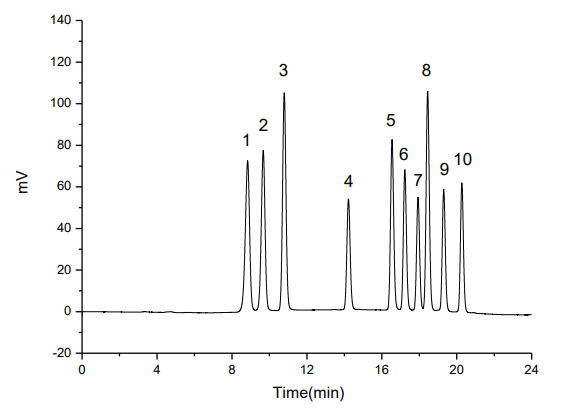
Fig. 1. Chromatogram of A mixed standard solution of the 10 carbamate pesticides, peak 1) Aldicarb sulfoxide; 2) Aldicarb sulfone; 3) Methomyl; 4) 3-Hydroxy carbofuran; 5) Aldicarb; 6) Metolcarb; 7) Carbofuran; 8) Carbaryl; 9) Isoprocarb; 10) Fenobarb.
Repeatability
Seven consecutive injections of a mixed standard were performed (Figure 2). The retention time RSDs were below 0.23% and peak area RSDs were below 1.38% for all compounds (Table 2), demonstrating excellent system precision.
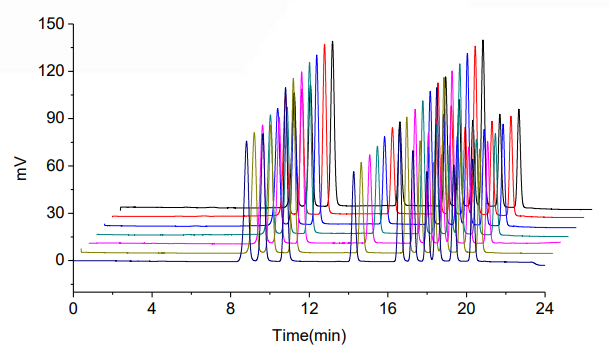
Fig. 2. Overlay-chromatograms of a mixed standard solution of the10 carbamates with 7 consecutive injections
Table 2. Repeatability data for 7 consecutive injections
| Peak |
Compound |
RT RSD% |
Area RSD% |
Peak |
Compound |
RT RSD% |
Area RSD% |
| 1 |
Aldicarb sulfoxide |
0.21 |
1.38 |
6 |
Metolcarb |
0.08 |
1.00 |
| 2 |
Aldicarb sulfone |
0.23 |
1.17 |
7 |
Carbofuran |
0.08 |
1.00 |
| 3 |
Methomyl |
0.21 |
1.14 |
8 |
Carbaryl |
0.07 |
1.00 |
| 4 |
3-Hydroxy carbofuran |
0.16 |
0.99 |
9 |
Isoprocarb |
0.08 |
0.80 |
| 5 |
Aldicarb |
0.09 |
0.98 |
10 |
Fenobarb |
0.08 |
1.18 |
Linearity
Calibration curves were constructed over the concentration range of 0.05–10.0 mg/L. All compounds showed excellent linearity with correlation coefficients (R) ≥ 0.9999 (Table 3).
Table 3. Linear equations for 10 carbamate pesticides
| Peak |
Compound |
Linear Equation |
R |
| 1 |
Aldicarb sulfoxide |
Y = 104.07x – 4.6139 |
0.9999 |
| 2 |
Aldicarb sulfone |
Y = 106.47x – 4.5611 |
0.9999 |
| 3 |
Methomyl |
Y = 140.42x – 5.1506 |
0.9999 |
| 4 |
3-Hydroxy carbofuran |
Y = 70.005x – 2.9517 |
0.9999 |
| 5 |
Aldicarb |
Y = 105.33x – 4.2844 |
0.9999 |
| 6 |
Metolcarb |
Y = 84.315x – 3.3494 |
0.9999 |
| 7 |
Carbofuran |
Y = 57.280x – 2.8600 |
0.9999 |
| 8 |
Carbaryl |
Y = 122.17x – 3.9678 |
0.9999 |
| 9 |
Isoprocarb |
Y = 68.789x – 2.7711 |
0.9999 |
| 10 |
Fenobarb |
Y = 61.055x – 3.1133 |
0.9999 |
Detection limits
Based on a signal-to-noise ratio of 3, the method detection limits for the 10 carbamates ranged from 0.02 to 0.05 mg/L (Table 4), meeting the sensitivity requirements for pesticide residue analysis. Figure 3 shows a chromatogram of a mixed standard solution of the 10 carbamates with concentration of 0.05 μg/mL each.
Table 4. Detection limits (S/N = 3)
| Peak |
Compound |
LOD (mg/L) |
| 1 |
Aldicarb sulfoxide |
0.03 |
| 2 |
Aldicarb sulfone |
0.03 |
| 3 |
Methomyl |
0.02 |
| 4 |
3-Hydroxy carbofuran |
0.04 |
| 5 |
Aldicarb |
0.03 |
| 6 |
Metolcarb |
0.03 |
| 7 |
Carbofuran |
0.05 |
| 8 |
Carbaryl |
0.02 |
| 9 |
Isoprocarb |
0.03 |
| 10 |
Fenobarb |
0.04 |
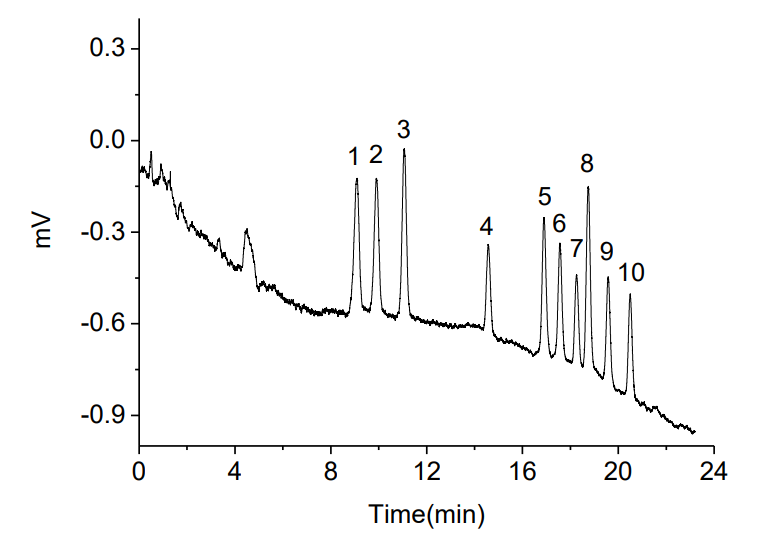
Fig. 3. Chromatograms of a mixed standard solution of the10 carbamates with concentration of 0.05 μg/mL each
Conclusion
The HPLC method with post-column derivatization and fluorescence detection using an Elite ACO dedicated column provides reliable separation, excellent linearity, and high sensitivity for 10 carbamate pesticides. It is suitable for quality control of pesticide formulations and residue analysis in various matrices.