Determination of Benzo(a)pyrene in Water by Online Solid-Phase Extraction-HPLC
- Analyte: Benzo(a)pyrene (BaP)
- System: EClassical 3100 HPLC System with Fluorescence Detector and Online SPE Modue
- Column: SinoPak C18 (5 μm, 4.6 × 250 mm)
- Highlight: A fully automated online SPE-HPLC method for trace analysis of benzo(a)pyrene in water, achieving ultra-low detection limits and compliance with drinking water standards.
Introduction
Benzo(a)pyrene (BaP) is a representative polycyclic aromatic hydrocarbon and a potent carcinogen. It is the only PAH specifically regulated in drinking water (GB 5749-2006, limit 0.01 μg/L) and seawater (GB 3097-1997, limit 0.0025 μg/L). Traditional liquid-liquid extraction (LLE) methods are time-consuming and labor-intensive. An online solid-phase extraction (SPE) coupled with HPLC and fluorescence detection offers a rapid, automated, and highly sensitive alternative. This chapter presents an online SPE-HPLC method for the determination of BaP in water, providing superior sensitivity and simplicity.
Standards and Reagents
Standards
Benzo(a)pyrene
Reagents
Methanol (HPLC grade), Benzene (Analytical grade), Cyclohexane (HPLC grade). Deionized Water (18.2 MΩ·cm).
Other materials
PDVF membrane filters (0.45 μm), C18 guard column (used as SPE cartridge), etc.
Standard Solution Preparation
Stock solution (100 μg/mL): Accurately weigh 5.00 mg of BaP, dissolve in a small amount of benzene, and dilute to 50 mL with cyclohexane. Transfer to an amber bottle and store at 4°C (stable for 6 months).
Intermediate solution (1 μg/mL): Pipette 1.00 mL of stock solution into a 100 mL amber volumetric flask and dilute to volume with cyclohexane. Store at 4°C (stable for 1 month).
Working solutions for calibration: Prepare spiked water samples by diluting the intermediate solution with water to obtain concentrations of 0.001, 0.005, 0.01, 0.02, 0.05, and 0.1 μg/L. These are used directly for online SPE-HPLC analysis.
Sample Pretreatment
- Collect water sample and add sodium thiosulfate (if chlorine is present) to eliminate residual chlorine.
- Transfer 50 mL of the water sample into a 100 mL volumetric flask, add methanol to volume, and mix well.
- Sonicate for 10 min to ensure homogeneity.
- Filter the solution through a 0.45 μm PDVF membrane.
The filtered sample is ready for injection into the online SPE-HPLC system, where it will be loaded onto a C18 SPE cartridge for enrichment and subsequent elution onto the analytical column.
Instruments and Equipment
Online SPE-HPLC System (EClassical 3100)
Two P1100 high-pressure pumps for mobile phase delivery (pumps A and B), one additional P1100 pump for sample loading (pump C), fluorescence detector, O1100 column oven, two-position six-port switching valve with electric actuator, S3100 autosampler, DG3100 degasser, Chromatography data station
SinoPak C18 analytical column (5 μm, 4.6 × 250 mm), C18 guard column (used as SPE cartridge, e.g., JieJie C18 guard column),
Additional Equipment
Solvent filtration apparatus (1000 mL), Vacuum pump (GM-0.33A, 0.08 MPa, 160 W), Ultrasonic cleaner (AS3120, 40/60 kHz, 120 W), Analytical balance (0.0001 g precision)
Chromatographic Conditions
Analytical column: SinoPak C18 (5 μm, 4.6 × 250 mm)
Mobile phase: A: Methanol; B: Water
Flow rate: See gradient table below
Detection: Fluorescence, excitation at 290 nm, emission at 430 nm
Column temperature: 30°C
SPE cartridge: C18 (e.g., JieJie C18 guard column)
Online SPE sequence:
| Time (min) |
Pump A (mL/min) |
Pump B (mL/min) |
Pump C (mL/min) |
Valve Position |
Description |
| 0–1 |
0.5 |
0.5 |
4 |
Inject |
Sample loading onto SPE cartridge |
| 1–2 |
0.5 |
0.5 |
4 |
Inject |
Continue loading |
| 2–7 |
0.9 |
0.1 |
0 |
Load |
SPE cartridge washing |
| 7–32 |
0.9 |
0.1 |
0 |
Inject |
Elution and separation |
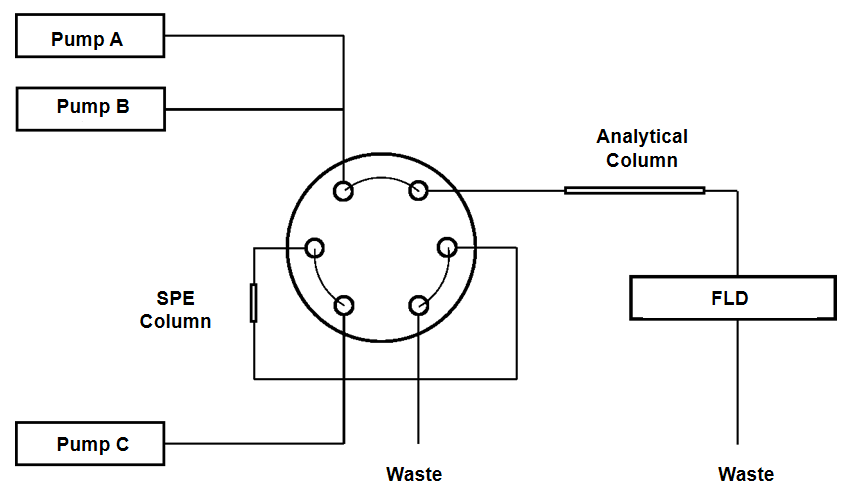
Figure 1. Flow-process diagram of online SPE-HPLC
Experimental Discussion and Results
Typical Chromatogram
Under the optimized online SPE-HPLC conditions, a standard BaP solution at 0.01 μg/L was analyzed. The chromatogram (Figure 1) shows a sharp, well-resolved peak with a retention time of approximately 14 min.
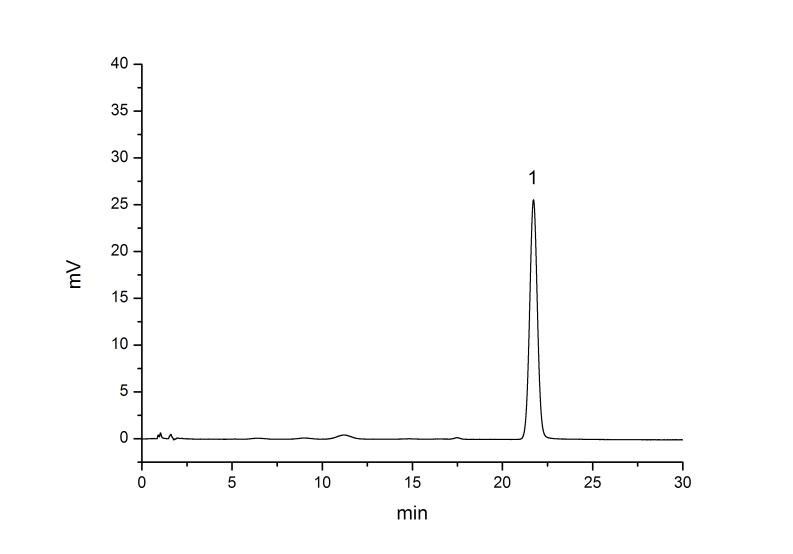
Figure 1. Typical chromatogram of benzo(a)pyrene standard (0.01 μg/L) by online SPE-HPLC
Calibration Curve
Water samples spiked with BaP at concentrations of 0.001, 0.005, 0.01, 0.02, 0.05, and 0.1 μg/L were analyzed. The calibration curve (Figure 2) was constructed by plotting peak area against concentration. The linear regression equation is:
y= 51617x + 76.328, R = 0.9994
where y is peak area and x is concentration in μg/L. The method shows excellent linearity over the range of 0.001 – 0.1 μg/L.
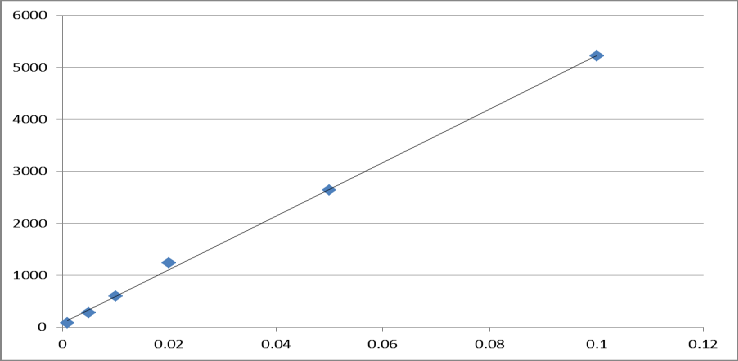
Figure 2. Calibration curve for benzo(a)pyrene in water by online SPE-HPLC
Detection and Quantification Limits
Based on a signal-to-noise ratio of 3 for the detection limit and 10 for the quantification limit, the instrument detection and quantification limits are given in Table 1. The method is far more sensitive than the regulatory limits (drinking water, 0.01 μg/L; seawater, 0.0025 μg/L).
Table 1. Detection and quantification limits for benzo(a)pyrene
| Parameter |
Value (μg/L) |
| Instrument detection limit (S/N=3) |
5×10⁻⁶ |
| Instrument quantification limit (S/N=10) |
3×10⁻⁵ |
Recovery and Precision
Recovery was evaluated by spiking blank water samples at three concentration levels (0.001, 0.0025, and 0.01 μg/L). Each level was analyzed with multiple replicates. The results are summarized in Table 2. The recoveries ranged from 80.35% to 105.08%, and the relative standard deviation (RSD) at the 0.0025 μg/L level (n=8) was 3.34%, demonstrating good accuracy and precision.
Table 2. Spike recovery results for benzo(a)pyrene
| Spike Level (μg/L) |
Mean Recovery (%) |
RSD (%) |
Number of Replicates (n) |
| 0.001 |
99.7 |
4.2 |
3 |
| 0.0025 |
83.8 |
3.34 |
8 |
| 0.01 |
100.1 |
2.1 |
3 |
Conclusion
The online SPE-HPLC method with fluorescence detection provides a fully automated, rapid, and highly sensitive solution for trace analysis of benzo(a)pyrene in water. It achieves detection limits as low as 5×10⁻⁶μg/L, which is well below the regulatory limits for drinking and seawater. The method offers excellent linearity, accuracy, and precision, making it ideal for routine monitoring and compliance testing.