Aldehyde and ketone compounds are important components of volatile organic compounds (VOCs) in the atmosphere. They are chronically toxic to humans and can cause health damage upon long-term inhalation. In the automotive industry, these compounds are present in exhaust emissions and interior materials, polluting cabin air and the environment. Several Chinese standards regulate the limits and detection methods for aldehydes and ketones in vehicles, including GB/T 27630-2011 (evaluation of air quality in passenger cars), HJ/T 400-2007 (sampling and determination methods), and emission limits for light-duty vehicles. This solution presents an HPLC method using DNPH derivatization for the determination of 13 target aldehydes and ketones, suitable for monitoring automotive emissions and interior air quality.
DNPH mix standard
Commercially available (e.g., from J&K Scientific) containing the 13 target aldehydes and ketones as their 2,4-dinitrophenylhydrazone (DNPH) derivatives. The 13 target aldehydes and ketones are Formaldehyde, Acetaldehyde, Acrolein, Acetone, Propionaldehyde, Butyraldehyde, Hexanaldehyde, Benzaldehyde, Methyl ethyl ketone, Methacrolein, Crotonaldehyde, Valeraldehyde, m-Tolualdehyde.
Reagents
Acetonitrile (HPLC grade), deionized water (18.2 MΩ·cm), 50% acetonitrile-water solution (for dilution)
Other materials
Amber volumetric flasks (10 mL, 50 mL), 1.5 mL plastic centrifuge tubes, pipettes, syringe filters (0.45 μm), disposable syringes, etc.
Standard Solution Preparation
Pipette 100 μL of the DNPH mix standard into a suitable container and dilute 5-fold with 50% acetonitrile-water solution. Mix well and filter through a 0.45 μm membrane before injection.
- Collect gas samples (automotive exhaust or cabin air) using a gas sampling bag.
- Connect the sampling bag to a DNPH sampling cartridge, and attach the cartridge to an air sampling pump.
- Draw the gas through the cartridge at a controlled flow rate (0.5–5 mL/min) to enrich the aldehydes and ketones as DNPH derivatives.
- After enrichment, elute the derivatives from the cartridge with 5 mL of acetonitrile.
Filter the eluate through a 0.45 μm membrane filter before HPLC analysis.
HPLC System
EClassical 3200 configured with two high-pressure pumps, UV-Vis detector, column oven, Rheodyne 7725i manual injector (or S3100 autosampler optional), gradient mixer, chromatography data station, solvent tray.
Pretreatment equipment
Air sampling pump, gas sampling bags, DNPH sampling cartridges, syringe filters, etc.
Column: SinoPak C18 (3 μm, 4.6 × 100 mm)
Mobile phase: A: Water; B: Acetonitrile (gradient elution), in gradient (Table 1)
Flow rate: 1.5 mL/min
Detection wavelength: 360 nm
Injection volume: 10 μL
Column temperature: 40°C
Table 1. Gradient program:
Typical Chromatogram
A mixed standard solution of the 13 aldehydes and ketones as DNPH derivatives was analyzed under the above conditions. The chromatogram (Figure 1) shows baseline separation of all target
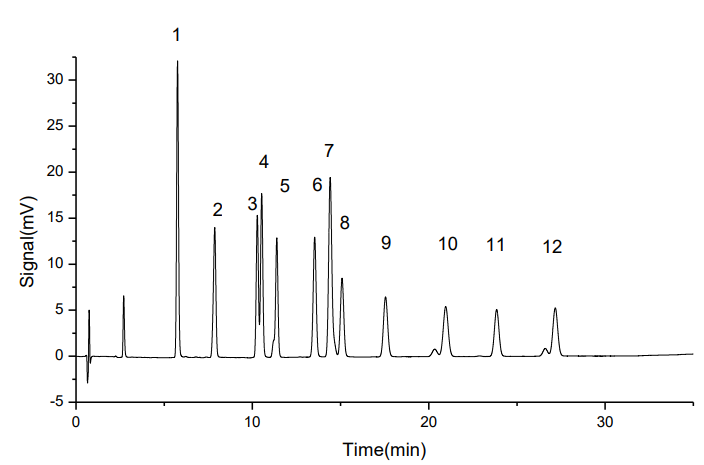
Figure 1. Chromatogram of the 13 aldehydes and ketones standard (10mg/L).
Peaks:
1. Formaldehyde;
2. Acetaldehyde;
3. Acrolein or Acetone;
4. Acetone or Acrolein;
5. Propionaldehyde;
6. Crotonaldehyde;
7. Butanone + Butyraldehyde;
8. Methacrolein;
9. Benzaldehyde;
10. Valeraldehyde;
11. m-Tolualdehyde;
12. Hexanaldehyde.
Method Performance
While detailed validation parameters such as linearity and detection limits were not provided in the original document, the method achieves good separation of all 13 compounds, meeting the requirements of relevant automotive standards (e.g., HJ/T 400-2007, GB 18352.5-2013). The use of DNPH derivatization ensures sensitive detection at UV 360 nm.
The proposed HPLC method using an EClassical 3100 system with a SinoPak C18 column effectively separates 13 aldehyde and ketone compounds as DNPH derivatives. It is suitable for monitoring automotive exhaust and interior air quality, complying with Chinese regulatory standards.