Determination of 36 Alkylphenols and Alkylphenol Ethoxylates by LC-MS/MS
- Analyte: 36 Alkylphenols (APs) and Alkylphenol ethoxylates (APEOs)
- System: MS²Vertical 9100 LC-MSMS
- Column: Supersil ODS2 (2.1 × 100 mm, 3 μm)
- Highlight: A comprehensive LC-MS/MS method with polarity switching for simultaneous determination of 36 APs and APEOs in a single run.
Introduction
Alkylphenol ethoxylates (APEOs) are widely used as non-ionic surfactants in textiles. They degrade into more toxic and persistent short-chain compounds such as nonylphenol (NP) and octylphenol (OP), which are endocrine disruptors. Many countries have restricted their use (e.g., EU Directive 2003/53/EC). This method, based on GB/T 23322-2018, employs LC-MS/MS with polarity switching for the rapid and sensitive determination of 36 alkylphenols and alkylphenol ethoxylates in textile samples.
Standards and Reagents
Standards
AP and APEO standards: 36 individual compounds (including NP, OP, NPEOn, OPEOn, etc.) with purity ≥ 98%.
Reagents
Methanol (HPLC grade). Acetonitrile (HPLC grade), Deionized water(18.2 MΩ·cm), Formic acid (LC-MS grade).
Other materials
Centrifuge tubes, solid-phase extraction cartridges (for cleanup), syringe filters (0.22 μm), etc.
Standard Solution Preparation
Mixed stock solution: Prepare a mixed standard solution containing all 36 compounds at appropriate concentrations in methanol.
Calibration standards: Dilute the stock solution with methanol to obtain concentrations in the range of 5–500 ng/mL (or as required).
Sample Pretreatment
- Cut the textile sample into small pieces (approximately 5 mm × 5 mm) and homogenize.
- Accurately weigh about 1 g (to 0.01 g) into a 50 mL centrifuge tube.
- Add 30 mL of methanol and sonicate at 70 ± 2°C for 60 ± 5 min.
- Concentrate the extract to near dryness using a rotary evaporator at ≤40°C.
- Dissolve the residue in 2 mL of methanol and filter through a 0.22 μm syringe filter.
If matrix interference occurs, further clean up the extract using a solid-phase extraction cartridge (as described in the standard) before filtration.
Instruments and Equipment
LC System
EClassical 3200L HPLC system equipped with a binary pump, autosampler, and column oven.
Mass Spectrometer
MS²Vertical 9100 triple quadrupole mass spectrometer with electrospray ionization (ESI) source.
Chromatographic Conditions
Column: Supersil AQ-C18, 2.1×100mm, 3μm
Mobile phase: A: Water (containing 0.1% formic acid); B: Acetonitrile, in gradient (Table 1)
Flow rate: 0.3 mL/min
Column temperature: 40°C
Injection volume: 10 μL
Table 1. Gradient program
| Time (min) |
A% |
B% |
| 0 |
95 |
5 |
| 5 |
5 |
95 |
| 7 |
5 |
95 |
| 9.2 |
95 |
5 |
| 12 |
95 |
5 |
Mass Spectrometry Conditions
Ionization mode:ESI positive for ethoxylates, ESI negative for alkylphenols (polarity switching)
Spray voltage: 4800 V (positive), -4500 V (negative)
Ion source temp.: 300°C
Curtain gas: 20 psi (N₂)
Nebulizer gas: 20 psi (N₂)
MRM parameters: For each compound, the precursor ion, product ions, collision energy, etc., were optimized
Experimental Discussion and Results
Typical Chromatograms
The MRM chromatograms of the 36 compounds at 50 ng/mL are shown in Figure 1, and Figure 2 displays individual MRM chromatograms.. All peaks are well-shaped and baseline separated, with sufficient data points for accurate quantification. Polarity switching allows simultaneous detection of both APEOs (ESI+) and APs (ESI-) in a single run.
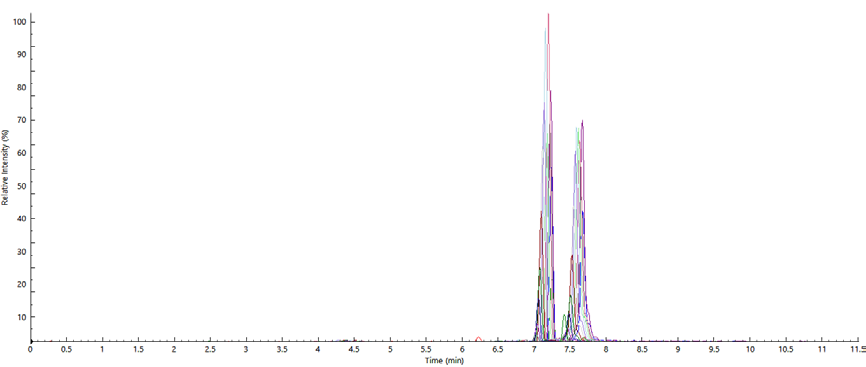
Figure 1. MRM over-lay chromatograms of the 36 compounds at 50 ng/mL
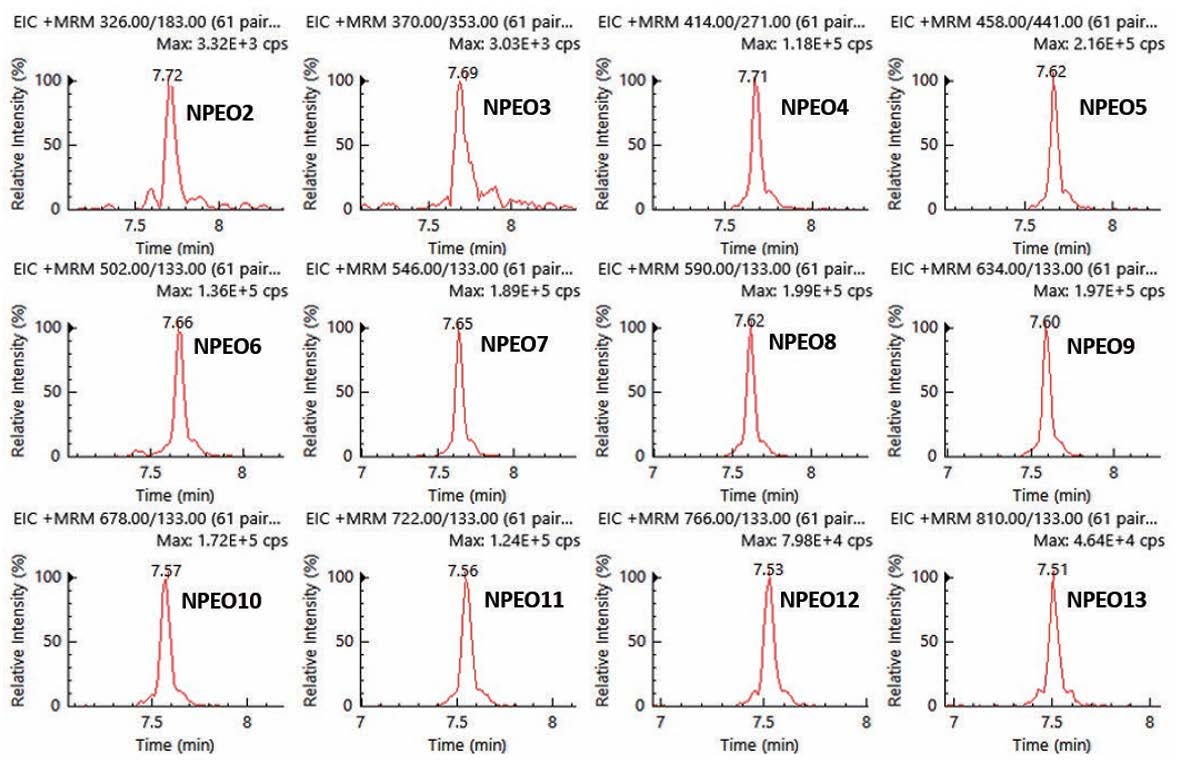
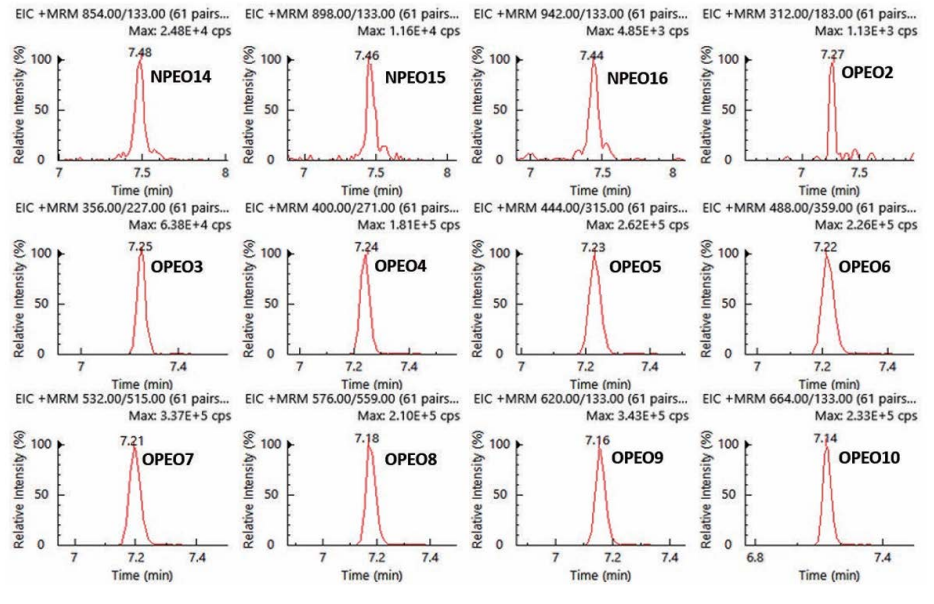
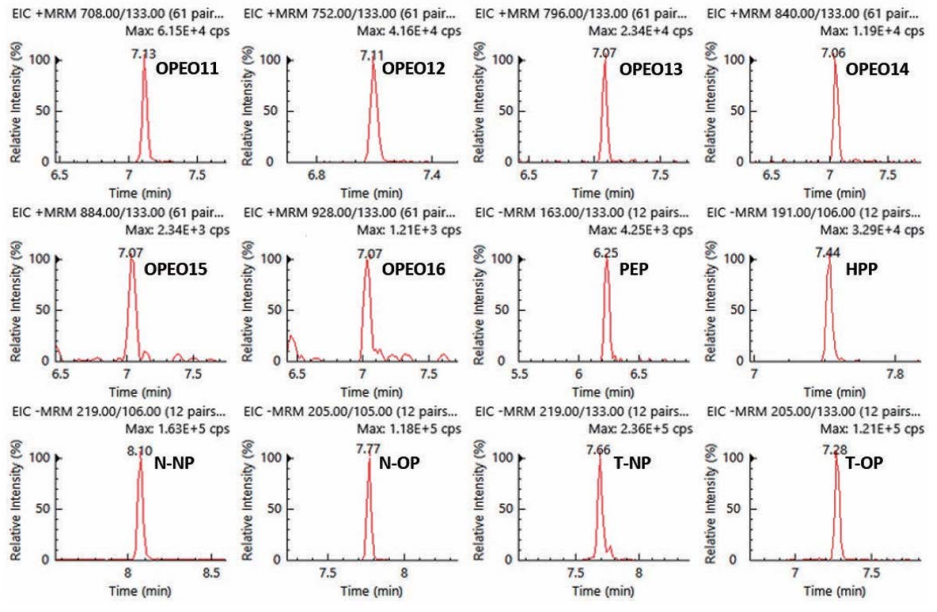
Figure 1. MRM chromatograms of the 36 compounds at 50 ng/mL
Linearity and Sensitivity
Calibration curves constructed over the relevant concentration range show excellent linearity with correlation coefficients > 0.999. The method detection limits are far below the requirements of GB/T 23322-2018.
Repeatability
The method demonstrates excellent reproducibility with RSD values below 5% for most compounds.
Conclusion
The LC-MS/MS method using polarity switching on the EClassical 3200L and MS²Vertical 9100 system enables rapid, sensitive, and reliable determination of 36 alkylphenols and alkylphenol ethoxylates in textile samples. It provides a high-throughput screening tool that meets the stringent requirements of current regulations.