Determination of 27 Perfluorinated Compounds (PFCs) by LC-MS/MS
- Analyte: 27 Perfluorinated compounds and 2 internal standards
- System: MS²Vertical 9100 LC-MSMS
- Column: Supersil ODS2 (2.1 × 100 mm, 3 μm)
- Highlight: A sensitive and reliable LC-MS/MS method for simultaneous determination of 27 perfluorinated compounds in a single run.
Introduction
Perfluorinated compounds (PFCs) are widely used in chemical, textile, and leather industries due to their excellent thermal and chemical stability, surface activity, and hydrophobic/oleophobic properties. However, PFCs are persistent organic pollutants that can cause chronic liver damage, immunotoxicity, and endocrine disruption. Many countries have restricted their use. This method, developed in accordance with ISO 23702-1:2018 and CEN/TS 15968-2010, utilizes an EClassical 3200 LC system coupled with an MS²Vertical 9100 triple quadrupole mass spectrometer for the simultaneous determination of 27 PFCs, offering high sensitivity and excellent reproducibility.
Standards and Reagents
Standards
PFC standards: 27 individual perfluorinated compound standards (purity ≥98%) and isotopically labeled internal standards (e.g., MPFOA, MPFOS).
Reagents
Methanol: HPLC grade; Deionized Water, ≥18.2 MΩ·cm.
Other materials
Polypropylene centrifuge tubes (50 mL), syringe filters (0.22 μm), etc.
Standard Solution Preparation
Mixed stock solution: Prepare a mixed standard solution containing all 27 PFCs at appropriate concentrations in methanol.
Internal standard solution: Prepare a mixed internal standard solution (e.g., MPFOA, MPFOS) at a concentration of 200 ng/mL.
Calibration standards: Dilute the mixed stock solution with methanol to obtain concentrations of 0.5, 1, 2, 5, 10, and 20 ng/mL. Add a fixed amount of internal standard to each calibration level.
Sample Pretreatment
Sample preparation follows ISO 23702-2018:
- Cut the sample into small pieces (approximately 2 mm × 2 mm) and homogenize.
- Accurately weigh about 1 g (to 0.01 g) of the prepared sample into a 50 mL polypropylene centrifuge tube.
- Add 10 mL of methanol and 100 μL of internal standard solution.
- Sonicate at 60 ± 2°C for 60 ± 5 min.
- Centrifuge at 4000 r/min for 5 min.
Filter the supernatant through a 0.22 μm syringe filter. The filtrate is ready for LC-MS/MS analysis.
Instruments and Equipment
LC System
EClassical 3200L HPLC system equipped with a binary pump, autosampler, and column oven.
Mass Spectrometer
MS²Vertical 9100 triple quadrupole mass spectrometer with electrospray ionization (ESI) source.
Chromatographic Conditions
- Column: Supersil ODS2 (2.1 × 100 mm, 3 μm).
- Mobile phase: A: Water; B: Methanol, in gradient (Table 1)
- Flow rate: 0.3 mL/min
- Column temp.: 40°C
- Injection volume: 10 μL
Table 1. Gradient program
| Time (min) |
A% |
B% |
| 0 |
70 |
30 |
| 2 |
20 |
80 |
| 5 |
10 |
90 |
| 8 |
0 |
100 |
| 10 |
70 |
30 |
| 12 |
70 |
30 |
Mass Spectrometry Conditions
- Ionization mode: ESI negative (ESI-)
- Spray voltage: -4500 V
- Ion source temp.: 300°C
- Curtain gas: 20 psi (N₂)
- Nebulizer gas: 20 psi (N₂)
- MRM parameters: For each compound, the precursor ion, product ions, collision energy, etc., were optimized.
Experimental Discussion and Results
Typical Chromatograms
Under the optimized conditions, the 27 PFCs and 2 internal standards were well separated and detected in a single run. Figure 1 shows the overlay MRM chromatograms of all 29 compounds at 2 ng/mL, and Figure 2 displays individual MRM chromatograms. All peaks are symmetrical with sufficient data points for accurate quantification.
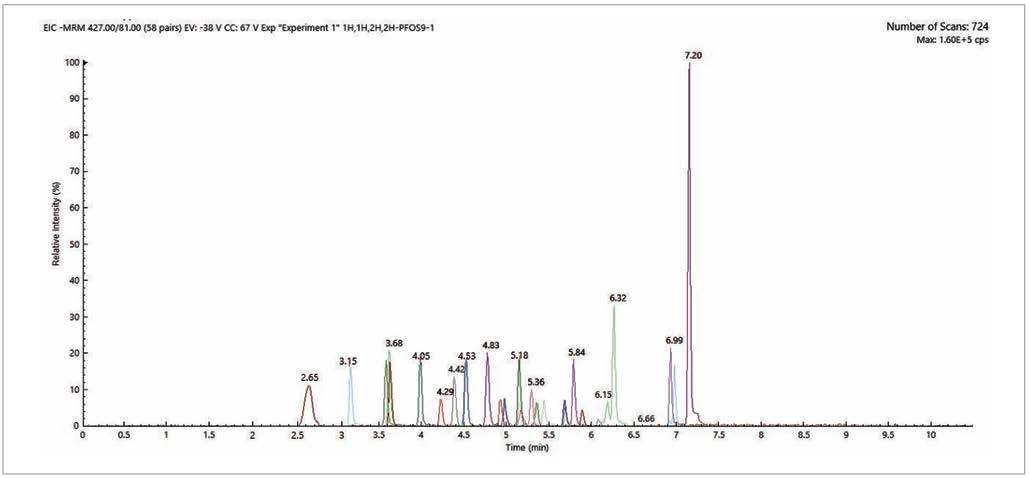
Figure 1. Overlay chromatograms of MRM extraction for 29 compounds at 2 ng/mL
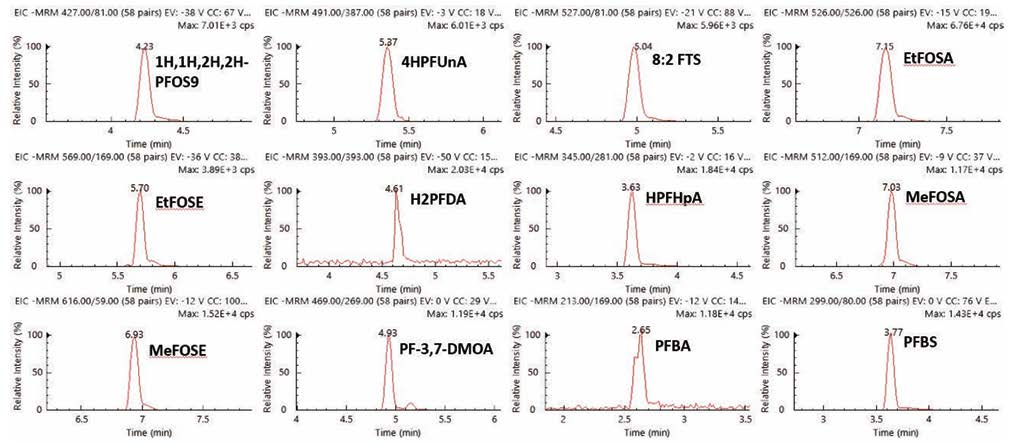
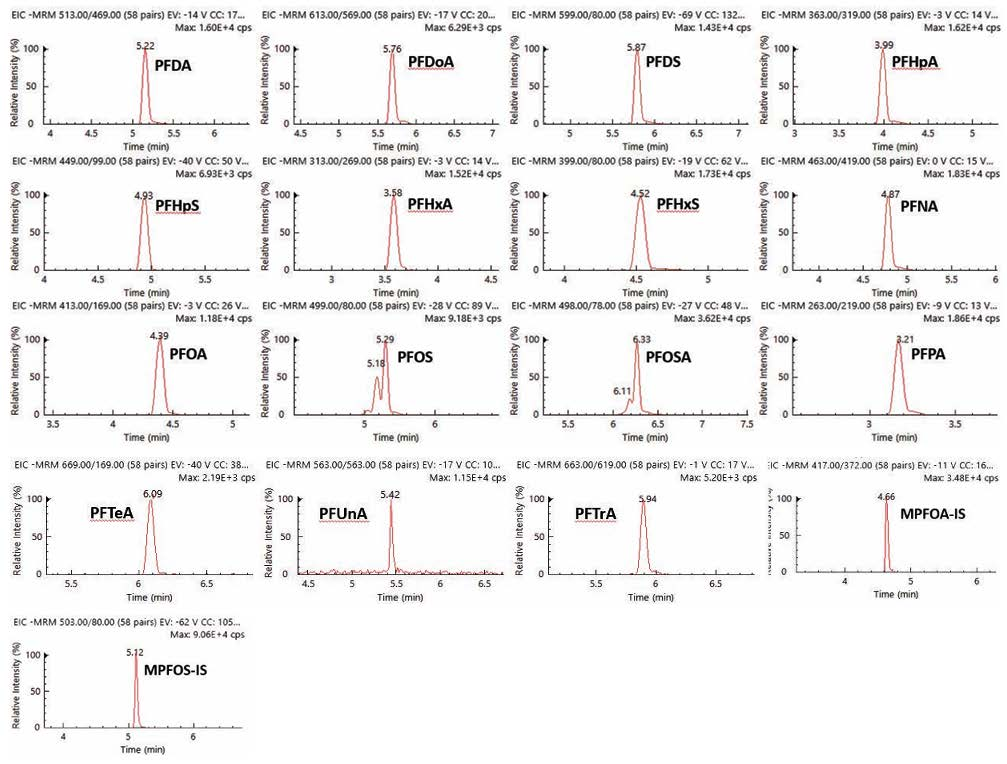
Figure 2. MRM over-lay chromatograms of the 29 compounds at 2 ng/mL
Linearity
Calibration curves were constructed by plotting peak area ratios (analyte/IS) against concentrations over the range of 0.5–20 ng/mL. All 27 compounds exhibited excellent linearity with correlation coefficients (R) > 0.997.
Sensitivity and Repeatability
The method detection limits are well below the requirements of the reference standards (CEN/TS 15968-2010 and ISO 23702-1:2018). The high sensitivity and reproducibility make this method suitable for routine monitoring of PFCs in various matrices.
Conclusion
The developed LC-MS/MS method using the EClassical 3200 and MS²Vertical 9100 system enables rapid, sensitive, and reliable determination of 27 perfluorinated compounds in a single analysis. It provides a high-throughput screening tool with excellent linearity and repeatability, meeting regulatory requirements.