Polybrominated biphenyls (PBBs) and polybrominated diphenyl ethers (PBDEs) are widely used as flame retardants in electronic and electrical products, including circuit boards, cables, plastic casings, keyboards, and monitors. These compounds are persistent organic pollutants that can leach out during use or disposal, causing environmental contamination and potential health risks. The European RoHS Directive restricts PBBs and PBDEs to a maximum concentration of 0.1% in homogeneous materials. In China, the national standard GB/Z 21276–2007 specifies methods for the determination of these substances. This solution presents an HPLC method using the EClassical 3100 system with a dedicated column for the analysis of PBBs and PBDEs, following relevant international and national standards.
Reference standards
PBBs and PBDEs standard solutions (available commercially)
Reagents
Acetonitrile (HPLC grade), Methanol (HPLC grade), Toluene (HPLC grade), Concentrated sulfuric acid (analytical grade), Deionized water (18.2 MΩ·cm)
Other materials
Volumetric flasks, round-bottom flasks (250 mL), Soxhlet extractor, extraction thimbles, MT-type sample purification columns, rotary evaporator, vortex mixer, PTFE membrane filters (0.45 μm), etc.
Standard Solution Preparation
PBBs standard solution: Dilute the commercial PBBs standard solution with toluene to 25 mg/L, then further dilute with acetonitrile to 10 mg/L.
PBDEs standard solution: Dilute the commercial PBDEs standard solution with toluene to 25 mg/L, then further dilute with acetonitrile to 10 mg/L.
Two alternative pretreatment methods are provided:
Method 1 (Soxhlet extraction):
- Cut or crush the sample into particles ≤1 mm.
- Weigh about 5 g of the prepared sample and extract with toluene/methanol (10:1) in a Soxhlet extractor for 3 h.
- Concentrate the extract using a rotary evaporator at 50°C, 30 rpm, and dilute to 5 mL.
- Mix the concentrate with an equal volume of concentrated sulfuric acid and shake.
- Pass through an MT-type sample purification column: load 0.4 mL of extract and elute with 1.2 mL of toluene.
Dilute the eluate to an appropriate concentration, filter through a 0.45 μm organic membrane, and inject.
Method 2 (Ultrasonic extraction):
- Cut or crush the sample into particles ≤1 mm.
- Accurately weigh 0.5 ± 0.001 g of sample, add 5 mL of toluene, and sonicate for 30 min.
- Dilute to 5 mL with toluene.
- Take 100 μL of the extract, dilute to 1 mL with mobile phase, filter through a 0.45 μm organic membrane, and inject.
HPLC System
EClassical 3200 configured with high-pressure pumps, diode array detector (DAD), column oven, Rheodyne 7725 manual injector (or S3100 autosampler optional), TD-1-15 gradient mixer, Chromatography data station, solvent tray
Pretreatment equipment
Analytical balance, ultrasonic cleaner, Soxhlet extractor, rotary evaporator, vortex mixer, solid-phase extraction manifold, solvent filtration apparatus, etc.
Column: Dedicated column for PBBs/PBDEs analysis (5 μm, 4.6 × 200 mm)
Mobile phase: A: Water; B: Acetonitrile, in gradient (Table 1)
Table 1. Gradient program
Flow rate: 1.0 mL/min
Detection wavelength: 244 nm
Injection volume: 20 μL
Column temperature: 35°C
Typical Chromatograms of Standards
Mixed standard solutions of PBBs and PBDEs were analyzed under the above conditions. The chromatograms (Figures 1 and 2) show good separation of the individual congeners. PBBs’ and PBDEs’ peaks corresponding to mono- to decabrominated biphenyls are well resolved.
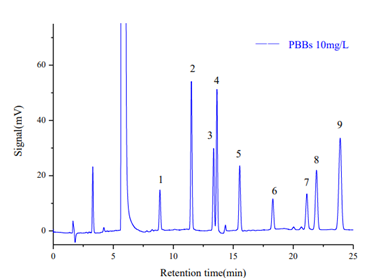
Figure 1. Chromatogram of the polychlorinated piphenyls (PBBs) standard (10mg/L).
Peaks: 1) 2-Bromobiphenyl, 2) 2,5-Dibromobiphenyl, 3) 2,4,6-Tribromobiphenyl,4) 2,2',5,5'-Tetrabromobiphenyl,
5)2,2',4,5',6-Pentabromobiphenyl, 6) 2,2',4,4',6,6'-Hexabromobiphenyl, 7) Octabromobiphenyl, 8) onabromobiphenyl, 9) Decabromobiphenyl
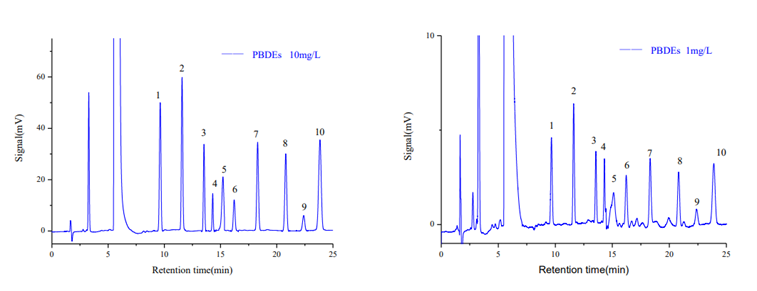
Figure 2. Chromatograms of the polybrominated biphenyl ether (PBDEs) standard with concentration of 10mg/L and 1mg/L.
Peaks: 1) 4-Bromobiphenyl ether; 2) 4,4 '-dibromobiphenyl ether; 3) 3,3',4-tribromobiphenyl ether; 4) 3,3 ',4,4' -tetrabromobiphenyl ether;
- 2,2 ',3,4,4' -pentabromobiphenyl ether; 6) 2,2 ',3,3',4,4 '-hexabromobiphenyl ether; 7) 2,3,3',4,4 ',5,6-heptabromobiphenyl ether;
- 8) 2,3,3',4,4 ',5,5',6-octabromobiphenyl ether; 9) 2,2 ',3,3',4,4 ',5,6,6' -nonabromobiphenyl ether; 10) Decabromobiphenyl ether
Sample Analysis
Wire samples from an electronic product were analyzed following the described procedures. The chromatograms (Figures 3 and 4) demonstrate the presence of PBBs and PBDEs, confirming the applicability of the method for real samples.
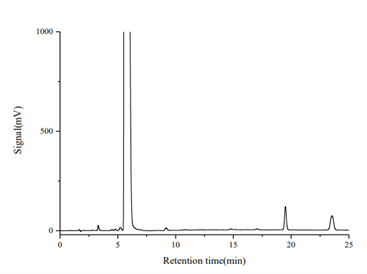
Figure 3. Chromatogram of PPBs in wire sample.
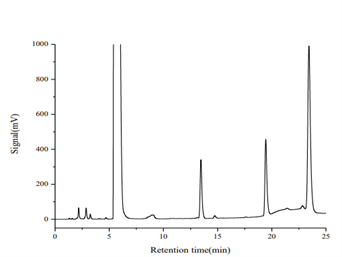
Figure 4. Chromatogram of PBDEs in wire sample