Determination of Fructose, Glucose, Sucrose, and Maltose in Honey by HPLC-RID
- Analyte: Fructose, Glucose, Sucrose, Maltose
- System: EClassical 3200 HPLC System with Refractive Index Detector (RID)
- Column: Supersil NH2-S (5 μm, 4.6 × 250 mm)
- Highlight: Simultaneous determination of four sugars in honey using HPLC-RID
Introduction
Honey is a natural sweet substance produced by bees from nectar. It consists mainly of carbohydrates (about 75%) and water (about 25%), with fructose and glucose being the predominant sugars. Adulteration of honey with inexpensive sugars such as sucrose, maltose, or syrups is a common practice. Therefore, accurate determination of fructose, glucose, sucrose, and maltose is essential for quality control.
Standards and Reagents
Standards: Fructose, glucose, sucrose, and maltose (analytical grade)
Reagents:Acetonitrile (HPLC grade), 40% acetonitrile solution (for sample and standard preparation), deionized water (18.2 MΩ·cm).
Standard Solution Preparation
Stock Solutions
Accurately weigh 2.5 g of fructose and 2.0 g of glucose (to 0.0001 g), dissolve in 40% acetonitrile solution, and dilute to 50 mL in volumetric flasks. These are the fructose and glucose stock solutions.
Accurately weigh 1.0 g of sucrose and 1.0 g of maltose (to 0.0001 g), dissolve in 40% acetonitrile solution, and dilute to 50 mL in volumetric flasks. These are the sucrose and maltose stock solutions.
Mixed working standards
Prepare a series of mixed standard solutions according to Table 1by combining appropriate volumes of the stock solutions and diluting to the specified volumes with 40% acetonitrile. The concentrations cover the ranges: fructose (1.00–3.00 g/100mL), glucose (0.80–2.40 g/100mL), sucrose (0.05–0.60 g/100mL), and maltose (0.05–0.60 g/100mL).
Table 1. Preparation of Standard Working Solutions for Fructose, Glucose, Sucrose, and Maltose
| Fructose/Glucose Stock Solution Volume (μL) |
Sucrose/Maltose Stock Solution Volume (μL) |
Final Volume (mL) |
Concentration of Standard Working Solution (g/100mL) |
| Fructose |
Glucose |
Sucrose |
Maltose |
| 200 |
25 |
1 |
1.00 |
0.80 |
0.050 |
0.050 |
| 300 |
50 |
1 |
1.50 |
1.20 |
0.100 |
0.100 |
| 400 |
100 |
1 |
2.00 |
1.60 |
0.20 |
0.20 |
| 500 |
200 |
1 |
2.50 |
2.00 |
0.40 |
0.40 |
| 300 |
140 |
0.5 |
3.00 |
2.40 |
0.60 |
0.60 |
Sample Pretreatment
Accurately weigh 2.5 g of honey sample (to 0.0001 g) into a suitable container. Dissolve in 40% acetonitrile solution, transfer to a 50 mL volumetric flask, and dilute to volume with the same solvent. Mix well and filter through a suitable filter membrane before HPLC analysis.
Instruments and Equipment
HPLC System: EClassical 3200 equipped with P3200 high-pressure pump, Refractive index detector (RID), S3210 autosampler, O3220 column oven, T3200 solvent bottle tray, Kromstation CDS.
Pretreatment equipment: Analytical balance, ultrasonic cleaner, solvent filtration apparatus, vacuum pump, volumetric flasks, pipettes, syringe filters, etc.
Chromatographic Conditions
- Column: Supersil NH2-S (5 μm, 4.6 × 250 mm)
- Mobile Phase: Acetonitrile / Water = 75 / 25 (v/v)
- Flow Rate: 1.0 mL/min
- Detection: Refractive index (RID)
- Injection Vol.: 20 μL
- Column Temp.: 35°C
Experimental Results
Standard and honey sample separation
A typical chromatogram of a mixed standard and a honey sample is shown in Figure 1. The four sugars are well separated under the described conditions, allowing reliable quantification.
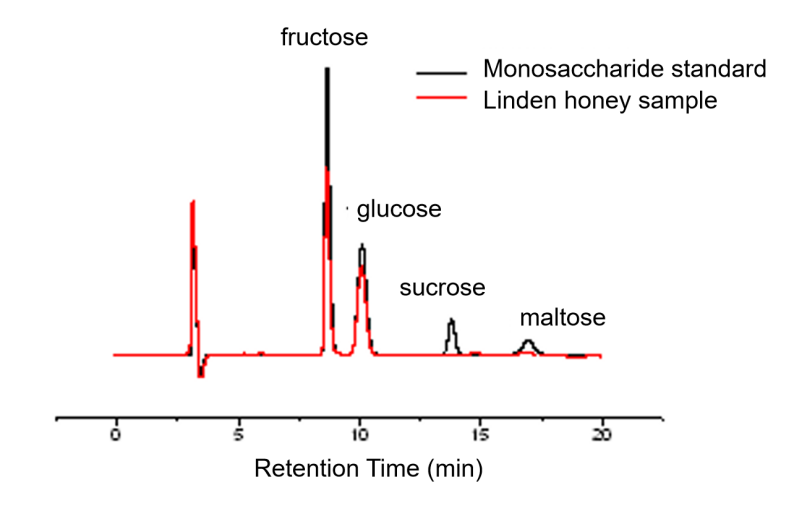
Fig. 1. chromatogram of a mixed standard and a honey sample
Linearity and honey sample analysis
Calibration curves were constructed using the mixed standard series. Linear regression equations and correlation coefficients are summarized in Table 2. The method shows excellent linearity over the tested ranges.
Table 2. Linear Equations and Sample Results for Tree Honey
| Sugar |
Regression Equation |
Correlation Coefficient (R) |
Concentration (g/100mL) |
Content (g/100g) |
| Fructose |
y = 0.00015 x - 0.028 |
0.9991 |
1.9559 |
39.19 |
| Glucose |
y = 0.00017 x - 0.0022 |
0.9985 |
1.9308 |
38.62 |
| Sucrose |
y = 0.00016 x - 0.0079 |
0.9996 |
0.0001 |
0.002 |
| Maltose |
y = 0.00021 x - 0.013 |
0.9988 |
0.0720 |
1.44 |
*Note: x = peak area; y = concentration (g/100mL).
The system suitability was evaluated against the Chinese Pharmacopoeia requirements for honey. The results (Table 3) indicate that the sample meets all specifications: fructose+glucose >60% (70.41%), fructose/glucose ratio >1.0 (1.09), sucrose <5.0% (0.23%), and maltose <5.0% (1.79%). The method is reliable and suitable for routine analysis of sugars in honey.
Table 3. System Suitability According to Chinese Pharmacopoeia
| Parameter |
Requirement |
Measured |
Conclusion |
| Theoretical plates (fructose) |
≥2000 |
6200 |
Pass |
| Total fructose + glucose |
≥60.0% |
70.41% |
Pass |
| Fructose/glucose ratio |
≥1.0 |
1.09 |
Pass |
| Sucrose content |
≤5.0% |
0.23% |
Pass |
| Maltose content |
≤5.0% |
1.79% |
Pass |